Only In My Dreams!

This year, Christmas, more than any other recent Christmas, has been very bittersweet for me. Although it truly has been a blessed year with the birth of my newest grandson, Mason, this Christmas seems to be a struggle for me.

As you all know, Christmas when I was growing up in Duquesne was all about family. The entire time between Christmas and New Years was a social whirlwind. My mom and dad and brother visited every aunt, uncle and cousin during those seven days. The season was joyous and happy beyond belief. By New Year’s Day, we were all ready for the traditional pork and sauerkraut meal after a week of ham, stuffed cabbage and poppyseed rolls! I would love to be able to spend a Christmas, just one more time, back home.

I leave tomorrow, Tuesday, to visit my daughter, son-in-law, and two grandsons in Philadelphia, and I am super anxious. Unfortunately, my wife and I will be driving back home on Christmas Day, so our excitement will be short-lived, but such is life.
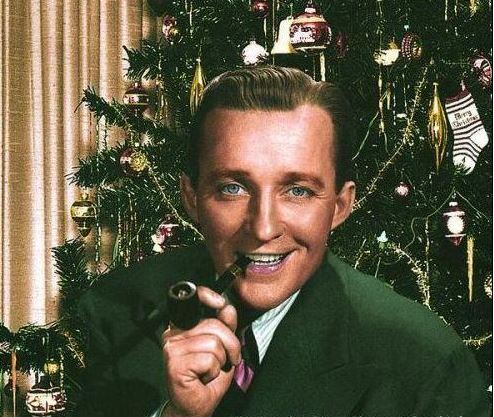
bingI am reminded of Bing Crosby’s hit, I’ll Be Home For Christmas, right now. I found out this year that it was one of my mom’s favorite Christmas songs, and I understand why. On a happier note, I am reposting a few previous articles that I wrote previously to conjure up some very special memories of Christmas in Duquesne. I hope you enjoy them.

Merry Christmas Everyone!!!


I’ll be home for Christmas,
You can plan on me
Please have snow and mistletoe
And presents on the tree 

Christmas Eve will find me,
Where the love light gleams.
I’ll be home for Christmas
If only in my dreams. 

There is a wonderful story that relates to this song and it occurred the very same Christmas this holiday classic was first released. While I’ll Be Home for Christmas was not written about this account, it very well could have been.

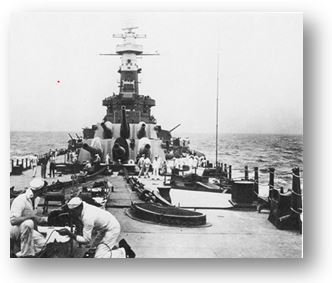
The story is about the crew of the Battleship North Carolina, and it will now forever be cemented in my mind when I hear I’ll Be Home for Christmas around this time of year.

The story goes that around Christmas in 1943 the chaplain onship the Battleship North Carolina knew that the crew was feeling homesick as they were expected to still be overseas during the holiday season. He had an idea and collected $5 from every crew member that had children back home.

The chaplain made a list of all that gave him money for their children at home and he sent that money along with the addresses of the sailor’s home to Macy’s department store. The request was made for Macy’s to buy gifts using the money provided for the crew’s family and have the gift mailed to their homes in time for Christmas.

As Christmas approached, the service men on the ship gathered for the annual Christmas show that involved songs, skits and entertainment for the troops aboard the Battleship North Carolina. When the entertainment had ended, the chaplain had a surprise to reveal.

When Macy’s had received the money from the chaplain along with the list of the addresses, they thought that in addition to just giving gifts to these military families at home, they should give a one of a kind gift to the soldiers as well. Since they had the addresses for all the sailors’ homes, they reached out to each family and asked if they wanted to come to the Macy’s store and send a special message to their loved one who would not be able to be home for Christmas.

The mean aboard the Battleship North Carolina sat there and saw their wives, children and loved ones appear before them on the screen as Macy’s had videoed each of their families sending them a Christmas message. These rugged sailors watched, wept and rejoiced. They weren’t home for Christmas, but what made their homes special was the Christmas gift they received on that December 25th in 1943.

Now that you know this story you can see how that sentiment is also found in the song, I’ll Be Home for Christmas. I know that I can’t hear that song without thinking of the brave men and women serving overseas to protect the freedoms we all enjoy.
– – – – – – – – – – – – – – – – – – – – – – – – – – – – – – – – – – – – – – – – – – – – – – – – – – – – – – – – – – –

Jim and Steve SantaPerhaps some of my fondest memories growing up in Duquesne are those associated with the Christmas season. Being part of a HUGE hunky family, Christmas always meant LOTS of celebrating, visiting and fun.

Each day leading up to Christmas brought more and more excitement. Christmas activities and preparations never really began until well after Thanksgiving, quite different than the present day “overkill” that exists. In our house, timing always seemed to be centered around “how long will it be before the tree drops its needles?”

The concept of an artificial was not even in the vocabulary of people in those days. The irony is that my dad, in his own way, created an artificial tree of sorts. You see, he was never satisfied with the shape that the good Lord had bestowed on any Christmas tree he decided to purchase. Instead, he spent at least two days, tucked away in our freezing cold garage sculpting the “perfect tree.” In addition to any “Charlie Brown” tree that he had drug home, he also brought piles of extra greenery. He would spend hours and hours drilling into the tree truck and inserting the extra branches until the tree took on the “perfect” shape! I remember being in the garage with him, coaxing him to hurry, and all the while enjoying the crisp, clean smell of fresh pine needles and pine sap.

Once Dad had completed that transformation of our Christmas tree, he would then begin the next step of the transformation. For the next couple of hours, the garage became an indoor blizzard of sorts as my dad began spraying each and every branch of the tree with artificial snow. Within a short amount of time, a perfectly shaped white Christmas tree stood ready for its entrance into the house. Transformation completed, the last step was to let the tree stand overnight in a bucket of water that had been laced with aspirins. The aspirins apparently had some mystical power to extend the life of the tree. Hey, it works for humans with heart issues, why not trees??

Our white flocked tree was always decorated with blue lights. There was always that special smell the lights had when they were first lit up for the year. The scent may have just been my excited imagination that sensed the smell, or it could have been the hot lights next to the fake snow or the crusty old frayed wires heating up that caused the smell. Fortunately, the magic aspirin always did its job and prevented any smoky result!

The introduction of the tree into the house and then the lights to the tree always seemed to produce the discovery that at least a dozen of the blue lights were burnt out. Of course for some reason, my dad and mom would never anticipate this dilemma, and Dad and I would soon be out and about to buy a few packages. The trip always took us to one of my favorite haunts, a virtual  wonderland in Duquesne, Schink’s Hardware Store on Grant Avenue. As we drove down Grant Ave. on the way to Schink’s, the traditional street decorations shined brightly as we drove under each one. Although they were simple in design by today’s standards, to me they are legendary! Simple straight wires with multicolored standard incandescent light bulbs provided the magic. In the center of the span was a circle of the bulbs that I suppose symbolized a wreath. These light strings were alternated with similar lines of lights which held three oversized illuminated bells. Each bell in the set of three would blink independently in order  to try to created a special effect of sorts. Hey, I was a kid, it worked for me!!
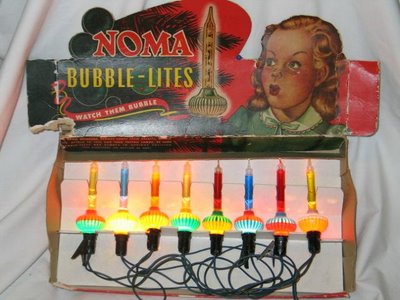
Schink’s always had their Christmas items gathered into one area of the store. Since energy conservation was not a thought in anyone’s head in the 50’s, the lighting area glowed with Christmas lights. There were no mini-lights that are used today virtually everywhere. There were basically light sets in two sizes, small bulbs for indoors and larger bulbs for outdoors. Of course, there were one type of lights that we unfortunately were unable to afford, bubble lights!

After our excursion to Schink’s, Dad and I made our way back home to finish the tree.  The ornaments were the same from year to year. No theme, just tradition. There were drummer boys, angels, Santas and snowmen that were all made of wax, As fragile as they were, somehow my mother always was able to keep them intact from year to year. There were silver colored filigree bells and shiny bright silver balls as well. Our tree top was an angel of course, and when the tree was lit, the blue, silver and white looked magical.

The tree seemed to kick off our holiday season and the holiday preparations! Things seemed to shift into high gear at that point and didn’t stop until well after Christmas Day. Check back later and see what I mean!

Merry Christmas!

Veselé Vianoce

– – – – – – – – – – – – – – – – – – – – – – – – – – – – – – – – – – – – – – – – – – – – – – – – – – – – 

My mother was Croatian, my father was Slovak. As a result, I was immersed in two different Eastern European cultures, each with their own set of traditions. It seems that these traditions came to the forefront during the holiday season.

As a Slovak, I was fortunate to be able experience one of the most beloved Christmas traditions, the Vilija (pronounced vă – lē´ -yă.) Vilija is the traditional Christmas eve gathering and dinner that is rich with traditional foods, religious symbolism and family.

The vilija continues to this day in my family, and although the venue may have changed, the traditions and symbolism remains intact. What an incredible testimony and homage to the parents, grandparents and hunky culture that helped to set our moral compass.

As part of this posting, I have included a 2005 article from the Pittsburgh Tribune-Review by Karin Welzel. The author does an outstanding job of explaining the tradition, the content and the meaning behind the celebration. Rather than be redundant, allow me to give you my impressions and memories of the event as I experienced it in the 50’s.

The vilija always took place at my Uncle Gary and Aunt Helen’s home in West Mifflin. Just like a scene from “A Big Fat Greek Wedding,” I remember entering their house and immediately getting drawn into the crowd of family that were already preparing the feast.

Their home was always decked out with Christmas decorations galore and every light in the house seemed to be burning. Usually, by Christmas eve in Western Pennsylvania, the weather had usually taken a definite turn and it was normally either snowing or on the verge of doing so. For that reason, whenever I entered their home, it felt so toasty warm compared to the outdoors. Their windows were usually steamed up from all of the cooking that was occurring and from the cranked-up thermostat (Grandma was always cold you know). And then there were the smells! The freshly cut Christmas tree scent hit me as soon as I entered the house. (It must have been the magic aspirins!) Combined with the smell of fresh pine was the amazing aroma emanating from the kitchen and dining room.

All of my aunts were buzzing around a rather cramped kitchen preparing all of the traditional foods. Somehow, all of the foods which were part of our every day lives growing up as a hunky smelled so much better on Christmas Eve!  Stuffed cabbages, pirogies, kielbasa and poppy seed rolls smelled like food for the gods! I was a very picky eater in those days, but somehow, a became a modern day foodie during the vilija.

My uncles had the responsibility of creating a dining surface large enough to accommodate our ever growing family. Since my dad was one of 8 children, the number of people attending was quite large. There was no such thing as a “kids table” in those days, so the eating surface had to accommodate approximately 25 people PLUS the feast itself. The table was usually assembled using two tables which supported large sheets of plywood. It was at least 16 feet long, extended from the dining room into the living room and was always covered with crisp white linens. There were never any decorations on the table, only food, lots and lots of food! The chairs that surrounded the table were a potpourri of chairs from around the house, the out-of-town neighbors and often times from St. Michael’s Church hall. Your seat may not have matched with the neighboring chair, but every family member had their place.

The timing of the dinner was very strategic. It was essential that we ate and were finished with dinner by 6 p.m. In those days, it was important that we allowed for the correct about of time before receiving communion at midnight mass. The Roman Catholic Church has very specific rules governing communion.

Grandpa would always begin the vilija with a blessing. This would be followed by the passing of oplatky (non-blessed communion bread). We would pass a large square piece of oplatky and each person would break a small piece off to be consumed in unison at the end of Grandpa’s blessing. I remember tha the oplatky would always come to the table in an envelop that was decorated with a colorful representation of the birth of Christ.

Once we had taken our oplatky, the feast began. With amazing speed and dexterity, plates and bowls of food were passed around the table and plates were loaded up to the max. Jokes, teasing, memories, and plans for the holidays were just some of the discussions that occurred during the meal. My dad would always be yelled at by my mom and my Aunt Helen for something he might have said to instigate some trouble, but that was expected, and welcome. After the main courses were completed, out came platters and platters of goodies. Poppyseed, apricots and walnuts seemed to be part of every creation. Each would probably be capable of clogging any artery in the room, but somehow, it either didn’t happen or didn’t matter in those days. Naivety was bliss in those days.

Once the dinner was over, my aunts would begin clean-up. Sexist or not, that was the way it was in those days. The men would gather and have some celebratory “shots” and beers, the kids would share their wish lists with each other and the ladies would clean-up the remnants of the feast. There seemed to be an unspoken exception to the communion rule in our family that shots and beers didn’t count when it came to abstaining before communion. Go figure.

After everything was in order, each family departed to get ready for midnight mass at their own parish church. Fully stuffed and raring to go, the remainder of the Christmas Eve activities still laid ahead.

More later………


Celebrate Slovak Style

By Karin Welzel
TRIBUNE-REVIEW
Sunday, December 11, 2005

From the straw scattered under the dining table to the honey that is spread onto thin oplatky to share among diners, the Slovak Christmas Eve meal — called the Vilija table — abounds with religious symbolism.

Christmas Eve is the most awaited day of the Christmas holiday season, according to Albina and Joseph Senko of Mt. Lebanon, members of Western Pennsylvania’s Slovak community.

“The big day is Christmas Eve rather than Christmas Day,” says Albina Senko, a native of Spis in Slovakia. She is a director of the Western Pennsylvania Slovak Cultural Association, founded by her husband in 1997.

A certified public accountant with McKeever Varga & Senko and a certified financial planner, Joseph Senko also is honorary consul to the Slovak Republic.

The Senkos continue to observe the customs and traditions of their ancestry — Joseph Senko was born in Pittsburgh to Slovakian immigrants — and have made it a personal mission to educate Slovak-Americans and the general public about their culture. They are Roman Catholic, as are most of the inhabitants, but they say Byzantine and Orthodox Rite worshipers might follow similar traditions. Slovakia features a wide variety of dialects and customs, varying from region to region, village to village, family to family.

Albina Senko has her home decorated Slovak-style, including a table-size tree festooned with edible ornaments, such as whole walnuts and wrapped candy. There are intricate ornaments made from straw. On larger trees many years ago, family members used apples, paper roses and candles for decorations, too. The top of the tree often was a star made from straw.

Slovak cooks are busy on Christmas Eve, Albina Senko says. Sauerkraut-mushroom or pea soup, bobalky (sweet dough dumplings) and a variety of fish are a must, as well as meatless pirohy, to maintain the fast observed by the faithful during Advent, which begins the fourth Sunday before Christmas.

In anticipation of the celebration, hay or straw is placed under the tablecloth or under the table — or both places — to symbolize the poverty of Christ in a humble manger. Some families place straw in the center of the Advent candle wreath, Albina Senko says, and a figure of the baby Jesus is placed on top.

The table is covered with a white cloth as a symbol of the swaddling clothes of the Christ child. Another tradition is to set an extra place setting to receive a stranger or in honor of a deceased loved one.

The dinner starts at the sighting of the first star of the evening.

“You tell the youngest child to look for it — it may be that it’s just to keep them occupied, because there is a lot of expectation,” says Albina, adding that there is just as much merriment at her house for Christmas Eve now as when her six children were small. She has grandchildren who are excited about the lights, the dinner and gifts.

After the house and table are blessed using a pine bough and holy water, a mulled red wine steeped with cinnamon sticks or herbs and honey is served to diners. Albina Senko sweetens her wine with cranberry juice, cinnamon-sugar and a dash of nutmeg.

The ceremony then focuses on a waferlike “bread” called oplatky (altar bread) that is broken, dipped in honey and distributed to each family member, starting with the husband to his wife. The head of the household dips his thumb in honey and makes the sign of the cross on the foreheads of each member of the household so they will be reminded to keep Christ foremost in their thoughts and praying that harmony will sweeten their lives.

Part of this ceremony focuses on daughters who are eligible for marriage.

Says Albina Senko: “The mother takes honey on her finger, makes a cross on their heads and says, ‘May you be sweet and find a husband soon!’ I did it with my own daughters.”

The next course usually is a tart soup — sauerkraut and mushroom is a popular choice — to represent the bitter destiny of Christ and his suffering for humanity. The family then loads up their plates with bobalky, sweet dough balls baked and mixed with sauerkraut or poppy seeds, symbolic of a plentiful crop. Joseph Senko likes a topping of cottage cheese on them, too.

Platters display a variety of fish that has been floured and quickly sauteed in oil. Because Slovakia is land-locked, carp and trout are common, but Albina Senko likes white fish such as tilapia to grace her table.

Also served are pirohy stuffed with fillings ranging from sauerkraut to cheese and potato; and English peas, which represent a bountiful growing season. Albina Senko folds peas into a mayonnaise-rich potato salad; other families fold peas into hot mashed potatoes. Holubky are cabbage rolls stuffed with ground mushrooms and rice.

The Vilija ends on a sweet note, with nut and poppy seed rolls. Walnuts in the shell and apples also are placed on the table.

None of the foods contain meat, still keeping with the Advent fast.

To wrap up the meal sweetly, Slovaks traditionally serve kolaci, pastry rolls made with sweet dough filled with poppy seeds, dried fruit or nuts.

In recognition of the empty seat at the table, none of the food is removed from the table after the diners are finished. “It’s for the people who couldn’t be there,” Albina Senko says. Before midnight in Slovakia, the animals in the barns are given remnants of the meal — the food from the table is supposed to make them healthy and productive for the coming year.

The Senkos host tours regularly to Slovakia to acquaint Americans with their culture. Albina Senko is a retired travel tour operator, as well as a frequent translator for Slovakian visitors and officials who visit Pittsburgh. It is their wish to improve the lives of their countrymen across the sea and bring Slovakian culture into the homes of the general public.

These traditional dishes of a Slovak Christmas Eve table feature simple, earthy ingredients — plus a bevy of sweets.

Slovak Christmas Eve Soup
(Sauerkraut Soup)

This recipe is adapted from one by Albina Senko, a native Slovakian who lives in Mt. Lebanon. Senko is from Spis in the northeast region of the Carpathian Mountains. Although Slovakia is only about the size of West Virginia , with 5.5 million people, Senko says, there is a lot of variety in customs among the towns and villages.

  • 2 tablespoons vegetable oil
  • 1 medium-size yellow onion, chopped
  • 1 cup sliced mushrooms
  • 1 can (16 ounces) sauerkraut, drained but rinsed only lightly
  • Water
  • Paprika, to taste
  • Salt and ground black pepper, to taste
  • 1 vegetable bouillon cube, optional
  • 1 carrot, sliced
  • 1 potato, peeled and diced

Heat the oil in a soup pot. Add the onions and mushrooms and saute until translucent. Add the drained sauerkraut, water to cover the sauerkraut, paprika, salt, black pepper and the bouillon cube, if desired. Let simmer — do not boil — adding more water so you still have broth.

Add the carrot and potato and simmer until tender, for about 15 to 20 minutes, adding more water as needed to keep a souplike consistency.

Bobalky

These bite-sized dumplings can be made from frozen and thawed sweet bread dough to save time. Form portions of the dough into 1-inch rolls, then cut small pieces and bake. The National Slovak Society offers this recipe.

  • 1 package active dry yeast
  • 1/2 cup lukewarm water
  • 1 teaspoon salt
  • 2 tablespoons granulated sugar, divided
  • 6 cups all-purpose flour, more for dusting board
  • 1/4 cup vegetable oil, more for greasing baking sheet
  • About 2 cups tap water
  • Boiling water

Dissolve the yeast in the lukewarm water. Add the salt and 1 tablespoon sugar. Let set to proof, for about 10 minutes.

Sift together the flour and remaining 1 tablespoon sugar. Add the yeast mixture, 1/4 cup oil and enough of the 2 cups tap water to make a workable dough. Knead well. Let the dough rise until doubled.

Meanwhile, grease a cookie sheet with oil.

Punch down the dough. Cut off portions of the dough about the size of an egg. Roll each out on a floured board by hand to make rolls about 1 inch in diameter. Cut into 1-inch pieces. Place the pieces on the prepared cookie sheet and let rise for about 20 minutes.

Heat the oven to 350 degrees.

Bake the dumplings for about 10 minutes, or until lightly browned. Let cool, then separate. Place in a colander and pour boiling water over them. Drain quickly to prevent sogginess.

Combine these mixtures with half of the bobalky.

Sauerkraut: Saute 1 small onion, chopped, in 2 tablespoons vegetable oil. Add 1 pound drained sauerkraut. Cook for about 15 minutes. Add to half of the bobalky.

Poppy seeds: Combine 1 cup ground poppy seeds, 2 tablespoons honey and 1/4 cup water. Add to the remaining bobalky.

Oplatky

Commercially prepared Oplatky — the thin wafers coated with honey and then broken at dinner on Christmas Eve and shared among diners — is available from specialty food markets, Slovak and Polish churches and can be purchased through the Internet. Or, you can make your own, using a hot iron form or mold. This recipe is from the National Slovak Society.

  • 5 cups all-purpose flour
  • 1/4 cup granulated sugar
  • 5 teaspoons butter, melted
  • 2 cups cold milk
  • 3 3/4 cups cold water

Combine all ingredients in a large bowl until the mixture has a “pancake” batter texture — smooth and thin. Pour small portions — about a heaping tablespoon — onto a very hot iron form or mold.

Makes 98 oplatky, about 5 inches in size.

The Slovak Christmas Eve dinner does not contain dairy or animal products because the day before the Feast of the Nativity is one of strict fast and spiritual preparation. Here are some foods likely to be served. Their appearance depends upon whether the family is Roman Catholic, Byzantine or Orthodox.

Bandurky — Potatoes, usually boiled, to which onions sauteed in oil have been added. Many families prepare potatoes that are mashed and mixed with peas or prunes.

Bobalky — Small balls of dough prepared with honey and poppy seeds or sauerkraut

Borscht — Beet soup sometimes prepared with cabbage

Fasolji — Prepared brown bean paste spread onto bread

Garlic — Eaten raw on the Christmas bread dipped in honey, intended to keep away the evil spirits

Holuby — Cabbage rolls stuffed with ground mushrooms and rice

Hribi — Mushrooms sauteed with onions in oil

Kapusta i bandurky — Sauerkraut mixed with grated potatoes

Kasa — Rice, sometimes served as a separate dish with zapraska or macanka over it as a gravy

Kvasna Kapusta — Sauerkraut

Loksa (Loksha) — Unraised biscuits

Med — Honey, symbolic of the sweetness of being with the Lord.

Mezanec — An unleavened Christmas bread usually dipped in honey and eaten with a slice of raw garlic

Orehi — Nuts

Pagac — Two layers of dough between which cabbage or potatoes have been spread, then baked

Pirohy (often spelled pierogies) — Dough packets filled with sauerkraut, potatoes, sweet cabbage or prunes

Riba — Fish, usually a white fish baked or smoked, which is symbolic of the Christian faith because Christ was the fisher of men

Sol — Salt

Suseni slivki — Stewed prunes

Zapraska — A thick brown sauce used to prepare various soups and gravies. Among the soups prepared with Zapraska base:

Macanka (Machanka)— A thick mushroom soup

Sauerkraut Soup, with sauerkraut juice added. Usually single ingredients such as green beans, peas, lima beans, mushrooms or butter beans can be added.

Lima Bean Soup

Mushroom-Sauerkraut Soup

Green Split Pea Soup

Caraway Soup

Green Bean Soup

Rice and Mushroom Soup

— National Slovak Society, Canonsburg

– – – – – – – – – – – – – – – – – – – – – – – – – – – – – – – – – – – – – – – – – – – – – – – – – – – –

When I was just a wee one in Duquesne, I remember shopping at Christmas with my mom. Although it is had to imagine if you visit Duquesne today, but as I was growing up, there were a number of shops and stores where my mom enjoyed. The shopping Mecca in Duquesne, as I remember it, was primarily located on First Street between Grant Avenue and Hamilton Avenue and on Grant Avenue between First and Second Streets. There were several other shops that Mom enjoyed going to that were further up Grant Ave. such as Salkowitz’s Dress Shop, but for the most part we stayed in main shopping area.

There were no such things as malls in those days. Stores were street front and we were exposed to the elements as we shopped from store to store. The stores I remember shopping in with my mother were Sally Fashions for her clothes and Adler-Green for men’s and boy’s clothes. There were two other stores that I remember that I enjoyed visiting. One was the G. C. Murphy 5 & 10 on First Street. I think it was located right behind Alexander’s Market which was on the corner of First and Grant. Just like Perry Como’s song “Its Beginning to Look A lot Like Christmas”, at Christmas, Murphy’s was glistening with candy canes and silver lanes aglow.

And then there was Elsie’s, otherwise known as Avenue News. Just two doors up from First Street on Grant Ave., Elsie’s wasn’t really a Christmas shopping destination, but rather a meeting place for the locals. I remember being in the vicinity of Avenue News around shift stage time at the mill. 7 a.m., 3 p.m. and 11 p.m. were the crazy time at Elsie’s. The steel workers who worked from 7 a.m. till 3 p.m. called it the “Daylight Shift.”  If they worked from 11 p.m. until 7 a.m., they worked “Night Turn.” But for some reason, the 3 p.m. until 11 p.m. shift was only know as “3 to 11.” Go figure! However, I’ve digressed…..

I have stronger childhood memories of Christmas shopping in McKeesport than in Duquesne. Shopping in McKeesport was our equivalent of shopping in New York City! What a wealth of stores; Cox’s, The Famous, Jaison’s, Immel;s, Katzman’s, David Israel’s, and Kadar’s. Then there were the specialty stores like; The Golden Rule, National Record Mart and the variety stores like; G.C.Murphy and H.L.Green,

I remember going to McKeesport with my dad once when he was Christmas shopping for my mother. Dad was never the type of guy who planned too much ahead. To this day, it never surprised me that we were shopping on Christmas Eve. It seemed perfectly normal. I remember going to Katzman’s with him to buy my mom a slip. The lingerie department was on the mezzanine of the store. The saleslady pulled out several different slips from the wall of drawers that lined the wall behind the glass showcases. She pulled out dozens until Dad finally settle on the perfect color. Leopard skin!!!! It was like the 1950’s of Victoria’s Secret!

Yet another early memory about Christmas shopping was my Christmas Club check. Every year, my mom would start a Christmas Savings Club account for my brother and I at Duquesne City Bank. She would put 25¢ a week in my club account and the same in my brother’s club account. By the time November rolled around, we each received a Duquesne City Bank check what we view as an astronomically large amount………… $12.50!!!! It was amazing how I was able to make that $12.50 cover all the gifts I wanted to buy; Mom, Dad, my brother, 3 of my aunts and 2 of my cousins. Bubble bath was always a top choice for Mom, big bottle, low price, the perfect combination. My dad used to roll his own cigarettes back then, so rolling papers were always a good and thrifty choice. (Today, I would be accused of trying to buy drug paraphernalia when I bought rolling papers, times have changed!) I was always able to find some kind of sports magazine or book for my brother and my aunt and cousins always seemed to end up with lavender soaps. I really made it stretch since there was always enough left for me to buy a pound or so of sugar wafers at the cookie counter at the 5 & 10!

It was always exciting counting the days down until Christmas. I remember that  on the very last page of the McKeesport Daily News, there was always a small block that indicated the number of shopping days left til Christmas along with a reminder to by Christmas seals. Oh, those were the days……..


Posted in Christmas Memories | 7 Comments

Hunkys and Turkeys and Snow, OH MY!

Well folks, we are approach an auspicious occasion! In just 3 days, this blog will be celebrating its 4th Anniversary! Its hard to believe that it has been 4 years already! I have really enjoyed talking to all of you but more importantly, I’ve been thrilled to reconnect to so many of my Duquesne cronies. I’ve enjoyed seeing so many other friends reconnecting after so many years as well. I really feel like my labor of love has been well worth it.

I’m sitting in my living room as I’m writing this 275th post to my blog wishing I was about to see some of the snow that is supposed to hit the eastern seaboard over Thanksgiving. Alas, we’ll be cold but not cold enough to get any snow. I really do miss the snow. I know I’m crazy, but I’ve always been a fan of the white stuff! 

So, in celebration of two different anniversaries, I am reposting some past pieces for your enjoyment. First up, in celebration of the 64th anniversary of the infamous Thanksgiving Snow of 1950, here are two posts that discussed that event:

 I was rummaging through some old photos that I had forgotten about and unearthed two photos dated on the back. However, the date on one was different than the other. I was reminded of the big storm in 1950 and think these may have been taken at that time. The largest recorded snowfall in the Pittsburgh area was 27.4 inches from November 24-26, 1950. I am not sure who took the photos, but I assume it was my father. If I recall, both were taken in different directions, but from the same vantage point, Hamilton Avenue. They struck me as poignant and at the same time, peaceful. Allow me to surmise about each photo.

This photo shows First Street looking toward Grant Ave from Hamilton Ave. I couldn’t believe that I had a photo that showed the Christmas lights that I described in a previous post. I can still see them lining Grant Ave in my mind. The car nearest the camera seems to be in the process of being dug out. The store is Rosenzweig and Gross, one of two furniture stores that I remember. The other furniture store that I remember was at the corner of Grant Ave. and Prune Alley (the name of the alley behind Holy Name between First and Second Sts.) I don’t recall the name of the store, but if anyone does, please fill me in. I don’t recall any other businesses in the photo, but I remember that Bud and Jerry’s Donuts was located on the left hand side of the street and many have been about a block up from Rosenzweig’s. If you look almost dead center in the photo, you’ll see the building that appears in the header of this blog. You can detect the curved facade if you look hard. Onto photo two:

Placing the vantage point in this photo is a bit tricky. I think it is taken from the intersection of First Street and Hamilton Ave looking up Hamilton, but I could be wrong. It is definately looking up Hamilton, but it may have been from the intersection at 3rd Street. I recall a variety store that was located across the street from my grandfather’s home at 307 Hamilton Ave. The store in the picture looks just like the store I remember AND there was a bar, which is no suprise, on the corner just up from the store. I found it remarkable that there were still horses around in 1945. I wish I had living relative who could tell me more about this picture, but alas, they are all gone.

I came across some additional pictures of the BIG Thanksgiving Snow Storm of November, 1950. I have no idea of who the people are in the photos, but I am fairly sure of the vantage point from where they were taken. Again, I am fairly sure my dad was the photographer. I think they are rather cool looking. He’s like the hunky Ansel Adams!!

This first photograph was taken while he was standing in the middle of Kennedy Avenue just above 3rd Street looking toward the mills. The snow obviously put an immediate hault to any vehicular taffic!

This second photograph was again taken from Kennedy Ave looking toward the mills. This time, it appears to have been taken just above 1st Street. I recognized the homes on the right. I owuld love ot know who the poor soul is that is walking in the middle of the road, but I am afraid that her name is lost forever in history.

If anyone has any other vintage pictures of Duquesne or places there in that they would like to share, please email them to duquesnehunky@gmail.com. I am certain that we all would love to see them!

Now, in honor of the 4th Anniversary of the Duquesne Hunky Blog, here is my very first post, appropriately titled “”HUNKY” Is Not A Four Letter Word!”

Let me get one thing straight. I am an authentic Duquesne Hunky. I use the term “hunky” in the most endearing and loving way possible. I am a hunky, my entire family were hunkies, I grew up in a world of hunkies and my kids are hunkies….well, at least in part!

According to Wikipedia:

  • The use of the term Hunky as a disparaging reference to a person, especially a laborer, from East-Central Europe, is falling into disuse.
  • The “Hunkies” are a composite Polish, Hungarian (Magyar), Rusyn, Slovak ethnic group which primarily inhabits western Pennsylvania and Upstate New York (Binghamton) and speaks English.[1] The immigrants came en masse prior the turn of the century (starting around 1880) searching opportunity and religious freedom. The Hunkies image was a departure from Hungarian prestige that peaked around Lajos Kossuth‘s visit in 1851-1852, aka Triumphal Tour[2].
  • The term Hunky or “bohunk” can be applied to various Slavic and Hungarian immigrants who moved to America from the Austro-Hungarian Empire. Many of these immigrants fled religious persecution and loss of personal freedoms in their native land. Deriving from a rich culture, the people are entrenched in music, food and family. Hard work and traditions of family are considered important. Traditional food of the hunky culture include: fried cabbage, halušky / galuska, stuffed cabbage or ‘pigs in a blanket’ (halubki/gołąbki), kalacs and pierogi.
          
  • “The overwhelming majority of these economic immigrants (initially 85%, later 65%) consisted of young working age men. Originally they planned to spend only a few years in America, and then return to Hungary with enough capital to transform themselves into independent farmers or self-employed artisans. This was precisely the reason why, instead of moving into agriculture in line with their traditions, they went to work in the coal mines and steel mills. Only in heavy industry did they have a chance to collect enough money to be able to fulfill their goals back in the Old Country.[3]
 

 Hunkies settled in highly industrial areas: they worked in steel mills in western    Pennsylvania;  .more……..

Now, with all of that said, I have my own very concise and direct definition. Hunkies are love, family, food, warmth, compassion, fun, tradition and religion. That’s how I remember my childhood in Duquesne.

I plan on using this blog as an ongoing documentation of my memories of life in Duquesne, Pennsylvania, “the great years.” I am referring to the 50’s, 60’s and 70’s, before the decline and eventual closing of U.S.Steel’s Duquesne Works facility in 1984. There is no set path that I plan to take. Who knows, perhaps I’ll jump decades from one posting to the next. When the mood strikes, I’ll go there.

I hope that you will enjoy reading my ramblings and occasional very mild diatribes. Childe in when you disagree with something, but most importantly, let me know if something I have mentioned stirs up similar memories. I intend for this blog to be as loving, family oriented, warm, compassionate, and fun as the hunky life I remember.

Welcome or as we said in Duquesne…… Dobrodošli!!!

Finally, with all of that said, I decided to add just one more repost. This one in honor of the Thanksgiving Holiday!

I am always scouring The Duquesne Times or Observer for interesting tidbits of information to share with you. As I was rummaging through decades of issues, I came across some interesting facts about Thanksgiving in Duquesne. For instance, in the November 23, 1900 issue of The Observer, an article outlined the fact that not all businesses were closed on Thanksgiving Day. The Post Office observed shortened hours, although some merchants closed their businesses early, many were open for their regular business hours. Banks were closed, but telephone and telegraph offices, freight and shipping stations, and of course, the mills, were open for business as usual. (Doesn’t make Wal*Mart and other stores being open on Thanksgiving Day this year such a shocker, does it!) In 1900, for those not working, the day meant church services, turkey dinners, daytime football games in nearby cities and evening dances. By 1910, the paper validated that virtually all business and the post office had begun closing for the day. The steel mills however, continued to function non-stop.

In my family, real Thanksgiving traditions were rather obscure. The day would progress as most any holiday celebration throughout the year. While Mom, Steve and I would park ourselves in front of the TV to watch the Macy’s Thanksgiving Day parade, my dad would take over breakfast duties. Bacon, eggs, pancakes were always on the menu. In those “pre-cholesterol worry days,” heaps of real butter, Log Cabin syrup and eggs fried in bacon grease were always part of the menu.  Today, I’m sure I’d either go into sugar shock or feel like there was a lead weight in my stomach if I ate a breakfast like that!

While my parents prepared to cart us off to Grandma and Grandpa’s house, I remember sitting at the kitchen table making a Thanksgiving decoration out of a potato. Using toothpicks, construction paper and crayons, I would try to “build a turkey” to take to our Thanksgiving feast at my grandparents. Although it was always rather “Picasso-like” in its appearance, it was MY tradition.

Once we arrived at my grandparents house on Duquesne Ave. in West Mifflin, my mother and all of my aunts went into “auto-drive.” They’d all march into the kitchen and go about their meal prep assignments. It was like a room full of Harriet Nelsons, complete with 1950 dresses and frilly aprons! Aunt Peg and Aunt Helen had begun preparing, stuffing and roasting the mammoth turkey in the pre-dawn hours. The remaining tasks were preparing the side dishes, baking the rolls, setting the table and so on.

In the meantime, all of the guys would park themselves in the living room and begin watching the football games on TV, toasting the holiday with shots and beers, and basically assuming the male-chauvinistic posture of the era. They would spend their pre-meal time arguing about the game, making their plans for their post-Thanksgiving deer hunting expedition and discussing “the good old days” and growing-up in Adrian, Pa in Armstrong County.

By the time the guys were getting a bit “hammered,” it would be nearing dinnertime. My dad, as the eldest son in the Volk family, had the responsibility of carving the turkey. He would carefully slice the bird and divide the meat into light and dark platefuls of juicy goodness. By the time he was finished, the ladies had prepared the gravy and everyone was called into dinner. Of course, the children were relegated to the “kids table” in some remote corner of the kitchen, while the adults gathered around the oversized, makeshift banquet table. I always felt sorry for my aunts during the meal. They would normally sit near the stove and constantly bounce up and down from their seats, refilling the bowls and platters of food, as they were practically inhaled by everyone. No one walked away from the table hungry. The food just kept on coming until everyone was satisfied.

Immediately after the main meal, all of the men would retreat from the table and reposition themselves to their former seats in front of the TV. (I’m not saying it was the correct thing to do, but it was the reality of the era!) All of the ladies would be stuck with the post-meal clean-up chores without the aid of their brothers/husbands. Tables would be cleared, leftovers stored, dishes washed and dried (no dishwashers in those days,) and as a treat for themselves, fresh coffee would be perked. After all of the duties were completed, the ladies would begin a much deserved rest, sitting around the kitchen table, drinking coffee, and taking part in a “gabfest.”

In the meantime, all of the husbands would practically be in a tryptophan induced coma in the living room for hours. The only way they were awakened, was through the enticement of dessert! Everyone would re-gather at the table and enjoy the numerous pumpkin pies that my aunts had prepared. The sounds of Reddi-Whip aerosol cans squirting mounds of whipped cream on top of the pies filled the room. There was always someone trying to squirt the whipped cream directly into their mouths, only to be yelled at by one of the aunts! Some things were so predictable!

After approximately an hour after enjoying the wonderful desserts, platters of sliced turkey, dinner rolls and other leftovers would re-emerge and make their way back to the table. One by one, everyone began gleaning the remaining food. Turkey and stuffing sandwiches, additional pieces of pie and every other left over made their way back onto plates and into the stomachs of all those attending.

And so went our Thanksgiving Day, and as I stated earlier, a blueprint of practically every other family get-together throughout the year. So here’s to good food, families and the good life in Duquesne. We had so much to be thankful for!

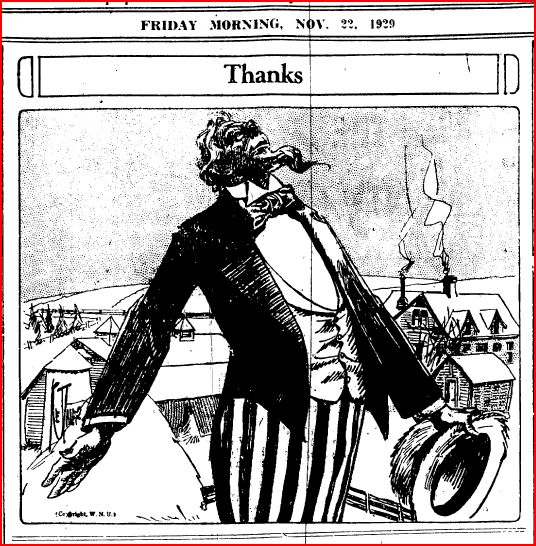
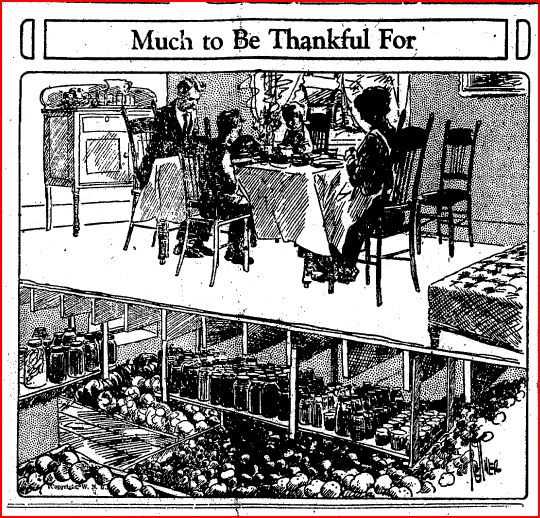
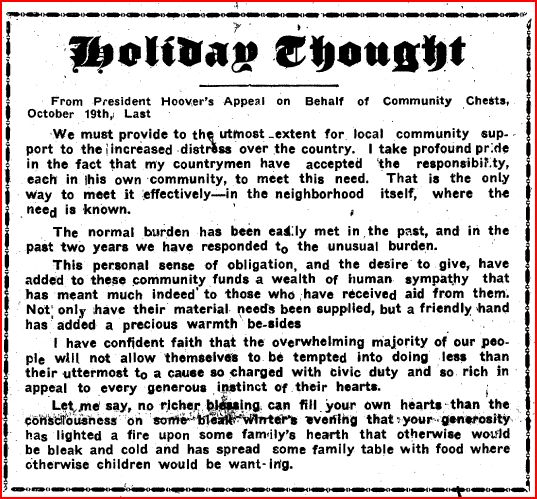
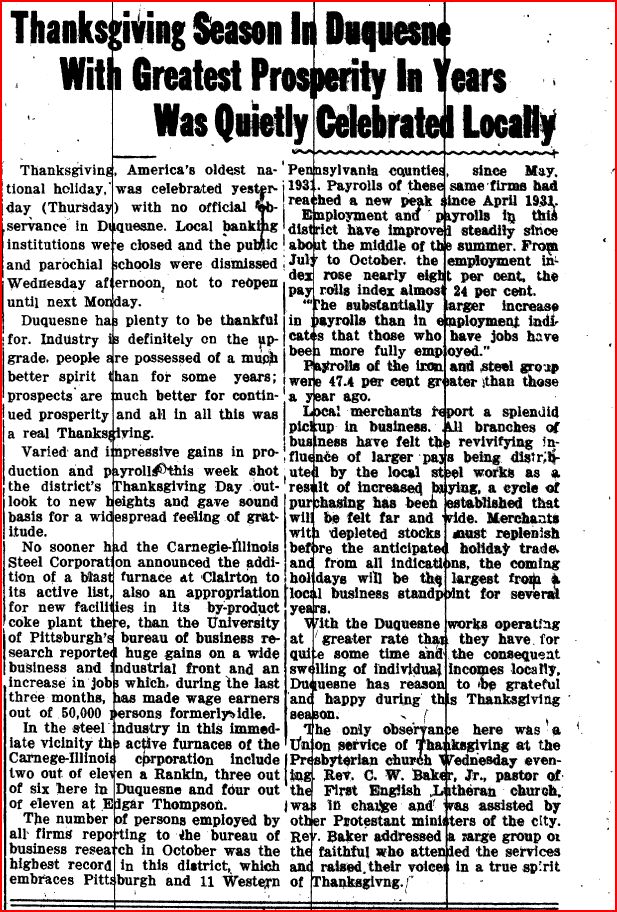
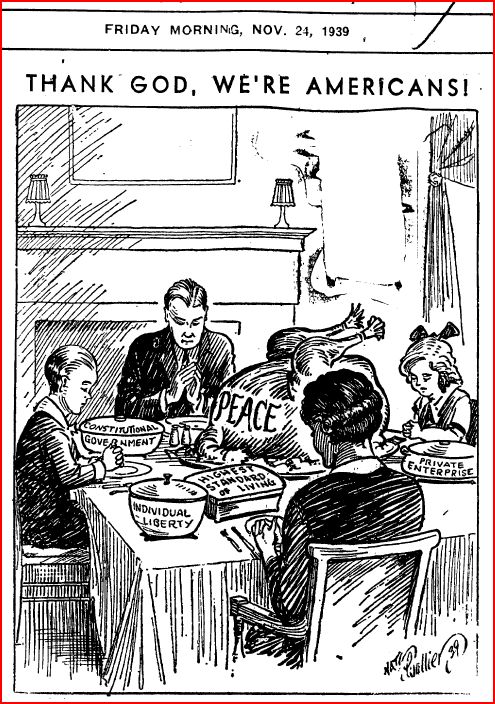
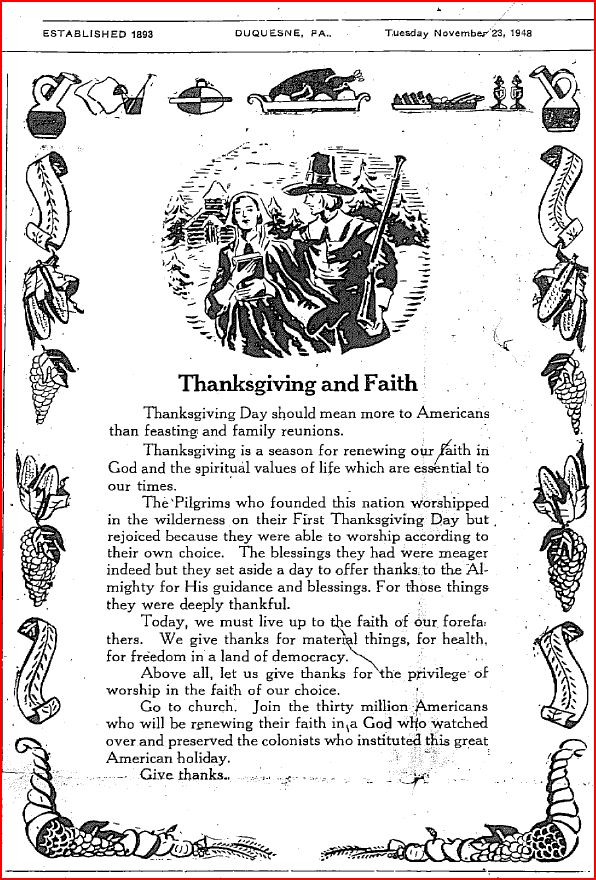
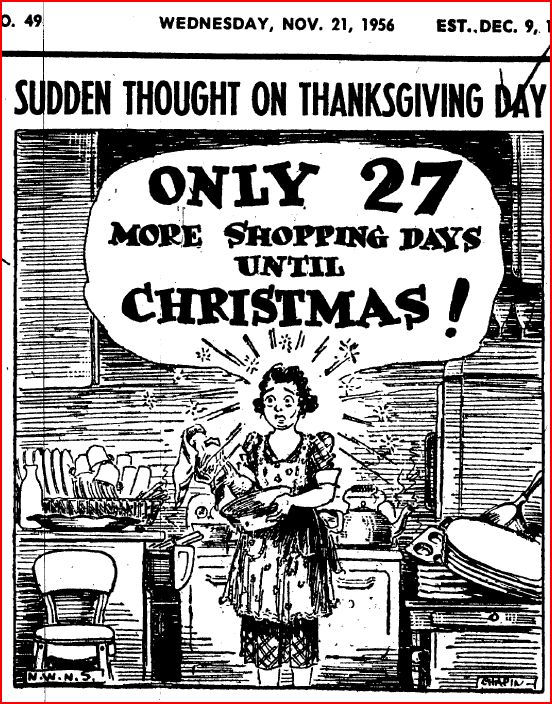
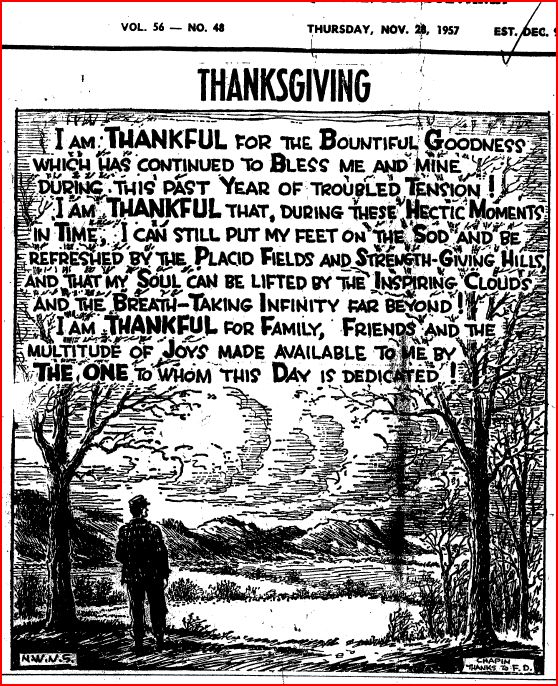
Here’s a little Thanksgiving retrospect from the Duquesne newspapers:

Below – 1929

Below – 1932

Prosperity Makes a Comeback – 1935

Posted in Uncategorized | 16 Comments

There’s Hope for Old Towns and Old People!

Well, it’s the beginning of November, and the start of a new month of excuses on my part. So, let me get it over with…..

I’m sorry my friends,

I don’t know what to do.

I try so hard to be 

a better blogger for you.

I screw up a lot

and I’m slow to write to.

I don’t know why,

I haven’t a clue.

But despite all my flaws

You hang in with me,

‘Cause we’re all Duquesne friends,

And friendship’s the key!


Actually, I need to bring you up to speed on what’s going on in my life right now. I may have made you aware of the fact that in spite of the fact that I continue to sell real estate (or not sell as the case may be), I have been attempting to find  a job that is reliable and one where a person can rely on a consistent income. Well, I am here to tell you that there is HOPE for all of us “old farts!”

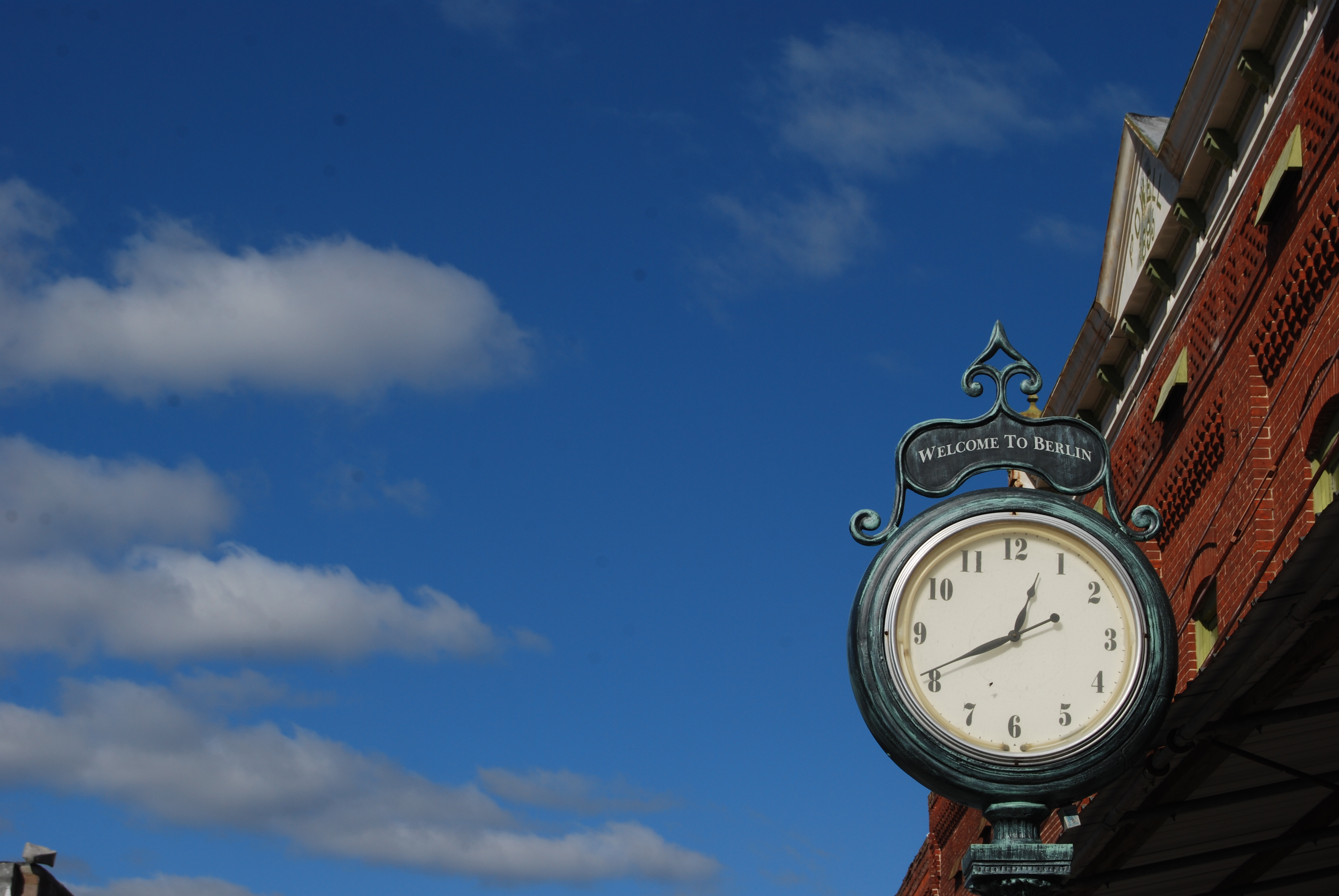
I received the best birthday ever last week by being hired for a position at 63 years of age!!! I landed a position as the Administrator of the Berlin, Maryland Chamber of Commerce! I am super thrilled, not only by working in the town of Berlin, but by the fact that the Board of Directors had the insight to realize that solid years of experience has merit. After looking for ANY position for over three years, I assure you that their insight is a rarity.

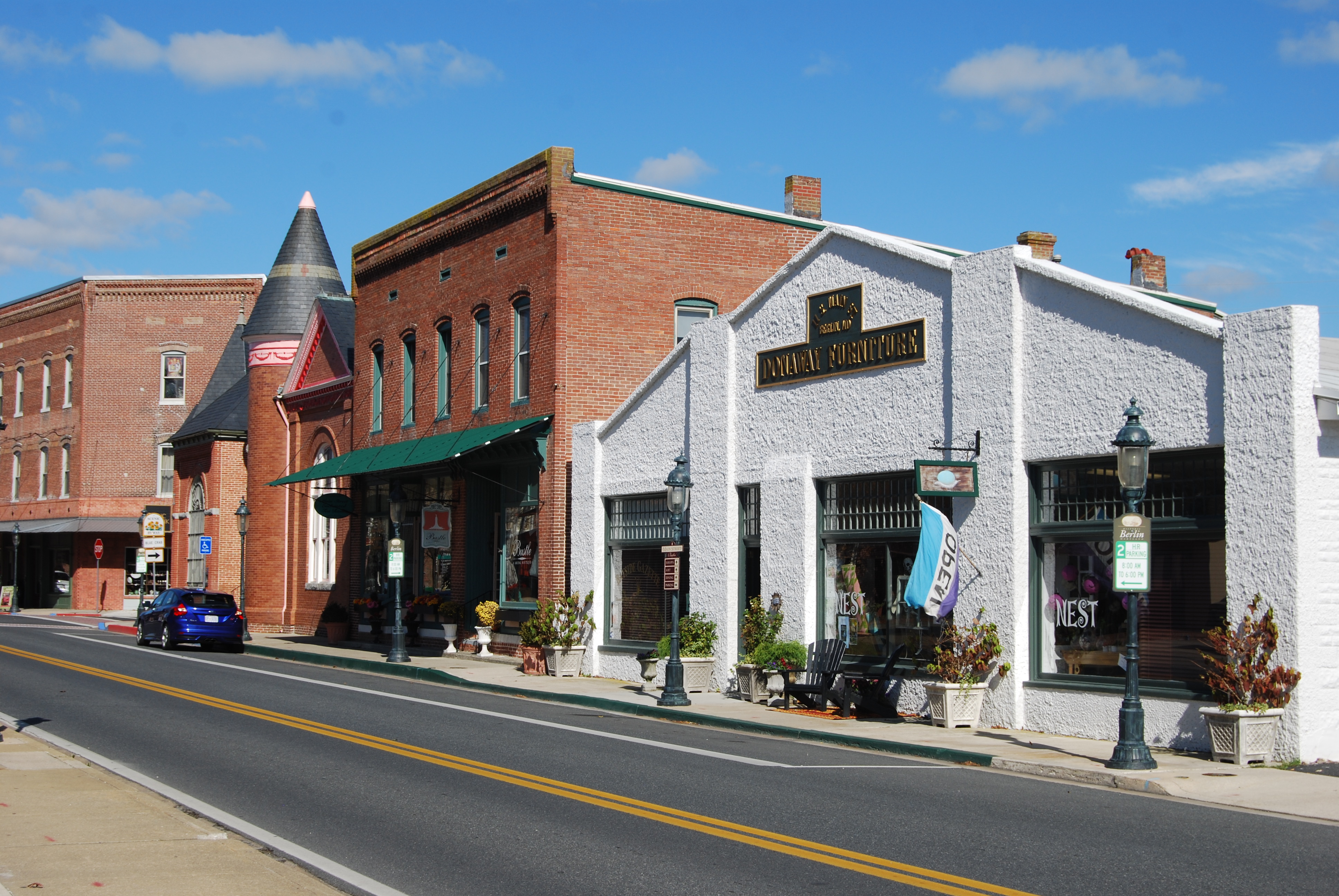
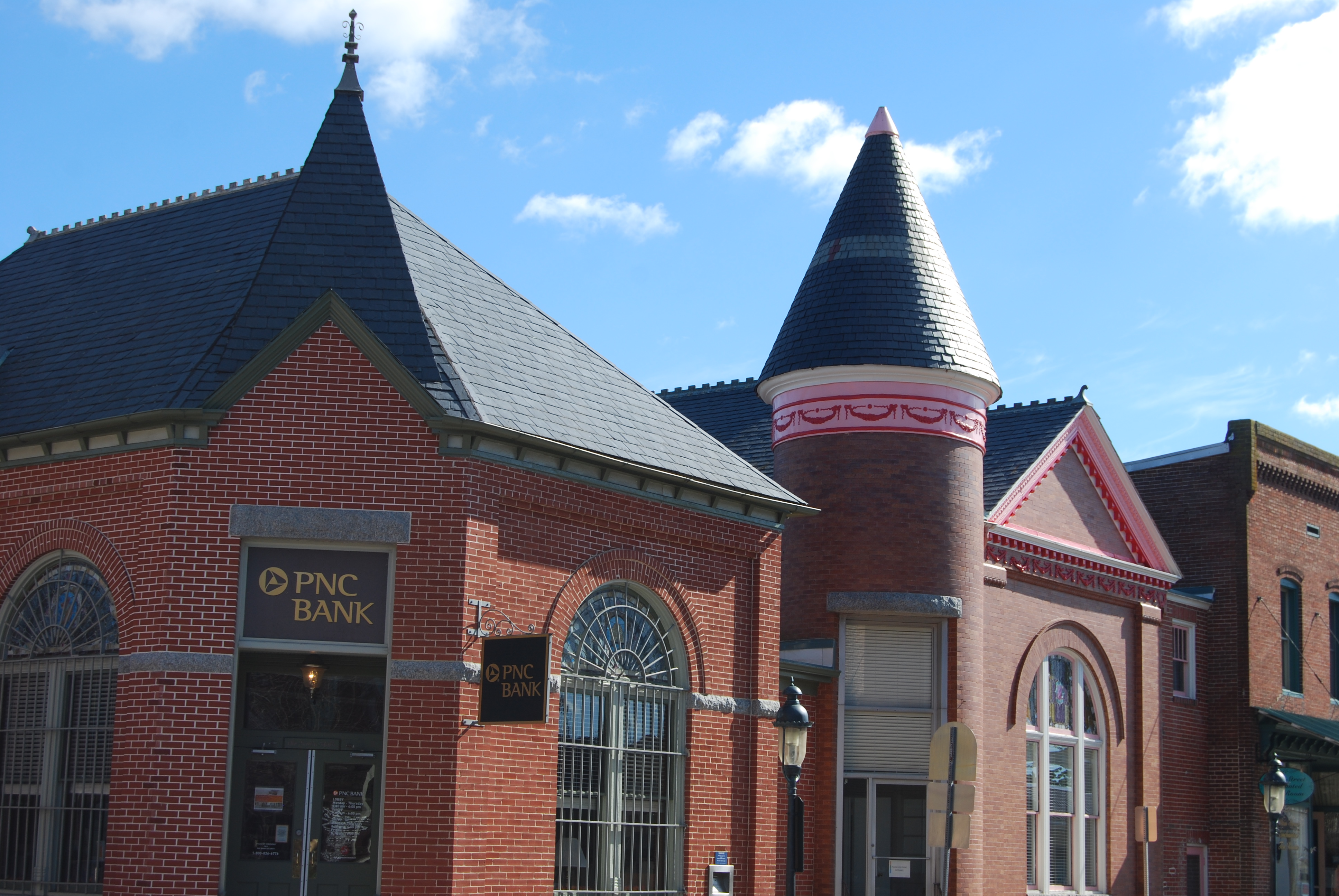
DSC_0026Aside from the thrill of being hired as Administrator, I am even more delighted to be part of the town of Berlin. The town recently achieved recognition in the travel industry as the winner of 2014’s “American’s Coolest Small Town,” and needless to say, there is a vibrant business community. However, beyond all of this, the most extraordinary aspect of working in Berlin is the feeling and connection I get to the Duquesne we all knew and loved. The shops, the storefront windows, the quaint little eating establishments and the unbelievable friendliness of the people resonate with the familiarity that we all felt in our Duquesne. Here’s a little history of Berlin, it doesn’t have the industrial heritage that we were all familiar with, but is still a wonderful small town:

As you step into Berlin, full of rich history and character, you can’t help but catch a glimpse of Berlins extensive past, a past that has shaped this town into what it is today. Berlin was first known as Stevenson’s crossroad, named after the local landowners, the Stevensons.  Berlin was later patented in 1677 as a tract of land named Burley which was situated at the crossroads of Philadelphia Post Road and Sinepuxent Road (a road going towards the ocean) which is the current day intersection of South Main Street and Bay Street. As a frequently traveled crossroad, Burley soon established the Burley Inn. Burley Inn was later renamed Berlin.

Through the late 17th century and early 18th century the area was mainly farm land DSC_0019owned by plantation owners as well as smaller farm owners. The area was mostly reliant on indentured servants and slaves. Tobacco was one of the popular crops grown in the area at the time. Around this time, the well-known war hero from the Barbary War, Stephen Decatur, was born in Berlin. A memorial can be seen at the Stephen Decatur Park and a plaque marks the spot of his house, which was located across the street from Stephen Decatur Park.

In the early 19th century, Berlin became the location of a rail junction between the North-South line, Worcester Railroad and the East-West line, the Wicomico and Pocomoke Railroad. This caused Berlin to flourish and grow.  In 1868, Berlin got its first mayor, Dr. John Pitts. During the Civil War not much happened in Berlin. Many of the young white men went to fight for the South and many of the young, free black men went to fight for the North.

In 1895, 1901, and 1904 the town experienced three devastating fires that destroyed the downtown. After these fires, the town passed an ordinance that said all new structures downtown must be built out of brick to prevent any further fires. This is the reason for Berlin’s distinct brick architecture. By 1905, Berlin began to flourish again as it became the hub of Worcester County.

DSC_0025When the modern era arrived, however, Berlin became one of the many small towns in America that began to dry up with the boom of the automobile and creation of highways. Trains were no longer needed and because of that Berlin was no longer a prosperous train hub. Berlin went through a slow time until the 1980’s when the town members got together and decided to revive their town. They realized the potential Berlin had and began to restore it. One notable feature of this restoration was the creation of the Calvin B. Taylor House museum which is still open today. The Calvin B. Taylor House museum houses many historical artifacts and pictures of Berlin as well as from the house itself.

With this restoration came Hollywood. Berlin was the perfect small town setting for two full length movies; Runaway Bride and Tuck Everlasting. Ever Since Berlin’s revival in the 80’s, Berlin has grown even more. In the past few years Berlin has welcomed new restaurants, shops, and businesses turning Berlin into a popular tourist destination. Berlin has truly shown its growth and prosperity by being named America’s Coolest Small Town. This is only the beginning for Berlin, make our past your future!


I hope you’ll pardon all the gushing that I have done, but it is always nice to experience a similar feeling from our youth. The geography may change, but those joys remain. I walked along Main Street (our North 1st Street in Duquesne), the weather was blustery, the sun was shining, but the temperature was in the low 40’s. I recalled the excitement of how invigorating it was to visit the stores on 1st Street at holiday time, and immediately had those same feelings of warmth and home. If you would like to check out a bit more about the Town of Berlin, click the following link: berlinchamber.org .

I have received several emails recently from our friends who follow this blog. I think you’ll enjoy reading them, I certainly have. My thanks and apologies to the email authors for the time lag in posting these. I promise to be more punctual in the future when I receive an email, but you know how that goes! LOL! Enjoy these voices from Duquesne….


 From – RICH SCHUR

Hi James, my name is Rich.  Today my wife & I were eating at Di’s Kornerstone eatery.  Two tables over were 2 women & a man who I told my wife that I recognized, but did not know his name or where I knew him from.  I finally asked the man where I knew from.  He used to own Huckster’s on Crawford.  I think his first name is Nick, but I did not get his last name.  Can you help me?  Also my dad is from Duquesne.  First on Camp Ave…then on Savey St.  I was born in West Mifflin & lived here all 64 years. My dad worked in the Duquesne mill until it closed.  I have nice memories of Duquesne…especially riding the Duquesne Motor Coach bus from Pennsylvania Ave to the library twice a week to swim.  My name is Rich Schur & I enjoy reading your Duquesne Hunky.  Thanks! 

From – J.RIMSKY

Have been reading your blog for at least 3 years now. Your journalistic skills have validated my youthful memories as a Duquesne Hunky.

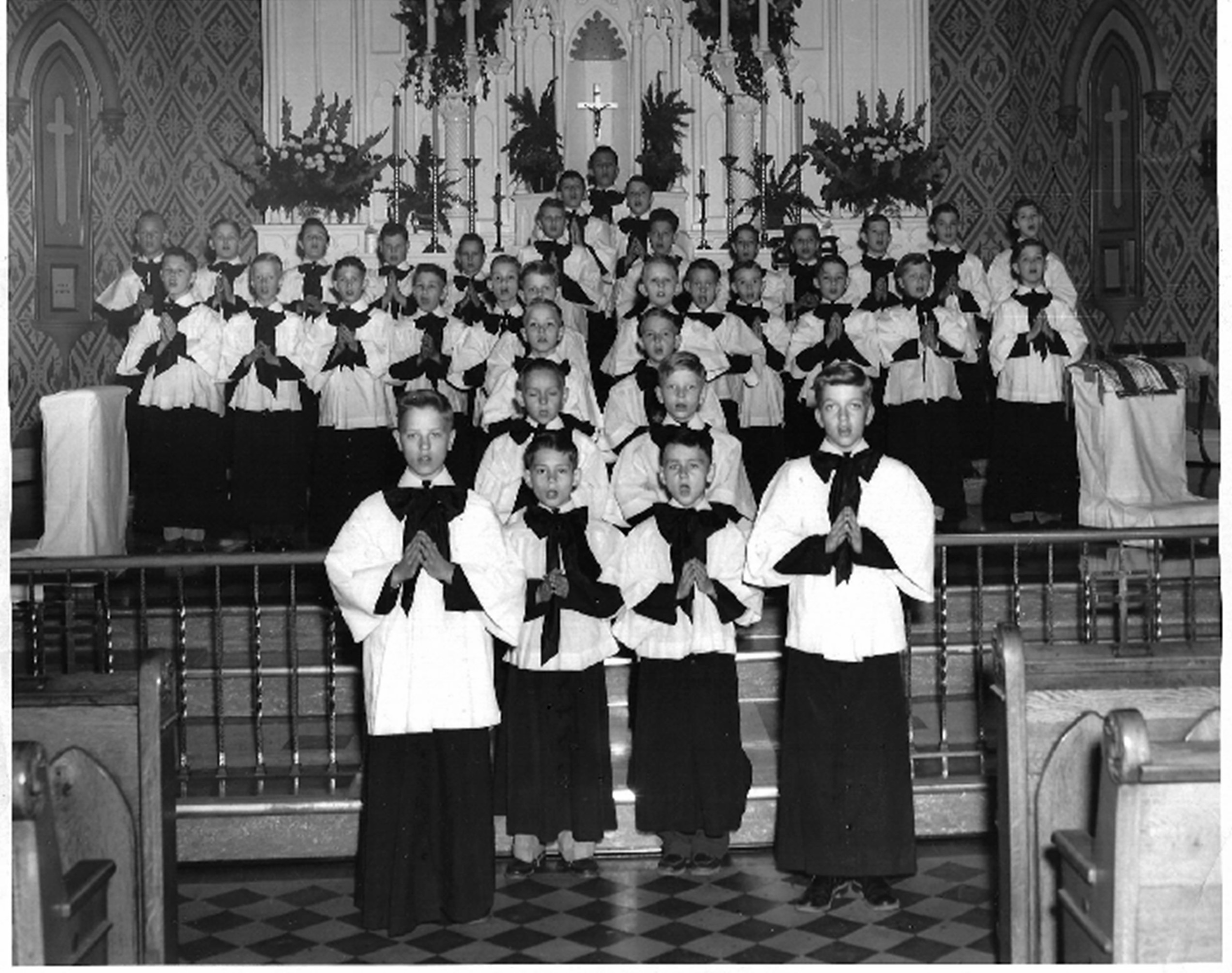
When I read your recent blog of Fr Dennis and saw the current look of the church’s inside (the altar, the choir loft), it reminded me that I haven’t seen the inside of the church in almost 50 years.  Attached is a photograph taken of the boy’s choir approximately in 1957,  posed in front of the altar,  as it looked back then.

Regards

J. Rimsky

 Holy Name 1957 Choir

From – LOU ANDRIKO

from the McK. Daily News –

“Preservation society sets sights on former landmark McKeesport hotel”

By Patrick Cloonan

Monday, Aug. 11, 2014, 4:01 a.m.

 McKeesport Preservation Society said it has taken steps to start a $5 million capital campaign to renovate the Penn-McKee Hotel. 

“That’s what it takes to restore a 99-room hotel, to turn it back into a hotel,“ said Maryann Huk, director of the society that claims title to the long-closed hotel along Fifth Avenue near the Palisades and Marina at McKees Point.

On its mckeesportpreservation.org website there is a link to “Fundrise Handbuilt City,” the organization that will handle what organizers call a “crowdfunding” project. “Crowdfunding” is a practice of seeking contributions from a large number of people, usually over the Internet.

In a news release issued last week, the society said it will work with Chicago-based real estate developer Nathaniel Zorach on a plan “to stabilize and renovate the historic hotel.”

Zorach was connected to the society through a concept known as Fundrise, based in Washington.

“Fundrise is the number one website for funding for real estate development,” said Alan Diede, a volunteer working with the society. “The main thing is that it creates a pathway to generate the interest and the ability to get serious, interested parties working toward developing the property.”

Diede prepared the society’s news release.

In it the society said Zorach’s company, The Handbuilt City, is among a handful on the Fundrise platform specifically focused on urban revitalization.

“Crowdfunding is the investor’s equivalent of a Kickstarter or Indiegogo,” Huk said, referring to two other community-oriented websites.

 Indiegogo claims it is “distributing millions of dollars every week to campaigners around the world,” while Kickstarter describes itself as “a vibrant community of people working together to bring new things to life.”

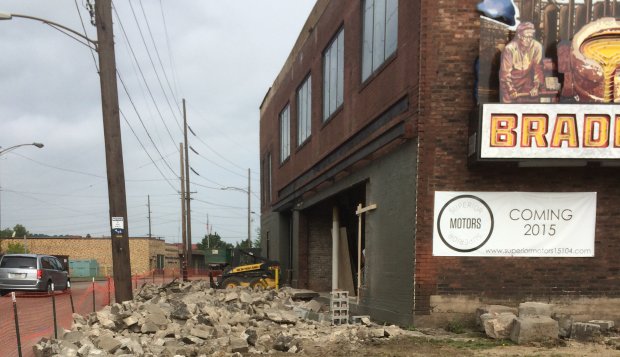
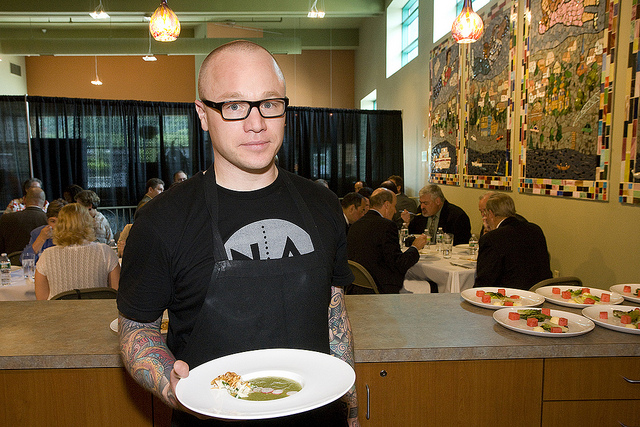
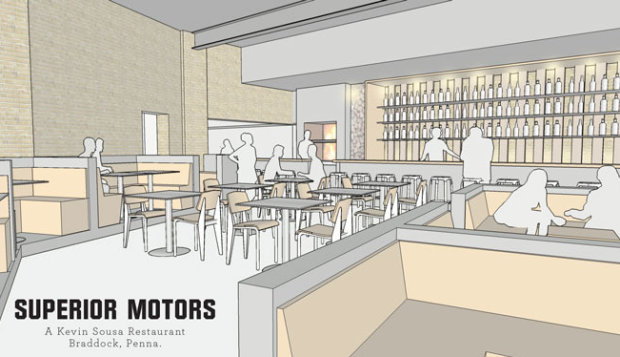
Huk said Kickstarter aided Kevin Sousa in Braddock. There he’s seeking to turn Superior Motors, a former car dealership, into a farm-to-table, community-influenced restaurant he hopes to open in February.

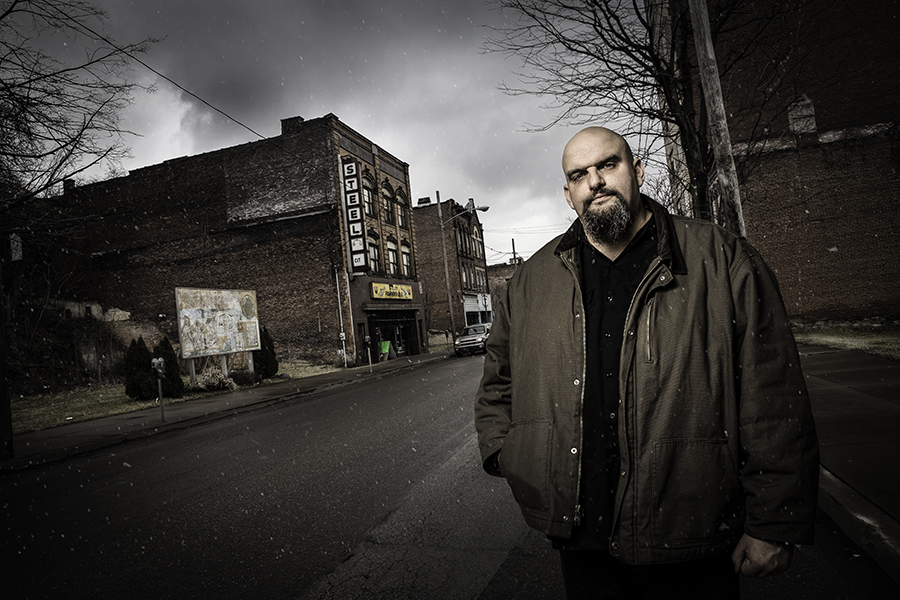
Braddock Mayor John Fetterman owns the building and is providing it free of charge. More than 2,000 people donated to his Kickstarter campaign while Sousa raised more than $300,000, including $40,000 from the Heinz Endowments slated for job training.

“We were searching for potential real estate developers who might be interested in working with us,” Diede said.

Huk said Zorach toured the long-closed hotel on July 28.

The Penn-McKee was a landmark in the days when McKeesport was among the largest cities in Pennsylvania. As former Daily News librarian Gerry Jurann wrote in a 2005 “Bygone Days” column, “if it happened in McKeesport” from 1926 until 1968, “it probably was at the Penn-McKee.”

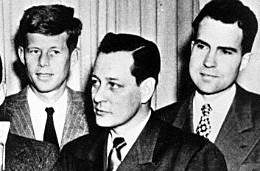
1947On April 21, 1947, two future presidents, U.S. Reps. John Kennedy, D-Mass., and Richard Nixon, R-Calif., squared off there over proposed changes in federal labor law in an annual gathering of the Junto, a group of city businessmen interested in politics and economics. A state historical marker outside the hotel recalls that debate.

In recent years the building was owned by SeeBee Inc., which bought it in 1985 for $25,500, according to the Allegheny County real estate website.

Redevelopment Authority of the City of McKeesport is listed by the county as having taken the building on Jan. 4, 2011.

Huk referred questions about that ownership history to her attorney William Bresnahan, who could not be reached for comment.

On its website, the society describes itself as “a nonprofit 501 (C) 3 organization passionate about its mission to preserve and restore the historic architecture and urban fabric of McKeesport and the lower Mon Valley.”

In its release, the society said Zorach was “excited to work on a project that can call attention to the tremendous assets offered by a town like McKeesport.”

Zorach was quoted by the society as comparing McKeesport to Brooklyn, N.Y.

“Distressed real estate in so-called ‘up-and-coming’ parts of Brooklyn is going for hundreds of dollars a foot versus pennies on the dollar in McKeesport, but how can you beat this view?” Zorach said.

The society said he stood on a bicycle trail and observed the hills around the Monongahela River as well as former U.S. Steel National Tube Works structures.

According to its website, The Handbuilt City has a mission “to seek creative and profitable solutions for urban innovation,” particularly so far in Gary, Ind., and St. Louis.

“Focusing principally on affordable housing development through the stabilization of distressed neighborhoods, we envision a regional effort to advance standards for design, community investment, and green building across the Midwest,” The Handbuilt City states as its mission. “We are backed by diverse sources of capital and diverse private equity partners and are ourselves investors, craftsmen, technicians, designers and problem-solvers.”

On its website Fundrise touts “a simple goal,” to “give everyone the opportunity to invest in real estate.”

Zorach told the society that he is confident that a critical mass of interested parties could bring some serious momentum and capital to development in the town.

“Regulations and markets are going to keep evolving, but cities are, too,” Zorach said. “So it’s important for smaller cities to remain just as involved to keep up.”

Patrick Cloonan is a staff writer for Trib Total Media.


From – ELLIOT MARKOVITZ

Jim: 

For some reason, your most recent post about the term Hunky and the pictures of Duquesne jogged all kind of personal memories for me.  I suppose I can lay claim to the title, sort of, since my father’s family came from Czechoslovakia.  I lived in Duquesne from 1951 (birth) until we moved to Pittsburgh in 1962.  Lived on Miller Ave. in Duquesne Place.   My grandfather, Ben Markovitz, and father, Alfred “Itzy” Markovitz, the butcher- had a grocery store on Patterson Ave.  Benny’s Market. I believe that entire neighborhood is gone now.  My dad had two brothers, Sidney (store on Kennedy) and Harold; and a sister Pearl.  Random thoughts (note: Not responsible for spelling errors):

  • Getting shots from Dr. Landay
  • Having a nickel coke at Palchak’s Drug Store
  • My mom –Shirley Markovitz- giving me $1.00 and sending me to Kennywood for the day.
  • The Dairy Queen at the bottom of my street
  • Being able to take the bus to McKeesport , go to the movies at the Liberty, Victor  or Memorial,  and get a bag of popcorn; all for $1.00
  • Duquesne Place Elementary School-all 4 rooms; two grades to a room.
  • Learning how to drink black coffee at Duquesne High School football games so I could be tougher than the other kids who got hot chocolate or milk and sugar with a little coffee added.  Having to behave at games because my dad knew all the cops.  One of the comments referred to Andrew Fendrick.  I had to especially watch out for Chief Fendrick because my dad knew him quite well; I think they went to school together.
  • Playing at “the dump” behind Herman St.
  • Being sent to Adler’s to get pants or shirts
  • The Nike missile base at the top of Miller Ave. that guarded the mills during the Cold War
  • Going to Paule’s Look-out for birthdays
  • Jim’s for hot dogs with his special sauce that he broiled under the grill (Still go when I can)
  • Getting haircuts at Frank Gigliotti’s on Grant St.
  • The night Martin Luther King was killed.  My dad got a call that the store had been broken into.  I went with him to store with a baseball bat.  The police were there and the place was a mess.  We saw a man walking up Patterson carrying something.  I don‘t  recall if it was a shotgun or rifle.  He was one of the regular customers and had tears streaming down his face.  He came inside and told us he thought his son may have been involved.   He moved a stool we kept near the cash register to the front door and told us to go home; that nothing more was going to happen to our store.  And he was right.   The next day a bruised kid and his dad came by, apologized and helped us clean everything up.

Thanks for doing what you’re doing.

Elliot Markovitz

Mechanicsburg, PA


From – Jeri Grandy

Hello James,

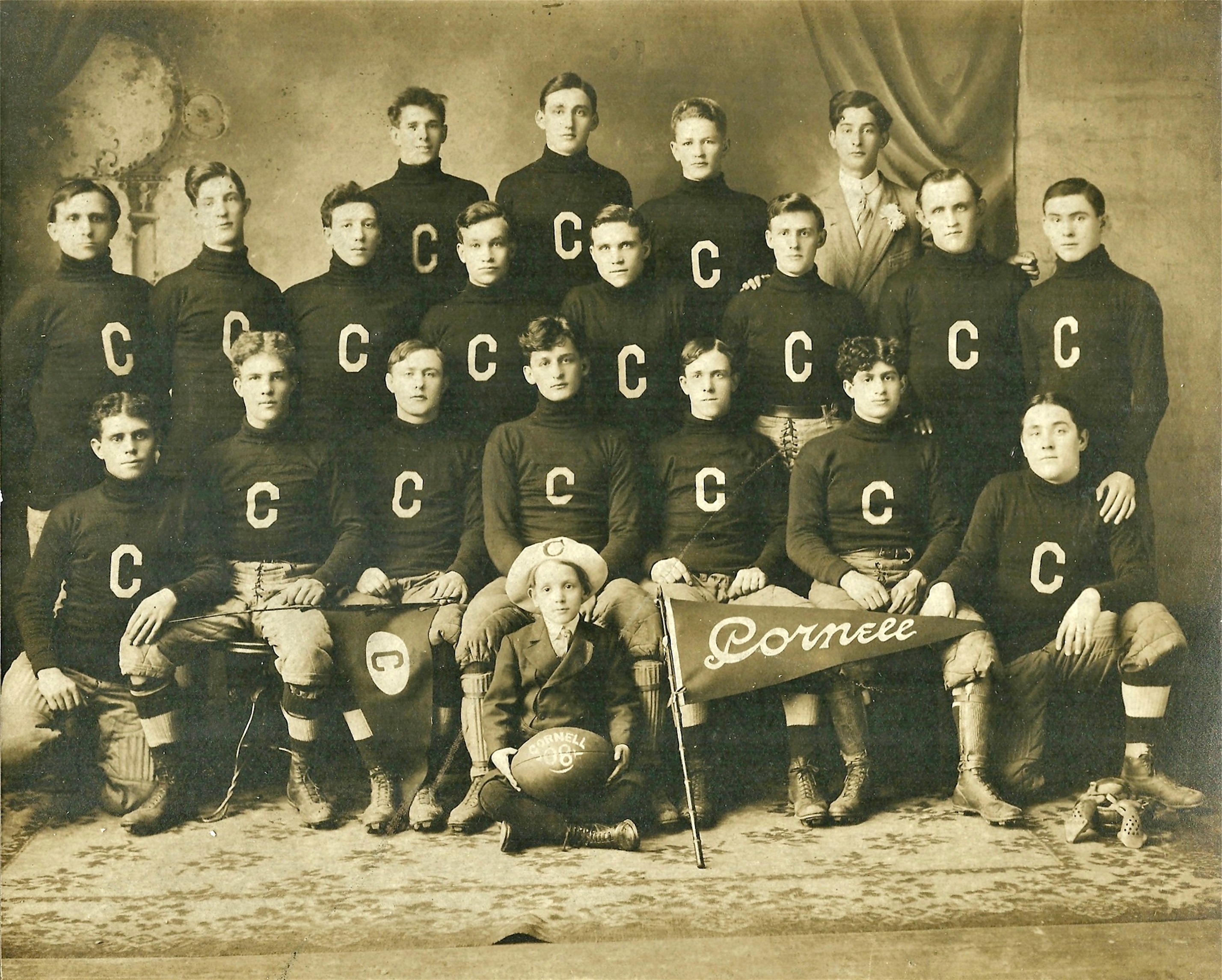
I was just Googling to see what I could find about Duquesne High School football. My grandfather, Joseph F Minotti, graduated from Duquesne in 1909.  I even have the graduation program!

Perhaps more interesting is the photo I have attached.  My grandfather is in the front row, center — the tall handsome guy.  My mother told me he was captain. I don’t know if that’s true.

But the reason I’m writing is that we don’t understand why the team was called Cornell.  Do you know?

Thank you!

Jeri Grandy

football team (1)

 Jeri,

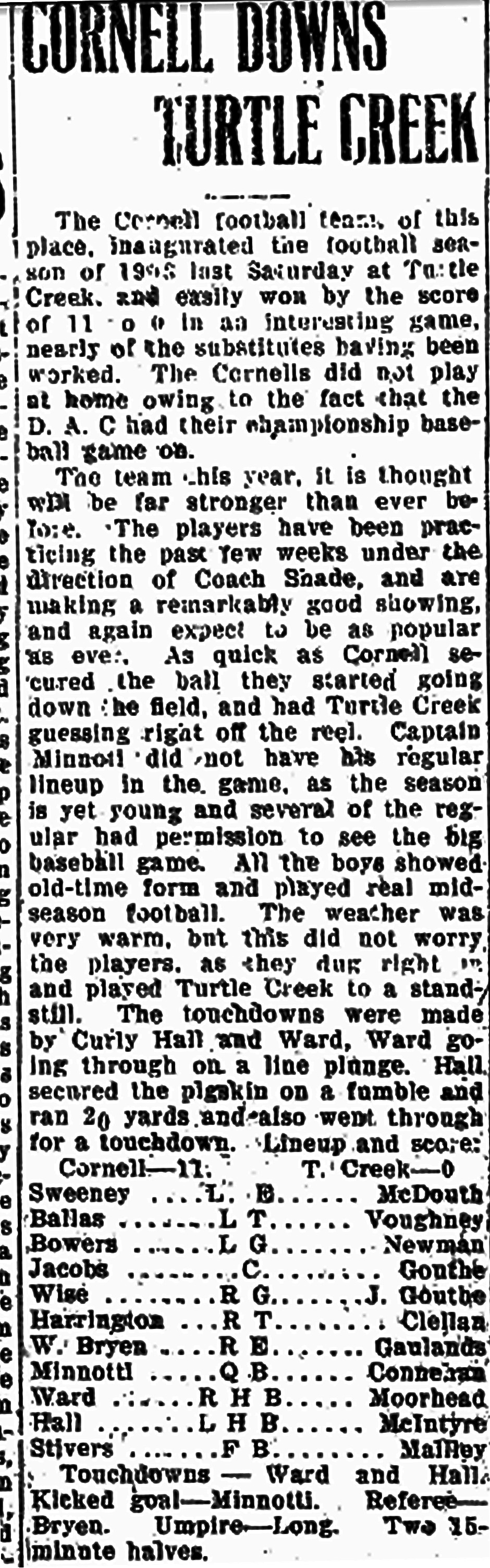
I happen to have found an article from the Duquesne News from September, 1908 that references the Cornell Team. It appears that your grandfather was a force to be reckoned with as Quarterback!!

 Cornell


Posted in Uncategorized | 22 Comments

Another Hunky Gettin’ Hitched!!!

I am very excited about an event that is happening tomorrow on Friday, October 17, 2014. I’m off to another HUNKY WEDDING!!! My first cousin’s son Tony Volk is getting hitched to Amanda Hertzog! The wedding is taking place in Jennerstown, Pa, and the weather is supposed to be great. I’m sure it will be a beautiful mountain setting that will greet us. I am so anxious to get together with all of my family for this joyous occasion, and I’m ready for a great time.

I decided to resurrect a post that I originally shared with you three years ago. I think it still captures what it was life to plan, participate and attend a good old fashioned hunky wedding when we were you. Please enjoy re-reading it and grab a stuffed cabbage roll while you reminisce with me.

hunky-wedding1I know I have written about weddings before, but I never get tired of thinking about how awesome a good old fashioned hunky wedding managed to turn out. I am sure that there was a lot of planning involved, but the involvement of aunts and uncles somehow made the process a bit easier back in my youth.

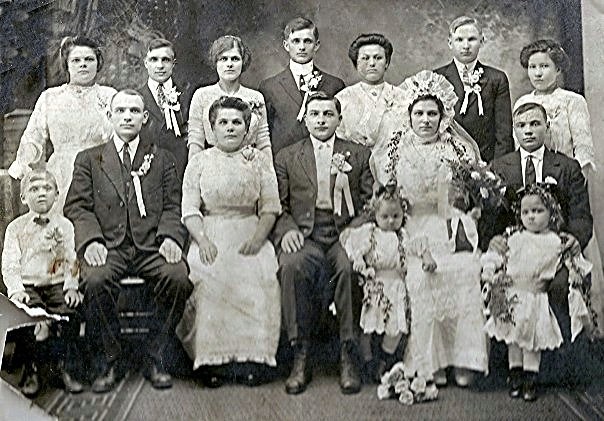
I was one of the “babies” in my extended Croatian/Slovak hunky family. Most of my cousins were older than me, and were getting married when I was not yet in my teens. What I remember however, is that there was what I would describe as a traditional Hunky Wedding “blueprint” each wedding would follow.

Step one was always the “announcement” that something exciting was happening in the family. The news of the engagement would spread like wildfire among all of the aunts and cousins the instant one of the family had become engaged. It was as if there was a hunky bugle call for the troops to “fall in” and almost instantaneously, plans were hatched:

  • Which aunts were going to host the bridal shower?
  • Who was going to cook the food for the reception?
  • Who was baking which cookies for the cookie table?
  • Who was going to make the flowers for the cars and who would be decorating them?
  • Etc., etc., etc.

As tradition would have it, once an engagement was announced, an “official” proclamation would be published in the paper. It would have a similar effect to changing one’s “status” on Facebook to “in a relationship.” In truth, I think it was a way to tell other suitors that it was “hands off” and for hunky mothers to proclaim “AT LAST” to all of their friends and family!

Preparing for the bridal shower was something I was never privy to. However, I recall fragments of conversations during the planning process as my mom would be on the phone talking to one of my aunts. Details for food, decorations, games and gifts were hashed out between family members for weeks and weeks. Based on what I learned from conversations with my aunts in later years, regardless of the tons of planning that went into the shower, they all seemed to serve the same food, play the same games and bring the same gifts shower after shower.

Kleenex(3)“Back in my day,” there was one key element that defined the Duquesne Hunky wedding! The Kleenex Carnation!!! I have seen many pictures of first generation Slovaks and Croatian wedding groups. In each picture, the bride was usually laden with a garland that was made of fresh flowers that was draped over her veil. However, as traditions evolved, flowers made a transition from bridal boas to auto garlands. Ergo, the Kleenex carnation of the 1950s and 60s!! My theory might be a bit flawed, but it serves the purpose.

The creation of these Kleenex carnations was a social event in itself. There were no “Carnations R Us” stores or surrogate carnation makers to hire. The design and creation of these little gems was an intense labor of love among hunky family members. I recall being drafted to assist in making these as a young boy. I believe it was for my cousin Joanne Carr’s wedding to Ken Matthews. We had gathered at my Aunt Rose and Uncle Sam’s second floor apartment on Aurilles Street in Duquesne. We all sat huddled on their living room floor to begin the creative assembly line. There were those that pulled the Kleenex from the box and then flattened them. Then a person who’s job was to fanfold each individual tissue, fold them in half, tie them, cut them and then pass them on to the “shaper.” The shaper was a sculptor of sorts. They pulled apart the individual plys without tearing them in order to create the carnation. This was a pivotal role, and one earned only after serving years in an apprenticeship capacity. As a novice, my job for Joanne’s wedding carnations was to cut bits of string that were used to tie the Kleenex together after the folding process, a humble beginning, but a necessary step.

In those days, Kleenex didn’t offer many options in color. There was the basic white, pink, yellow and powder blue. If a bride had chosen any other color for the carnations another step was added to the creation process. Fingernail polish! Yep! The creation team would manage to tip each flower with the color choice of the bride using small bottles of fingernail polish. With several bottles open and being used at the same time, I swear we all can pretty close to getting high from the fumes!! All of our labor paid off on the wedding day.

The actual wedding ceremony at the church normally began early in the day. It was a very solemn event that would take place in a church that was packed full of family, friends, neighbors, curious onlookers and devout little old hunky studda bubbas that were permanent fixtures at every Mass that took place each day.

Proud fathers walked their daughters down the aisle toward the altar anHoly Name Altard their future husband as ladies in the congregation pulled their hankies from their pocketbooks to dry their eyes. The priest would celebrate the Mass, the bride would visit the statue of the Blessed Mother to ask for her blessing and eventually, the couple would exchange vows and rings and be pronounced “man and wife.” This of course, was back in the days before the use of “husband and wife” began. The bride and groom would kiss and then gleefully walk down the aisle as husband and wife.

While the ceremony took place, a group of family members or close friends would apply the Kleenex carnations to the bridal car that was awaiting the new Mr. & Mrs. The thought of using tape on a car today would send anyone into a tailspin, but back then, it didn’t seem to be an issue. Perhaps it was all the lead in the paint that helped to keep it from being affected by the tape. By the time the wedding party finished posing for group pictures, the bride and groom would emerge from the church in a shower of rice (yep, real rice!) Their car would be decorated to look like a float ready to enter the Rose Bowl parade on New Year’s Day! One always hoped for sunny days and warm weather in order to pull off this transformation of the bridal car, and usually God provided. It must have been Hunky Luck! With horns blaring and family waving, the wedding party was on their way to the next part of their wedding day, the wedding party and immediate family brunch.

Since the ceremony would take place hours before the reception began, the entire bridal party, along with “special” family members would come together for a fantastic breakfast, usually held at a church hall or similar location. Bacon, eggs, pancakes, and more were part of the menu and everyone would feast on the feast. This respite would allow everyone to re-energize and prepare for the most exciting part of the day’s festivities, THE WEDDING RECEPTION!!!

I often hear about Italian weddings, Jewish weddings, Greek weddings and the exciting event they profess to be, BUT, without a doubt, NOTHING could compare to a good, old-fashioned HUNKY WEDDING reception! Different family traditions brought different variations of the long standing customs. However, the parts that were consistent at every hunky wedding were buffets, cookie tables, bridal dances, polkas and basically LOTS of laughing, dancing, eating, drinking, music and noise!

Inhibitions were lost at hunky wedding receptions. The purpose in attending was not to sit pristinely at a table and sip a glass of wine and elegantly cut into your prime rib or nosh on sushi while listening to chamber music. The purpose was to celebrate, and celebrate HARD! No one cared what you ate or how much you ate, no one cared that you may have celebrated a bit too much, no one cared that you didn’t possess the best rhythm while dancing and certainly, no one ever judged you when you cried as you danced with your daughter during the father-daughter dance.

mediumThe food feast that took place at the hunky wedding was as customary as the food that was part of the Slovak Vilija or Hebrew Sadder meal. “Chicki-Piggy-Rigi” pretty much describes the main components of fried chicken, stuffed cabbage and rigatoni, but there was so much more. You couldn’t forget the trays of sliced ham, sliced roast beef, cheeses, sandwich buns, garnish trays, dinner rolls and all types of condiments. Is it any wonder that these foods have become comfort food for hunkys?


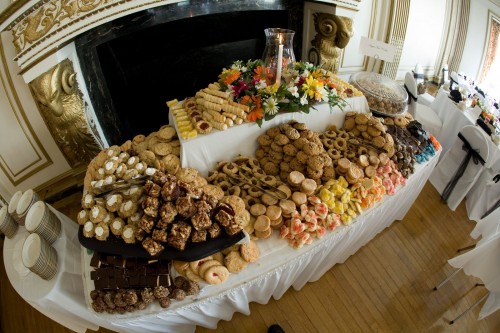
As much as I enjoyed the main courses, NOTHING could compete with the cookie table however. I recall mounds and mounds of homemade cookies that were yours for the taking! I remember my mother had to constantly rein me in when it came to the cookie table, a job that my wife has now taken on. There was no such thing as a store bought cookietablemrandmrshappilyeverafterblogspot-500x333cookies, then or even now. The goodies were prepared with loving hands by mothers, aunts, cousins, neighbors and just about anyone that wanted to be part of the celebration. I pride myself as being a veritable expert when it comes to cookies. They didn’t call me “cookie face” for nothing when I was growing up. My particular favorites were and still are cold dough apricot or poppyseed horns, lady fingers, raspberry sandwich cookies, pizzelles and those little thumbprint cookies made with jimmies and gobs of colored icing. The number of cookies was always disproportionate to the number of guests. I would estimate that each wedding reception attendee would have to consume at least three or four dozen cookies along with their meal. My daughter has been mentally preparing my 3+ year old grandson for the cookie table, and he is chomping at the bit!
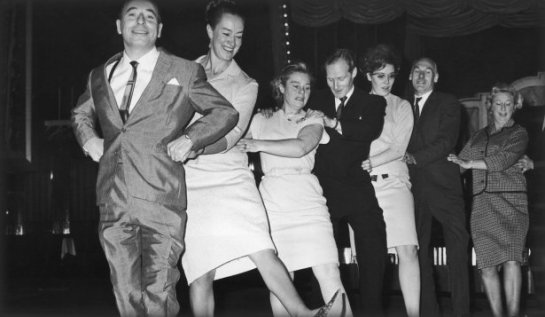
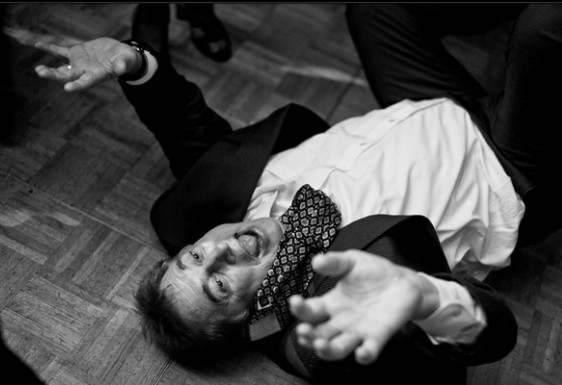
In my family, dancing was the part of the reception that we always looked forward to. As a child, I remember seeing my parents, aunt and uncles, and all the guests swirling around the floor whenever a polka was played, which was about every other song. They would hoot and holler and if they knew the words, would sing along LOUDLY while they danced. Jackets were quickly shed and tossed by the men, and the ladies were constantly moppingconga_line-gettyimage_0 their brow. The music that played was not only polkas but Big Band music as well. I remember being amazed at seeing my mom and dad dance. They were really, really good. I came to find out in later years, that my dad had actually taught dance when he was younger. As the evening wore on, dances such as the Csárdás (a.k.a. chardash), the Tarantella, the Mexican Hat Dance, the Viennese Waltz, Conga lines, and Zorba the Greek, etc. took place. We were a virtual United Nations of dance!!

Dance as ifThat love of dancing hasn’t changed much, even today. The music and the dances may have, but the spirit of uninhibited joy hasn’t subsided at hunky weddings. When we attend my cousin’s wedding this Friday, the tried and true traditional dances and music will be resurrected, but a whole new wave of dances will be attempted by family and friends of all ages. We’ll attempt the electric slide, the cupid shuffle that will get everyone to the dance floor. I am sure it will be a rip-roaring hunky hell-raising affair.

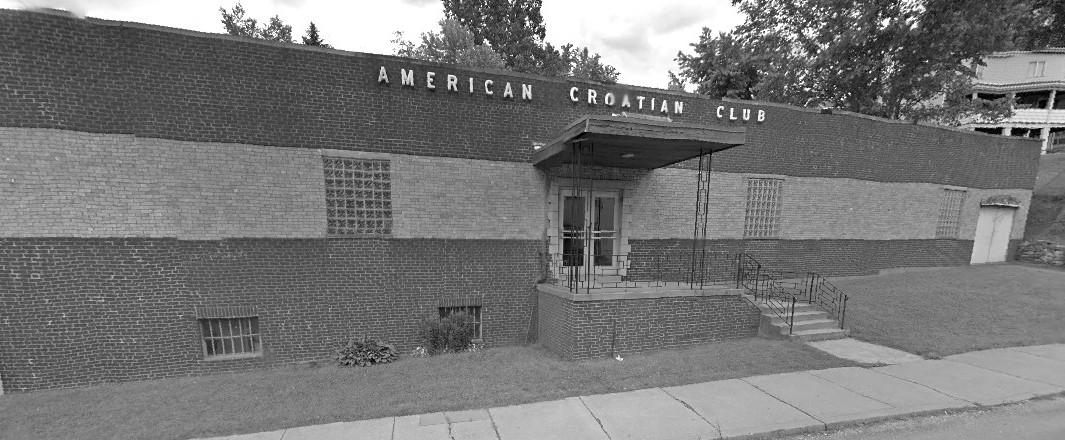
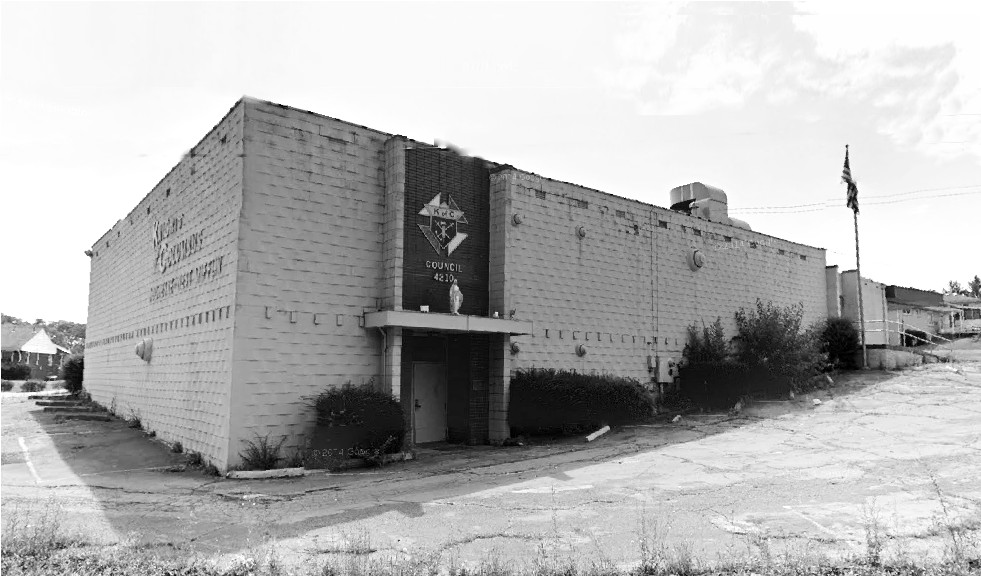
So many couples today are opting for upscale venues for their wedding; hotels, reception halls and a never ending assortment of places to celebrate are available. However, in Duquesne, things were quite simpler. Our venues consisted of the Slovak Club on Grant k of cAve, the Croatian Club (aka Cro Club) at the corner of Wilmont and Homestead Duquesne Rd., the VFW at the top 3rd Street and Duquesne Blvd., the K of C Hall on Pennsylvania Ave. in West Mifflin, and in later years, G & K Hall on Texas Ave. just across the Cro ClubDuquesne/West Mifflin line. So many wonderful events took place in those hallowed halls. If the walls could only talk……….


There was an event that occurred during every hunky wedding reception that would start the “waterworks” going for everyone attending the wedding. Toward the end of the event, the DJ or band director would announce the “Bridal Dance.” Almost instinctively, everyone would rise from their seats and form a line near the dance floor. One by one, each guest would drop money into a basket being held by the maid of honor at the front of the line. Each guest would then join the bride for a few brief moments of dance in the center of the floor. Aunts, uncles, cousins, next-door neighbors, men, women, and children all took part in the Bridal Dance.

Once each person was finished with their brief moment with the bride, they would exit the dance floor. The adults were presented a tray that was held by the best man that was laden with shot glasses filled with bourbon. Ladies and gentlemen alike would silently toast the bride and groom and enjoy the offering before they left the floor.


As each adult and child finished their dance, they would also be handed a napkin wrapped slice of wedding cake. By tradition, you were supposed to take the cake and place it under your pillow that night. It was said that young ladies would dream of their future husbands and young men, of their future brides. For everyone else, I think the only outcome of sleeping on the cake was… crumbs?

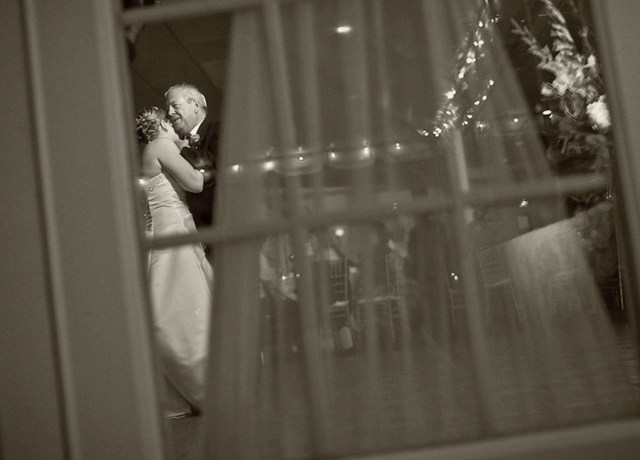
The evening would culminate with the most emotional part of the Bridal Dance. The bride would have chosen a special song for the final Mother-Father-Daughter dance of the evening. After the bride would dance for a tear filled moment with her mother, a loving Dad would step forward to embrace his “little girl” and begin his special time to say goodbye to his daughter. There would rarely be a dry eye in the house by this time.Dance

Eventually, a Daddy kissed his baby goodbye, her new husband would step forward to dance with his bride and eventually lift her into his arms and sweep her away to their new life together. The crowd that had remained gathered around the dance floor after the Bridal Dance would clap, cheer and part as the bride and groom would exit the dance floor and the reception to begin building their new life together.

After everyone dried their eyes, festivities would usually resume, toasts would continue to be made and by evening’s end, another WONDERFUL hunky wedding would come to a close. Could it get any better than this???


Posted in Uncategorized | 5 Comments

Just What the Doctor Ordered!

A new dental practice opened recently, located about 3 miles from my home. Their opening met with all the customary hoopla normally associated with new businesses, and the advertised their arrival extensively in the local press. I had to chuckle when my wife read their ad to me one evening as they tried to convey the services that they offered. Now get this –

“Our office offers spa-like services such as paraffin treatments, spamassage chairs and heated neck wraps. Our patients comment on how comfortable our office is and how much they enjoy the water views. Our waiting area has massaging back pillows & foot massagers. We offer a variety of teas, juices, lemon water & fresh fruit. Our waterfront waiting area also offers Wi-Fi & cable TV, but patients are rarely kept waiting long to enjoy it all.”

Once I stopped laughing at the absurdity of not only the description of what they offer, but at the fact that they even feel they need to provide these perks!

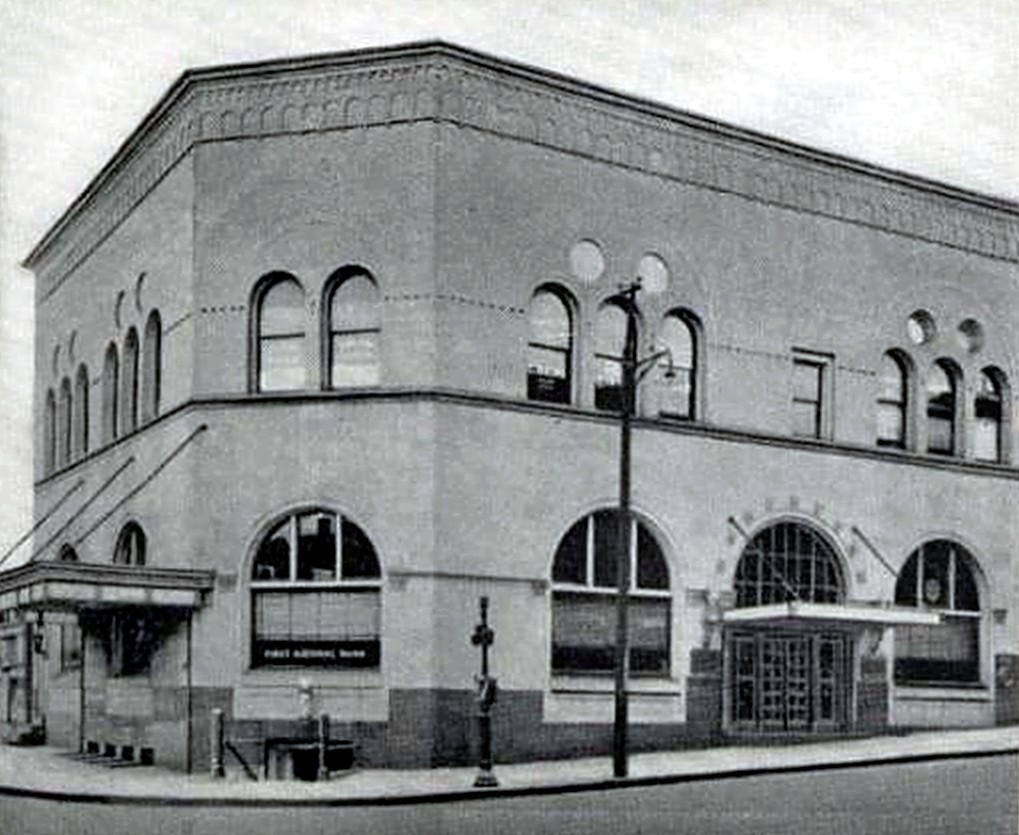
1st National BankWhen I was growing up in Duquesne, I only remember a few things about going to the dentist and/or doctor’s office. Dr. Sebastian was our dentist. The first time remember going to her office, it was located over the First National Bank on the corner of Grant Ave and Duquesne Blvd. I dreaded, no, actually feared going to her.

Claudia Repko Misage commented one time, that Dr. Sebastian’s office was located above King’s Jewelry Store in the bank building. Walking up the steps to her office, holding my mom’s hand, always felt like I was being led off to slaughter.

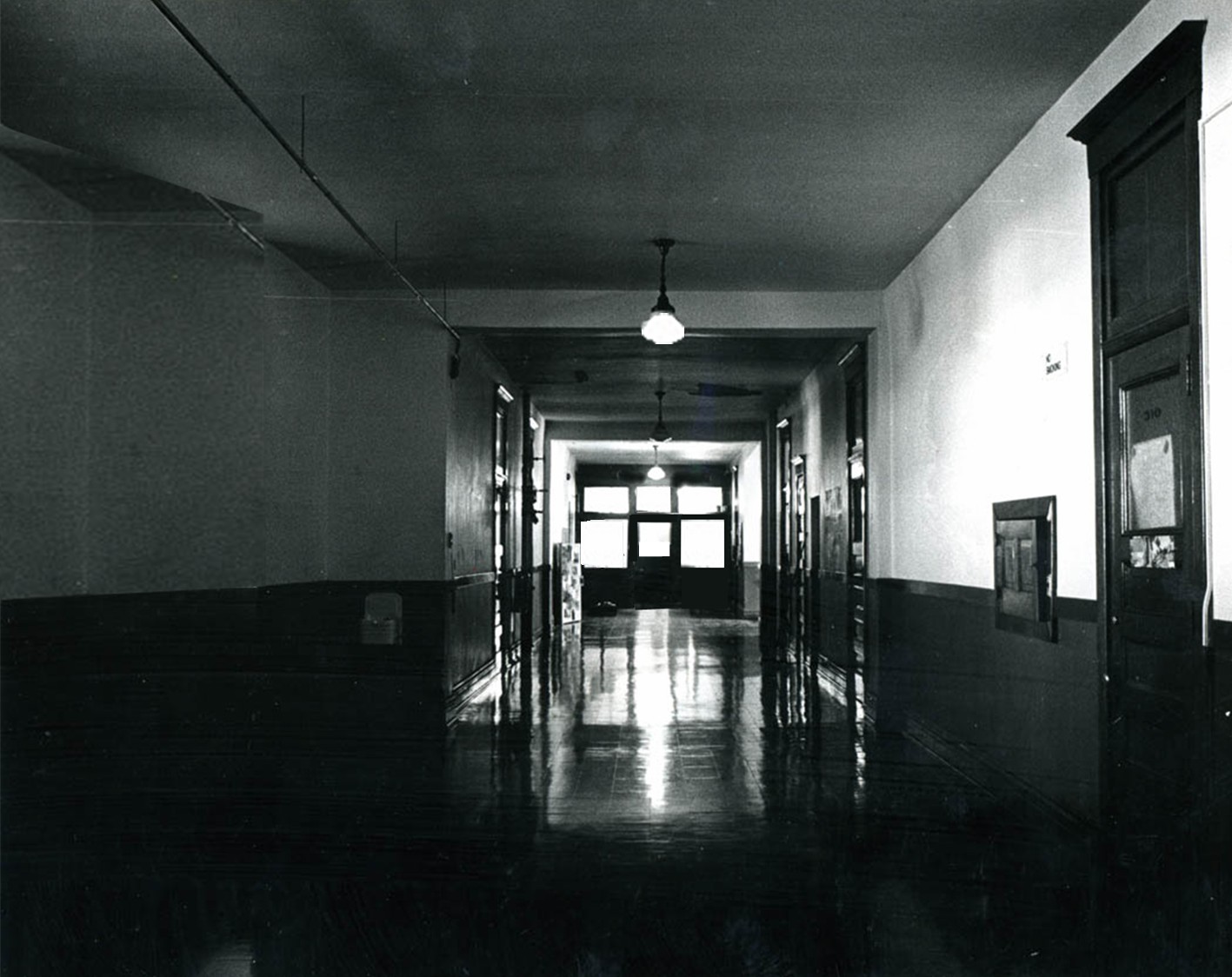
The hallways were lined with offices dark brown wooden doors with textured privacy glassHall that reminded me of the same glass we had in our bathroom window on Thomas Street. Each door had black stenciled letters and numbers that indicated the room number and the business or practice that was located behind the door. The lighting in the hall was rather dim and far from inviting. Dr. Sebastian’s office itself seemed to be a bit brighter than and not quite as dismal as the path leading up to it.

Once Mom and I had arrived for an appointment, we’d park ourselves in her waiting room and begin the agonizing wait until it was my time. In the waiting room, there were always Highlightscopies of Highlights Magazine for Children, which would take my mind off of the impending anguish. I remember the magazine very vividly, and recall tearing out one of the subscription cards every time I visited the office. Unfortunately, I never convinced my parents to subscribe on my behalf. My favorite part of the magazine was a feature called Goofus and Gallant. The feature was basically an Amy Vanderbilt etiquette lesson for kids. It must have worked since I remember it so well. There was also a page of hidden pictures, but someone always had gotten to it before me, so everything was already circled. Once I was invited to enter Dr. Sebastian’s “inner sanctum” and sit in “the chair,” my anxiety quickly dissipated. She always had a way of relaxing me a putting me as ease. There was something so soothing about her voice and mannerisms.

Dr. Sebastian eventually moved her off to her residence in Duquesne Place. She converted part of the 2nd floor into an office suite including a waiting room and a procedure room. I remember that HUGE difference that it made just by the mere fact that the waiting room was surrounded by windows and was so bright and sunny. Somehow, the whole experience didn’t seem so dark and ominous when compared to her first office in the bank building.

As I prepared to write this post, I once again found myself researching for additional information about Dr. Sebastian. I was thrilled to find another blog written by her son Paul. The title and theme of his blog is:

A Little Bit for God and His People – Views of a Layman with a Missionary Spirit Columns by Dr. Paul R. Sebastian Professor Emeritus of Management, University of Rio Grande (Ohio) 

On January 17 of 2012, Paul published a story which speaks to the remarkable accomplishments of Dr. Sebastian.  The publication was posted on the 6th anniversary of his mother’s death in 2006 and recounts the eulogy that he delivered at her funeral.

Dr. Stephanie Mihalich Sebastian died at a ripe old age. Apparently, in her later years, she wasn’t forthcoming about her age and asked her family to keep it a secret. Apparently, it wasn’t until after her death that they felt comfortable in reveling her true age, chronologically-97 years old, but ageless in spirit.

The vast majority of us knew Dr. Sebastian as our family dentist. It didn’t dawn on me as a child, just how unusual it was that she was a pioneer for women in dentistry. To me, she was just Dr. Sebastian, my dentist. As Paul Sebastian wrote in his mom’s eulogy:

“My mother was a pioneer in female dentistry. Excelling as a dental student, the University of Pittsburgh Dental School (Class of 1933) considered hiring her as an instructor until a male chauvinist cried; “Over my dead body will a woman serve on this faculty”. That poor soul must be doing summersaults in his grave.

Mom loved her patients and they loved her, even coming back for routine work when she was 90. Most gratifying was seeing old patients who came to the wake last night, even at considerable sacrifice and pain in climbing those steps. Some had her as a dentist when they were kids in the 1930s and 1940s. Yesterday, one old timer related that: while a soldier during World War II, army dentists raved at the quality of her work. Mom treated every tooth as a pearl and with her feminine touch did everything she could to save every tooth she ever worked on. She practiced what she preached, taking her own natural teeth to the grave at 97.

In her day, even women assumed that men did better work. Thus it was very frustrating when she had to fix botched up work of the guys.

Mom was horrified at how much dentists charge today since she used her dental work to serve people, not to take them. Thus she charged much less than the going rate especially during the depression days and before dental insurance. Mom was happy to do free work for nuns and priests. However, the word got around and a young nun came to her saying, “My Mother Superior sent me to you because your work is free”, not even asking “how much?” She didn’t like to be taken for granted.”

You can visit Paul’s blog by clicking HERE.

As insightful as Dr. Sebastian was in understanding the positive aspects of a bright and Dr. Fletcherwarm office, the other doctors that I saw as a child were less “forward-thinking.” Case in point is Dr. Fletcher’s office. It was located on South 2nd Street across from City Hall and next to the Jewish Synagogue. As a child I remember the front entrance and large waiting room that met you when you entered. The ambiance of the waiting room was relatively similar to the hallways of the First National Bank; dark, dismal and basically comprised of brown leather. Seriously, did EVERY doctor or their furnishings from the same place? Does anyone remember what doctor occupied the office that faced the street at the front of the building? Was it Dr. Umholtz?

I will give Dr. Fletcher some credit, at least his examine room had windows and shed some natural light onto the situation. If I recall correctly, he had a second waiting room that was accessible through a back door. In a previous comment, Barry Long asked “Do you remember the “secret” doorbell ring at the back door of Dr.Fletcher’s office? He would come down from his apartment over the office any time day or night and take care of you or yours.” I don’t think there was an occasion that necessitated an afterhour’s visit, but I do know that he was the kind of doctor that would immediately meet your needs. The one detail that I remember most about Dr. Fletcher is his black standard poodle. I recall the dog strutting down 2nd Street with Dr. Fletcher in tow. Does anyone remember the dog’s name?

There are three other doctor’s names and doctor’s offices that I recollect from my childhood. Needless to say, all three of their offices conjure up images identical to Dr. Fletcher’s office and Dr. Sebastian’s first office. Dark, gloomy and a preponderance of brown leather. The doctors were ones that my mother or my cousins would visit and dragged me along. First, there was Dr. Silverman, a dentist that I think was in Duquesne that my Aunt Mary and her kids used. I think his office was in one of the bank buildings as well, but perhaps someone might be able to provide some better information.

Hot-dogsMy mother would visit a chiropractor whose name was Dr. Cook(e), I think. I used to dread going with her to the appointments, but since she didn’t drive, my brother and I would be required to accompany her with my dad driving. Dr. Cook’s office was the standard brown blog, but it did have somewhat of a view. It was located in Wall and situated facing Turtle Creek. The ONLY part of this trek we would make to Wall was the return trip. Along 5th Ave. Extension (Rt. 148) at the intersection with Pennsylvania Avenue (which lead to White Oak) was a Hotdog business. I think it was call “Red Hots” or something like that. Does anyone remember the actual name?

Lastly, the last doctor that I remember visiting with my mom was in McKeesport. I think his office was on Walnut Street, but I could be wrong. I don’t remember him as much as, once again, the dark office that greeted patients. My mom must have loved going to him. In fact, she continued to visit Dr. Mermelstein instead of switching to Dr. Fletcher. It seemed that Dr. Mermelstein had been around forever. I did a bit of research on him and discovered that he graduated from McKeesport High School in 1926. He also served in the US Army and obtained the rank of Captain. I found two “V-Mails” that he sent to friends when he had been deployed to India, near Burma:

Cap’t M. Mermelstein MD

Xmas Day – 1944

Dear Staufs!

Merry Xmas and a Happy New Year! from India near Burma comes my thanks to you for your kind thoughtfulness to me on Xmas. I got your box of chocolates just yesterday. Boy wasn’t that good timing. Thanks a million! It was so darn nice of you 2 to remember.

Our life in India is mainly supplying troops in Burma. I am with a convoy of colored boys who are doing a SPLENDID JOB carrying loads over the Ledo and Burma Road! I run the Dispensary and must make decisions as to a boys physical fitness to drive – as important to the war as the Aviator’s. They are to be commended for their excellent WORK. No matter what you might read – their WORK IS EXCELLENT!

Today all had a big Xmas Dinner of canned turkey, Cranberry and Pumpkin Pie. It was nice to see how happy q one was about it this evening. I can hear singing from one of near-by tents. regards to Rudolphs & Campbells and Grampa Rudolph. 

Thanks a million – Milt.

USA-CBI-Time-p106

Dear Glenn & Cleona –

It was a pleasure to get a nice long letter from you but the joy was a little offset by the news of Granpa and Hope’s illness. I am very sorry to hear that. I do hope Hopie’s better by now. Her Larry sure must be a big boy by now. Your Harry weighs 40lb! boy, I’ll bet he’s as big as his dad. Are you going to supply him country food forever- Corn and Ham. When he grows up. he’ll want to reduce.

Things in my outfit are the same. they are still carrying stuff up the Ledo-Burma road. They will soon be going to China. I have already had a trip with a Convoy over the Burma Road. Its famous and I’m proud to have been over it. Spent a few days in China but there ain’t no place in the World like McKeesport!

Give my best to Hope and hers, & Vi & hers. Good luck to all.

Milt Mermelstein


Well, in spite of the typically dreary environment that most of the doctor’s offices had when we were young, their care, concern and compassion was unmatched. They really were the heroes of our day. As usual, it would be great if you would share some of your recollections about your medical experiences in Duquesne as well. I love hearing from you!!

Posted in Uncategorized | Tagged , , , , , | 26 Comments

There is Hope for our Hometown

I came across a VERY interesting story while I was checking out the online headlines on AOL (American On Line.) I was so thrilled when I immediately recognized the photo that accompanied the headline and article. Beyond recognizing the town of Braddock, I was delighted with the message of hope that the article conveyed.

Within a stone’s throw from the city we all love, Duquesne, Braddock’s mayor has taken the bull by the horns, thought outside the box, and took steps toward recapturing the  spirit, pride and hope the city needs to survive. 

I have always thought that Duquesne has the potential to accomplish similar success. Given the city’s adjacency to a monumental draw such as Kennywood Park, the views of the Monongahela and the industrial history on its banks, it could be achieved.

I have reposted the article for your enjoyment. Be sure you check out the video as well. It will immediately remind you of some of the sights from Duquesne.2014-08-18+10.03.18superiormotors

How Kickstarter’s Most Funded Restaurant Is Transforming a Town

Kevin Sousa’s Superior Motors is teaching a town to thrive

Kristen Felicetti  Oct 7th 2014 – AOL Orignal 

At the beginning of 2014, Kevin Sousa broke records when he raised $310,255 on Kickstarter for his new restaurant Superior Motors. It was the site’s most-funded restaurant project to date and it would not even be opening in New York, Los Angeles, or any cosmopolitan area. Superior Motors will open in Braddock, Pennsylvania, a struggling town outside of Pittsburgh, which currently does not have any kind of restaurant, not even fast food.

In addition to being the first restaurant in Braddock, Superior Motors will stimulate the town’s already existing ecosystem, by providing employment, a culinary training program, and sourcing its products from area vendors.

Kevin Sosua“I have as much of a passion for the kitchen environment as I do actual food,” Kevin Sousa told AOL Jobs. “I just feel really comfortable around restaurant people. They’re my people.”

In 2010, his years of working in a kitchen ultimately led to him opening Pittsburgh restaurant Salt of the Earth. As chef and owner of Salt of the Earth, Sousa created a fine-dining restaurant that was also involved with its community, using locally sourced products and working with charitable organizations. However, he wanted to take his social outreach work even further, using his skills and expertise to benefit others.

Enter John Fetterman, the innovative mayor of Braddock, John Feddermanwhose efforts to revitalize the town have been covered by The New York Times and The Colbert Report. The two became friends and Fetterman introduced him to what was going on in Braddock. 

Bottom of Form

Once a bustling steel mill town, the steel industry’s decline in the United States resulted in Braddock losing 90 percent of its population and many of its buildings. With Fetterman acting as a consultant, Sousa developed the idea for a restaurant that utilized Braddock’s existing urban farms and abandoned properties, while offering a free-of-charge job training program for at-risk teens or people who might not otherwise have such an opportunity. Fetterman also provided a rent-free industrial space. The space is a former 1920’s indoor car dealership, whose name the restaurant would revive –Superior Motors.

It was a great idea, but how could they make it happen? 

“Banks were not tripping over themselves to give us money,” said Sousa. Even though he already had a reputation as a successful restaurant owner in Pittsburgh, no banks, financial institutions, or foundations were willing to believe that Braddock was a good investment.

With traditional financing not an option, he turned to Kickstarter. He set the goal high, aiming to raise $250,000 in 33 days. A Kickstarter campaign is a significant amount of work and Sousa wanted the payoff to be a dollar amount that would actually facilitate getting the project started.

In December 2013, the Superior Motors Kickstarter launched with a video that told the story and mission of their project.

“My advice to anyone who is getting ready to launch a Kickstarter campaign and spending all this time on the wording of the page? Take all of that time and effort and put it into a strong video,” said Sousa.

Sousa and Fetterman reached out to their own networks and the local press quickly picked up on the story. Thirty-six hours before their campaign ended, they had raised over $100,000, but were still short of their $250,000 goal. So the night before their Kickstarter ended, they threw a party above where the restaurant would be to thank Braddock residents and all the people who had contributed.

All three channels of the local media showed up to cover the celebration, which involved local breweries and live music. The press and spirit of the party helped the campaign go viral in the next few hours. Sousa started getting constant notifications on his phone that people were donating. The morning after the party they hit their goal and by the end of the campaign they had exceeded it, raising $310,255.

Since the Kickstarter campaign ended, Kevin Sousa has been working non-stop to prepare for the Superior Motors opening in early spring 2015. He lives in Braddock now, and every day, as he walks down the street with his dog, neighbors stop him to chat about the progress of the restaurant.

A typical workday involves attending meetings with any of the various people involved in the restaurant’s construction, including the architect, the construction team, the demolition team, lighting designer, or the bread baker who will be designing their outdoor bread oven. Three days a week he’ll be cooking in one of the kitchens, often for a charity or promotional event in Braddock. In addition to working on Superior Motors, he still operates two other restaurants in Pittsburgh and raises two kids with his wife.

Sousa is also developing the curriculum for the culinary training program. In this five-day-a-week program, students will learn culinary training, agriculture, and basic life skills at Superior Motors on Monday, Tuesday, and Wednesday. On Thursday and Friday, they will work paid positions at the Superior Motors restaurant and farm for real work experience. The application process for the program will open at the end of October and it’s expected to receive over hundreds of applications to fill a few spots.

723c7682d5e4318bce95f507c9ee6f7b_large
When Superior Motors opens, visitors can expect food that will be seasonally driven, sourced from local farms, and generally mindful of the spirit of Braddock. It will toe the line between fine dining and a casual neighborhood vibe. Braddock residents will be 50-75 percent of its staff and all residents will be offered a significant discount to eat there.

“Cost should never be an issue for anyone to eat here,” says Sousa. After expenses are covered, any profits made by the restaurant will be filtered through Braddock Redux, the non-profit organization that is operating the job training program.

Sousa ultimately hopes that Superior Motors’ restaurant/culinary training project can be a model for other post-industrial towns across the Rust Belt that have had the same difficulties as Braddock. He knows his project is not easy, but the story of his Kickstarter shows that the Braddock and Pittsburgh community are interested in seeing long-term success.

“Pittsburgh supports its own,” says Sousa, and the over 2,000 individual backers of the Superior Motors Kickstarter are proof. While there were some high pledges (including one from actor Christian Bale), most of the pledges came from locals, and were under $100.

Sousa credits Kickstarter as a platform for helping small businesses change the world. “If banks and traditional financial institutions don’t change the way they operate, they’re going to be left behind,” he says.

It’s likely the people of Braddock will not wait for them to catch up, they will already be working as a community to find innovative ways to build the projects they deserve.


Posted in Uncategorized | 10 Comments

Seriously?

It seems that I spend a lot of my time apologizing for not writing a post for a longer than normal time, however, here I go again. I have a legitimate excuse this time.

If you recall from my last post, I have been involved as co-chairman of the Eastern Shore’s 2014 WALK TO END ALZHEIMER’S on October 18th. This role has been daunting, to say the least. I have never undertaken a task that has been so enjoyable and so disheartening at the same time. Struggling to convince someone to make a personal donation to an organization without receiving anything tangible in return is difficult.

Remember the days when as a child, we would go door-to-door in our neighborhoods andvisitation-rights-300x199 to our families and extended families to sell ANYTHING that was given to us by the nuns and teachers who were teaching us? Christmas cards, wrapping paper, Holy Childhood stamps and candy bars were the standard items we would sell. Somehow, we rarely met with rejection at any door we would target.

Unfortunately, the task as an adult trying to inspire people to consider and then take action through a donation, is not quite as easy as it was when we were kids, smiling at their front door. I believe that although we realize that Alzheimer’s Disease exists and is a devastating disease, unless it has touched us personally, our passion for supporting additional research has not reached the level of need……yet.

I was sent an article by my 27 year old daughter yesterday. My heart sank, my jaw dropped and every other applicable cliché occurred when I read the article. Through my involvement with the Alzheimer’s Association, I am aware of the statistics relating to the disease. I am conscious of the fact that Alzheimer’s Disease currently affects more than 5,200,000 people in the United States. Of that number, over 200,000 of the victims have been diagnosed with “Early Onset Alzheimer’s.” If a person is younger than 65 years of age, their diagnosis is classified as Early Onset Alzheimer’s.

DenialAlzheimer’s Disease as a diagnosis that, regardless of the age of the victim, is often difficult to accept. In the early stages, aside from a few isolated behavioral incidents, there is no tangible evidence of the illness. There isn’t the trauma of a heart attack or stroke to indicate heart disease; no outward malignancies, lumps, bleeding or persistent coughing that could be symptomatic of cancer. Is isn’t  muscle weakness in hands, arms, legs or the muscles of speech, swallowing or breathing twitching (fasciculation) and cramping of muscles or “thick speech” and difficulty in projecting the voice as would be evidenced with a diagnosis of ALS. The events that would indicate Alzheimer’s Disease are much more benign; occasionally forgetting a name, a route or a special date.

I ask you to take a few minutes to read the article I’ve been referring to below. Share it with those you love and increase the awareness of this fatal disease. People with a family history of Alzheimer’s are at higher than average risk for the disease.  I have to admit, I am worried, not only for my own wellbeing, but for the wellbeing of my family. With 4 out of 8 of my father’s siblings having been diagnosed with Alzheimer’s, I pray for the health of my children and grandchildren each and every day. THAT is the ultimate reason I became involved with the Alzheimer’s Association and the motivation for me to ask for your help.

Alzheimer’s at Age 30:An ‘Old-Person’s Disease’ Hits a Young Family By Everyday Health Guest Contributor  –  Published Sep 22, 2014

By Nikki Dodson, Special to Everyday Health

The first thing I noticed in my husband were some personality changes.ALZ

Ken and I had just recently gotten married and built a house, and we had three children who were then 8, 4, and 3 years old.

Somehow, Ken just seemed different.

One time he called me from a local store because he couldn’t remember how to get home. Another time, he went to pick up our kids and ended up going completely in the wrong direction. He was getting headaches. He started forgetting things at work — memory problems that eventually led to him losing his job.

I knew something was wrong.

A Crushing Diagnosis: Early-Onset Alzheimer’s

We went to Ken’s primary care doctor. He suggested maybe it was depression, but Ken didn’t feel depressed. The doctor put him on antidepressants anyway. The symptoms didn’t go away. After seven or eight months, I thought, this is getting ridiculous. That’s when we went to see the neurologist who tested Ken and concluded he had early-onset Alzheimer’s — a week before his 30th birthday.

At first, I thought the doctor was joking. I didn’t know people could get Alzheimer’s so young. But the follow-up PET and CT scans confirmed the diagnosis. We were then told we had just 7 to 10 “good” years left with Ken. That was six years ago.

I didn’t know a whole lot about Alzheimer’s. No one in either of our families had ever had it. I was working in hospice as a business coordinator at the time and there were people on my roster who had the disease, but they were old people.

What I’ve learned is that Alzheimer’s disease is a type of dementia that destroys memory and mental function over time and causes changes in personality and behavior – as I saw in Ken. Certain medications and treatments may help manage symptoms like memory loss, but there is no cure. If you get diagnosed when you’re younger than 65, like Ken, it’s called early-onset Alzheimer’s. My husband is one of about 200,000 Americans who have this form of Alzheimer’s.

The Losses Pile Up: Jobs, Cars, Insurance

At the time of Ken’s diagnosis, it was hard to find any information at all about the early-onset Alzheimer’s. I reached out to everyone I could think of — doctors, co-workers, social workers, Alzheimer’s organizations. I scoured the Internet. Even the support groups I visited were geared toward people dealing with their elderly parents.

The first couple of years weren’t bad. Ken had a few minor episodes. But things got worse as the disease progressed. He has wandered off; we’ve had to use police to locate him. He has lost our vehicles. He’s had rages. There is nothing that can prepare you for what every day begins to be like.

It also took a huge financial toll. Ken was the primary income provider before he stopped working. I also had to stop working to care for him full-time, though I do odd jobs whenever I can to help make ends meet. We lost our incomes, our insurance. We’ve had to sell anything we owned that was of any value.

Ken and the children receive disability compensation, but we don’t qualify for food assistance because his unearned income is too high. And though there are many agencies out there with government grants to help people with Alzheimer’s, Ken isn’t eligible for most because the funds are stipulated for older people.

I have caregiver insurance through the state, but as a spouse I don’t qualify for caregiver compensation. We’ve managed to keep our home, but we’ve lost a lot. We’ve had cars repossessed. We’ve lost our good credit. We’ve even lost friends who couldn’t handle Ken’s decline. It was a life-changer on many, many levels.

Life as a Caregiver: My Husband Is a Different Man Now

People don’t understand the magnitude of work and care that it takes to care for someone with Alzheimer’s. It’s just…endless. Quality sleep isn’t even an option for me. If I get five hours of intermittent sleep a night, I am doing really good.

We often use dark humor to cope with difficult stuff in our family. For example, one of the big jokes in my house is about how I have “some-timers” because sometimes I remember things and sometimes I don’t. That’s how it is for caregivers. We’re under so much stress and we have so many responsibilities, it can be hard to think straight sometimes.

But just when you think you’re at your wit’s end and you can’t do anymore, you somehow dig a little deeper and pray that God gives you a little more strength to deal with it and push forward. Some days I’m still a wife, but most days, I’m a caregiver. I’ve lost the man that I married. He’s another man now, and I still love him, but it’s so different. I just keep trying to be the best wife and mother I can be.

Fighting for My Family and Alzheimer’s Awareness

It became my mission to get out there and speak to people about what we were going through. I started working with the Alzheimer’s Association to help raise people’s awareness about early-onset Alzheimer’s. I’ve met people through AlzConnected.org. I wrote a book for children whose lives have been affected by this disease – I call it Forget Me Not – that I hope to publish someday. I do Alzheimer’s walks. I wear my Alzheimer’s T-shirts all of the time. I make connections everywhere.

I got connected to Lauren Miller-Rogen and Seth Rogen by messaging Lauren through Facebook to thank her and her husband for the work they’re doing to raise Alzheimer’s awareness among the millennial generation through their organization, Hilarity for Charity. We kept in touch.

Lauren asked us to be in a documentary film she was making. We also recently appeared on The Meredith Vieira Show with Lauren and Seth. Being on the show was great. It was a lot to take in, but I see a lot of positive feedback online, so I’m hoping people are really paying attention and beginning to understand the impact of Alzheimer’s on families, especially on kids.

My husband, Ken, is a phenomenal man. That’s why I fell in love with him; he was a great man, a great father, and a hard worker. He used to enjoy going on family vacations, riding motorcycles, and hanging out with family and friends. He now enjoys working in the garden and around the yard. His prized possession is his service dog, Bella.

I know my efforts to make other people aware of Alzheimer’s are not going to help Ken; I know it’s not going to save him. But if it’s going to help my children or my nephew, or somebody else, then I’ll feel that Alzheimer’s didn’t beat us – we beat it. We hope that people will hear our story and know that this disease can happen to anybody. We also hope that sharing our story will save others from having to go through some of the difficulties we’ve undergone.

Nikki Dodson is a 35-year-old wife, mother, daughter, sister, friend, and caretaker for her husband, Ken, in Adrian, Mich. She has a degree in early childhood education, but put her love of teaching preschool on hold to care for Ken full-time. Nikki spends as much time as she can speaking at Alzheimer’s events and reaching out to others that have been affected by this disease.

http://www.youtube.com/watch?v=IqnJYrmx4PE

If you are able to help, please do the following:

  1. Click on the following link: http://act.alz.org/site/TR/Walk2014/MD-GreaterMaryland?team_id=229354&pg=team&fr_id=5161
  2. You will now be connected to our walk page. Click the green box that reads: DONATE TO MY TEAM.
  3. You will now be connected to the contribution page. You can choose your level of donation from the list provided or enter the amount wish. I have started the ball rolling with an initial donation. Please be as generous as possible. The need is so great.The rest of the form in self-explanatory. You will be able to make your contribution with any major credit card or debit card AND also dedicate the donation on behalf of a special person.
  4. To finalize your donation, just press COMPLETE DONATION at the end of the form.


Posted in Uncategorized | 1 Comment

The Longest Goodbye

Duquesne Memories and The Longest Goodbye

As I have written so many times before, I receive such joy and satisfaction from sharing memories of the Duquesne of my childhood with all of you. To receive your comments and personal recollections affirms just how much the city meant to all of us. As long as I am able, I will continue to “shoot the breeze” with all of you and provide you with reminiscences of life in our hometown.

I created this blog on November 29, 2010, almost 4 years ago. I am so honored that you allLibrary 1 embraced the blog, your part in it and have been faithful readers. I suppose that the most logical reason that Duquesne Hunky has been embraced is that we ALL love to remember. What is more comforting and gratifying that being able to share those special memories with friends and former neighbors and classmates. We remember all of the special times and special people because…we can.

I have a very specific agenda for this post, and I hope that you all will take a few minutes to read the entire post to digest and act upon its message.

As much as I enjoy and love writing my blog, I dread writing this particular entry. That dread exists for two reasons. First, I have a fear that I might upset or alienate someone reading this piece due to what I’m asking. In the past 4 years, I have only taken this risk one other time. You were all more than gracious, and very understanding. The second and most upsetting reason I dread writing this post is due to the fact that there is still an urgent need TO write it, as the importance of continuing research has not diminished.

Last year, I reached out to all of you to step forward and step up in support of a cure for a very real, and very dreaded disease. It affects an estimated 5.2 million Americans of all ages, including an estimated 5 million people age 65 and older and approximately 200,000 individuals younger than age 65 who have younger-onset Alzheimer’s. Over 36 million people are affected world-wide.

Faces of Alzheimer's

  • Every 67 seconds someone in the United States develops Alzheimer’s.
  • Alzheimer’s disease is the 6th leading cause of death in the United States.
  • There approximately 500,000 deaths each year due to Alzheimer’s.
  • 1 in 3 seniors dies with Alzheimer’s or another dementia related illness.
  • Almost two-thirds of American seniors living with Alzheimer’s are women. Of the 5 million people age 65 and older with Alzheimer’s in the United States, 3.2 million are women and 1.8 million are men.
  • The number of Americans with Alzheimer’s disease and other dementias will escalate rapidly in coming years as the baby boom generation ages. By 2050, the number of people age 65 and older with Alzheimer’s disease may nearly triple, from 5 million to as many as 16 million, barring the development of medical breakthroughs to prevent, slow or stop the disease. 

This year, as a result of your generosity last year, I have been asked to step-up and serve as the co-chairman of the 2014 Walk to End Alzheimer’s. I gladly accepted the request and hope and pray that the fund-raising effort is successful again this year, and that we can top the $15,000 mark in honor of Duquesne Memories and all of those who were the very foundation of our lives.

040111.01TearoffSheetMy participation last year was in honor of my 4 family members who battled Alzheimer’s disease. This year, I am working in honor of all of my Duquesne friends, former classmates and the entire population of Duquesne, past and present. Although I know of a few people from Duquesne who have suffered from the disease, I am sure that there are many, many more. This is for all of the Duquesne Memories! 

In the past weeks, I have heard and seen an incredible outpouring of support to raise awareness and much needed research money for the devastating disease, ALS. Amyotrophic lateral sclerosis is commonly known as Lou Gehrig’s disease and is a neurodegenerative disease.

People throughout the Duquesne and West Mifflin area have been accepting the “Ice Bucket Challenge” in honor of Father Dennis, the beloved pastor of Christ the Light of the World Parish in Duquesne including Holy Name, Saint Joseph’s and St. Hedwig’s. Fr. Dennis, who has been diagnosed with ALS, is a pillar of strength as he faces and fights his disease head-on with every fiber within him. The support from the parishioners of his parish as well as the vast circle of family, friends and supports that surround has been enormous, and inspirational. From the recent Ice Bucket Challenge between Fr. Dennis and Bishop Zubik, Bishop of Pittsburgh to the very recent Walk for ALS that was held in Pittsburgh, it is VERY evident that the people of Duquesne and surrounding areas have a VERY generous, compassionate, concerned and determined spirit. Their efforts raised over $65,000 for ALS research and placed them as the #1 Team in Western Pennsylvania.

On a personal note, last year I shared news with all of you about my Aunt Peggy. She is my father’s youngest sister, and my oldest living relative, having turned 88 in April of this year. Sadly, she has been diagnosed with Alzheimer’s disease. Aunt Peg, along with two of her siblings, Aunt Helen and Uncle Joe, were tested to access their susceptibility to the disease. At that time it was determined that she, along with at least two other siblings, had already acquired the disease. None of them, at the time of the tests, were displaying any overt symptoms, but all began taking medication that would slow down the progression of the disease.

It was less than a year after the test results that my Aunt Helen and Uncle Joe began presenting symptoms. By the end of the second year following the tests, both had been taken to health care facilities that provided 24 hour care and treatment for the disease. Sadly, my Uncle Joe died shortly after beginning his stay at the home, and Aunt Helen died the following year, both from complications of Alzheimer’s.

Aunt Peggy began to present symptoms of the disease about eighteen months ago. Fortunately, as a result of her physician’s care and her medication, Aunt Peggy is still able to live independently. Her family is keeping a very watchful eye on her. They understand that an assisted-living facility will likely be in her future, but for now, she continues to do well enough to maintain her own apartment.

If you are able to help, please do the following:

  1. Click on the following link: http://act.alz.org/site/TR/Walk2014/MD-GreaterMaryland?team_id=229354&pg=team&fr_id=5161
  2. You will now be connected to our walk page. Click the green box that reads: DONATE TO MY TEAM.
  3. You will now be connected to the contribution page. You can choose your level of donation from the list provided or enter the amount wish. I have started the ball rolling with an initial donation. Please be as generous as possible. The need is so great.The rest of the form in self-explanatory. You will be able to make your contribution with any major credit card or debit card AND also dedicate the donation on behalf of a special person.
  4. To finalize your donation, just press COMPLETE DONATION at the end of the form.

I hope you will consider contributing to this walk. Since this blog is totally about the memories of our youth and the town we love, help to preserve those memories for everyone by helping to eliminate the disease that robs our seniors of those very recollections.

Recently, Fr. Dennis shared the following thoughts with his parish in their Sunday bulletin. I thought it so inspirational, I wanted to share it with you as I end this post………

Promise Yourself:

  • To be so strong that nothing can destroy your peace of mind.
  • To talk health, happiness and prosperity to every person you meet.
  • To make all your friends feel that there is something special about them.
  • To look at the sunny side of everything and make your optimism come true.
  • To think only the best, to work only the best, to expect only the best.
  • To be just as enthusiastic about the success of others as you are about your own. To forget the mistakes of the past and to press on to greater achievements of the future.
  • To wear a cheerful countenance at all times and give every living person you meet a smile.
  • To give so much time to the improvement of yourself that you have no time to criticize others.
  • To be too large for worry, too noble for anger, too strong for fear, too happy to permit the presence of trouble.


Posted in Uncategorized | 2 Comments

BYGONE SMILES

From time to time I get in this weirdly reflective mood. Something very innocent will normally precipitate the mood, which is exactly what happened yesterday morning.  I was just relaxing and sipping my morning coffee and decided to go through some recent pictures and videos that my daughter Megan had sent me. While doing so, I came across a video of my newest grandson, Mason James, smiling for his mommy. I had watched the video many times before, but this time, was surprised with what I saw in his smile. His smile was just like the smile I saw so many times on my dad’s face when he was happy. It was as if Mason’s grin was cloned directly from his great-grandfather.

After seeing Mason smiling, I immediately began reflecting about my dad and the things that would put that same smile on his face. He was always a happy guy, but some things just would make him light up with a special joy. For instance:

SMILE SOURCE #1 – When my father had his garage on South First Street, he had a reputation of being an ace mechanic. It always made him feel good when customers would give him a compliment. Although I didn’t spend a great deal of time at the garage (testimony to my inability to do an oil change,) I was there on several occasions when my dad would be beaming.You see, my dad loved to cook. Even greater than that love, was his passion for feeding people. He would always get the brightest smile when one of his “buddies” would come into the shop around noon and accept my dad’s offer to cook them a steak for lunch.

griddleThe building that housed my father’s garage at one time sold automobiles. There was a very large room at the front of the building that he would refer to as ‘the showroom,” but the only item in the entire room was an old GE refrigerator. This ancient piece of equipment seemed to have a never ending stock of butter, steak and wieners. Dad managed somehow to buy steaks at wholesale initially from one of his butcher buddies and eventually from the GBU Club on the corner of Norman Street and Grant Avenue. He and the club president, Stanley Neff, had some sort of deal worked out that kept Dad in stock at all times.

Nevertheless, my dad would prepare steaks on his little griddle on top of his oily workbench for anyone who wanted one, and do so with the biggest smile. They we amazingly delicious, and so there was never a lack of hungry mouths to feed.  Between the steak and my dad’s beaming smile and personality, everyone enjoyed their “lunch with Steve!”
SMILE SOURCE #2 – My dad LOVED the Pirates. His idea of a wonderful evening would be sitting on the back porch on his metal chairs, legs propped up on a metal coffee table, and an icy cold Iron City beer in his hands. If either of his sons or any of his neighbors, brothers , sisters or in-laws would decide to join him, all the better.

12The mere sound of Bob Prince or Nellie King’s voice on that old radio that Dad kept on the porch would bring the biggest smile to his face that wouldn’t disappear until some Pirate played ticked him off with something he would do. Dad was the prototypical Pittsburgh fan… loved them when they were winning, but called them bums when they weren’t.

SMILE SOURCE #3 – My dad never touched a computer in his lifetime. Even though he
lived until 1999, he remained “roadkill on the computer highway” his entire life. Despite the fact that he didn’t know how to operate a computer, he was nonetheless fascinated byWesterns what they could do.

I recall sitting with my dad in front of computer at our house and watching his face as I would maneuver and surf the internet for something special that would delight him. Being able to instantly recall and play ANY song by ANY artist that he could remember or being able to instantly view episodes of his favorite western mesmerized Dad. When I would first connect to an old episode of Gunsmoke or Bonanza, the loudest “Geez” and biggest smile would come across his face as he rubbed his face with his hands as he always did when he got excited.

SMILE SOURCE #4 – A deck of cards and a bottle of beer would always bring a smile to my dad’s face. When I was in high school, EUCHRE was his game of choice and in his later years, a game called TICK became his favorite. It became such a familiar scene to see my Uncle Lou3dad, Uncle Lou, and my brother Steve sitting around our kitchen table enjoying an evening of playing cards. The menu was simple, a bottle of Iron City or a bottle of Regent Cream Soda, a bowl of Wise potato chips, and beside my Uncle Lou, a big ashtray for his cigar.

Dad was often called an “instigator” by his siblings and virtually anyone he played cards with. Nothing brought a bigger smile to his face than when he had the winning hand. He was never a sore loser, but was more of a gloating winner! When he was victorious, he never said a word, but usually got a grin on his face that was often called a “s**t eating grin!” That grin had an irritating effect on the other players, especially since he was very skilled and/or luck at cards.

After I was married and my career had taken my family and I to the south, both my dad and my mother-in-law, Jean, would come down for a visit at the same time. We always enjoyed these times since it would bring us all together and my daughters would be in heaven with both of their grandparents around. Once the girls were in bed for the evening, we would after convene at the kitchen table for a few games of TICK. My dad’s remarkable ability to immediately rile my mother-in-law was usually illustrated once we began. Jean was an equally skillful player, but a bit more focused than my dad. His greatest joy came when it got to the point that Jean began yelling at him for being so irritating when he won a hand. I have to tell you, he always had that grin on his face after the win and I had to chuckle, knowing that when I looked at Jean, I always saw those pursed lips of anger! Ahh….good times!

SMILE SOURCE #5 – Dance, dance, dance! This smile source is a tougher one to explain, but I’ll give it my best try.

Simply put, by dad liked to dance. He, in fact, was a very accomplished dancer in the opinion of all of my aunts and uncles. I am told that when they were dating and first married, my dad and mom and  my aunts and uncles would often find their way to The Kennywood Dance Pavilion many times to enjoy an evening of entertainment. In 2005, The Tube City Journal posted an article that mentioned the pavilion, and does a great job in addressing its fate:

The Kennywood dance hall — in Kennywood parlance, the “Pavilion” — was one of the first structures erected after the park opened in 1898. The two-story enclosed structure featured a clerestory with screened windows and a ceiling of rugged, exposed beams.

But its Victorian details were looking decidedly old-hat by the 1930s, and though the Great Depression meant Kennywood couldn’t buy many new rides, it could invest in its buildings. Indeed, park management credited the Pavilion with keeping Kennywood open during the Depression; people couldn’t afford to play games or buy ride tickets, but they could stand around and listen to music, or dance with their sweethearts.

So, the Pavilion was substantially remodeled and updated into the current Art Deco style, just in time for the so-called “golden ages” of both big bands and network radio. During the 1930s and ’40s, live dance bands did national broadcasts from the Kennywood dance hall, via the Sun-Telegraph’s radio station, WCAE, and the Mutual Broadcasting System.

Dozens of nationally-known band leaders and singers played there, including Benny Goodman, Rudy Vallee, Ozzie Nelson, and Les Brown “and his band of renown.” Lawrence Welk did a week there in 1938, while playing at the William Penn Hotel in Downtown Pittsburgh. (It was the same summer that someone coined the term “champagne music” to describe his bouncy, inoffensive melodies.) Bandleader Tommy Tucker, who employed a then-unknown arranger named Gerry Mulligan, was a regular at the Kennywood Pavilion.

For a long time, Kennywood refused to allow “swing music” to be played at the Pavilion, for fear that it would attract the wrong element, but that restriction was eventually relaxed. Smoking was strictly forbidden; so was alcohol. (And so, for a long time, were African-Americans.)

The war years were good years, and the Pavilion was modernized again. It hosted soldiers, sailors and Marines in town for training or home on leave, and was busy nearly every night. But with the end of the war came a new threat that would ultimately end dancing at Kennywood: Television.

Pittsburgh’s first station, WDTV, signed on at Channel 3 in 1949. Soon, instead of going out to Kennywood to dance in the evening, people were staying home to watch the tube. Then, too, tastes in music were changing. The big bands were in decline, and would soon be eclipsed by rock ‘n roll.

In 1954, Kennywood converted the Pavilion into a fun house called the “Enchanted Forest.” A few years later, it was gutted and a “dark ride” was installed. Passengers boarded little tram cars and rode through various “spooky” attractions. It would be remodeled twice more, and in 1967, was themed as something called the “Ghost Ship” — a sort of haunted pirate ship. A California Gold Rush themed ice cream parlor called “The Golden Nugget” was built into one end, and another ride called the “Road Runner” occupied part of the massive old dance hall.

I was only able to see my dad “cut a rug” at family gatherings. Weddings gave him a great Westernsvenue to dance, and my mom, aunts and other ladies would all take turns dancing with him. He was that good. In fact, when he was much younger, he used to teach people how to dance on roller skates. I suppose if you’re able to move like that on wheels, transferal to a dance floor came easy.

There was always this one moment, right before he would begin dancing arm-in-arm with a partner that my dad would get this big smile on his face. It was when he would place his hand around her waist, extend his hand, allow her to place her hand in his, and then begin to whirl around the floor in perfect unison with his partner. He would keep on smiling throughout the dance, and relish every moment.

A wonderful recording artist, Luther Vandross, released a song in 2003 that expresses the feeling that I had when watching my dad dance, especially with my mother. Unfortunately, shortly after he recorded the song, Luther suffered a stroke that eventually led to his death just two years later at age 54. The song, “Dance With My Father,” and the lyrics are as follows:

Back when I was a child, before life removed all the innocence
My father would lift me high and dance with my mother and me and then
Spin me around ‘til I fell asleep
Then up the stairs he would carry me
And I knew for sure I was loved
If I could get another chance, another walk, another dance with him
I’d play a song that would never, ever end
How I’d love, love, love
To dance with my father again
When I and my mother would disagree
To get my way, I would run from her to him
He’d make me laugh just to comfort me
Then finally make me do just what my mama said
Later that night when I was asleep
He left a dollar under my sheet
Never dreamed that he would be gone from me
If I could steal one final glance, one final step, one final dance with him
I’d play a song that would never, ever end
‘Cause I’d love, love, love
To dance with my father again
Sometimes I’d listen outside her door
And I’d hear how my mother cried for him
I pray for her even more than me
I know I’m praying for much too much
But could you send back the only man she loved
I know you don’t do it usually
But dear Lord she’s dying
To dance with my father again
Every night I fall asleep and this is all I ever dream

I really miss my dad. The fact that he was always funny, caring and lucid until the day he died was a gift that God gave to my brother and I. Fortunately, he never suffered from Altzheimer’s Disease as 4 of his 7 siblings did. I hope you’ll excuse what I call the weirdly reflective mood  of this post, and celebrate all of the wonderful family and Duquesne Memories that make YOU smile!


Posted in Uncategorized | 6 Comments

Back-to-School Retrospective

In celebration of what used to be my favorite event of the year as a parent, I thought it would be appropriate to talk a bit about Back-to-School. Labor Day is behind us, and once again I’m stuck behind school buses that are loading and unloading the little ones in the neighborhood. I certainly don’t mind since it means that Fall and Winter aren’t far behind.

My recollections of going back to school at Holy Name are still pretty vivid in my mind. I still remember the names and mannerisms of each of the nuns or teachers that taught my grade. I’d be curious if those who had these same educators when they attended Holy Name, share the same thoughts and recollections as me:

  • FIRST GRADE – Sister Incarnata -Young and very kind

    Sister Martin dePorres and Sister Agnes Eugene 1961

    Sister Martin dePorres and Sister Agnes Eugene 1961

  • SECOND GRADE – Sister Martin de Porres – Very friendly and always smiling
  • THIRD GRADE – Sister Emily – Stern and tough
  • FOURTH GRADE – Mrs. Smith – Nice, but tough. Giggly upper arms (isn’t that awful that that’s what I remember?)
  • FIFTH GRADE – Mrs. Juliana – My favorite. Younger, fun and creative
  • SIXTH GRADE – Sister Clementine – a clone of Sister Emily (see Third Grade!)
  • SEVENTH GRADE – Sister Mary Immaculate – Some kids loved her, some… not so much! Unfortunately, I think she felt the same way about her students…. loved some of them, others… not so much.
  • EIGHTH GRADE – Sister Mary Daniel – Principle of the School -What a wonderful person. Jolly, happy, and yet stern when she needed to be. Definitely my favorite religious educator.

Walking back into Holy Name each grade year was similar to any other school in Duquesne.Project1 Desks were lined up in perfect straight lines, polished and as shiny as any decades old piece of wood could be. The huge double hung windows were sparkling clean and that long pole that we used to hook the top windows to open them stood at attention and ready for service in the corner of the room.

There was a distinct smell of furniture polish, blackboard conditioner, window cleaner and
liquid cleaner that seemed to hang in the air for weeks after school began. The aroma became quite different when I was in the 2nd and 5th grade however. Both class rooms were directly above the cafeteria exhaust fans, and although our menu was never announced beforehand, by mid-morning we all knew what was being prepared for our lunch. There was no mistaking the aroma of spaghetti sauce or beef stew as it was being prepared down below.

All of our books were either on our desk or seat, or in the desk itself, all destined to be in our bookbags by the end of the day. Each book would be carefully covered at home that night with brown grocery bags cut and folded to perfectly fit each book.

All seats were assigned beforehand, taking into account each student’s history of behavior, which I’m sure was discussed each evening by the good sisters as they enjoyed their evening meal together. Above each blackboard, the letters of the alphabet, both printed and in cursive, were perfectly placed, adhered and ready for the school year.

CaptureI have so many memories of my grade school years in Duquesne! Just think about how many schools populated our hometown! All of the Parochial have closed. Today, there remains only one school, the former Duquesne High School building. There are approximately 350+/- students enrolled in grades K through 6. Its kind of hard to believe when compared to the graduating class of 1940 when 355 young men and women finished their senior year at Duquesne High! The good news is that there is a strong Recovery Plan for the Duquesne School District that will help to resolve current issues within the district. If you’d like to review the plan, you can access the full report by clicking HERE!

I am reposting something I wrote back in 2011 regarding the dreaded preparation time before returning to school. Also, I am also including an article from The Duquesne Times that specifies teacher assignments in the public schools for the 1956-57 school year. How many teacher do you remember??

Article

 Now, my 2011 post: 

Well, it’s August 10th, and as a young boy growing up in the Duquesne area, the last thing on my mind would have been going back to school. In August, I was still thinking about playing outside all day, perhaps looking forward to a family vacation at Presque Isle, or at the very least, one more outing to Kennywood combined with a few more Volk Clan picnics.

During those swelteringly hot August days, my mom did manage to jolt my brother and me into realizing that school would be beginning soon, by subjecting us to one of my most dreaded activities…… trying on school clothes that had been packed away from the previous year. I still contend that this was a form of child abuse. Had Mom traded her secrets with the government, I’m confident that this form of torture could have been elevated to a point that would have surpassed waterboarding!

Early in August, Mom would always let my brother and I know that we would be trying on clothes at some point during the month. Once she had decided on a day, she would always count down the days and remind us each day that “IT” was approaching. I think it was to build the anxiety in Steve and me, and it worked.

Having no air conditioning in our home, Mom would somehow manage to pick the hottest day of the year to torture us. Of course, we had to do it during the daytime since she insisted that “the light was better” and she could “see how they fit.” We would be summoned up to our parent’s bedroom on the 2nd floor of our non-air-conditioned home. Since hot air rises, this made it an especially “toasty” experience.

The storage chest that contained all of the pack away clothes was in an area that we called the “cubby hole.” Now that I think of it, what an appropriate name. A perfect place for animals to hibernate during an ice-cold winter since it provided extra warmth. Our “cubby hole” was no exception. It was at least 20 degrees hotter in there than in the bedroom itself. Fortunately, Mom didn’t make us try the clothes on in the cubby hole. She did however, keep the door open so all that extra heat would pour out into the bedroom and raise the temperature even higher.

Now, the purpose of this entire exercise was to determine what still fit my older brother and what articles of clothing were now considered “hand-me-downs.” That was where I stepped in. I was the “hand-me-down” recipient! Lucky me.

The clothing had been stored in a huge green trunk that my dad had gotten from someone. It was so large, that you could fit a small nation of children in it comfortably. Since hunkys would never throw anything out until it had exhausted all practical use, it contained layers and layers of clothing that would be reused at some point in my childhood.

To add insult to injury, Mom believed in protecting the clothing from being eaten by moths. Seriously, you and I both know that moths are attracted to wool. Considering that the majority of items in the trunk were either corduroy, flannel or cotton, no self-respecting moth would even consider dining in our trunk. Nonetheless, Mom protected the clothing “just in case” by hermetically sealing the clothing in the trunk each season along with a VERY liberal sprinkling of moth balls and moth crystals. By the time these garments had been stored in a virtual vacuum of naphthalene for at least 6 months in a room that reached temperatures that could melt soft metals, let’s just say the odor was rather… “heady” to say the very least.

In order to find out what still fit my older brother Steve and what items would become his fashion leftovers, a.k.a. hand-me-downs, Steve and I had the pleasure of stripping down to our tighty whities and trying on item, after item, after item in the sweltering hot 2nd floor bedroom that was teeming with the smell of mothballs and sweat.

Steve as always the first to try on any item. After all, his size was the determinant by which an article of clothing would be reused or handed down. For him, it was a quick try on, an inspection by Mom, and then he was on to the next item. For me, the process was a bit more arduous. If a pair of pants or a shirt appeared to be both too tight and beyond the point of being altered to fit Steve once again, it became a hand-me-down. It was at that point that I stepped into the picture in my tighty whities. For my mom to decide if a newly created hand-me-down would be used during the upcoming school year, I had to try the item on. Nothing felt worse than being told to try on an article of clothing that had just come off of another person’s sweaty body (sorry Steve, I still love ya), AND then have to wait for Mom to inspect and decide on the fate of said item. I used to pray that each shirt, jacket or pair of pants would fit. Not because I liked it, but because it meant that I could quickly remove it and expedite the end to this torture. You see, IF an item fit but was too long, I would have to wait while Mom would pin the hem each pants leg or perhaps mark how much an item had to be taken-in for it to fit. I loved my mom, but she was no Ernie Plastino when it came to her sewing abilities. As a result, the measuring and pinning procedure seemed to last forever.

When we had gotten to this stage, the whole process was most like a form of torture that could be used at Guantanamo. To make my point, consider all of the finer points of this picture:

• A 6 year old boy and an 8 year old boy forced to give up a day of playing outside with their friends

• An extraordinarily hot second floor bedroom in August

• Bright and hot sunlight beating down through the windows adding to the steaminess

• The pungent odor of mothballs filling the air

• A young mother being forced to control her two fidgety sons without yelling since her mouth was busy holding onto straight pins for the task at hand

• The six year old standing perfectly still, dressed only in his underwear and a heavy corduroy jacket that reeked of mothballs and damp with his brother’s perspiration and his mother trying to determine and pin the perfect sleeve length.

• GET THE PICTURE??

Yes, I believe my mom could have eventually broken Bin Laden if given the opportunity. Thanks for those special memories Mom!!

Each year, The Duquesne Times would publish the upcoming school year’s list of teacher assignments. Interestingly, the lists contained not only the school and grade assignment, but also included their individual salaries as well. I am posting the lists from the 1948-1949 school year for your enjoyment. I would think that you might recognize some your favorite teachers and further realize that compared to the national average of $4300 to $7400, Duquesne’s teachers were truely on the low end of the scale.

1948-1949 Teacher’s List

Posted in Uncategorized | 11 Comments