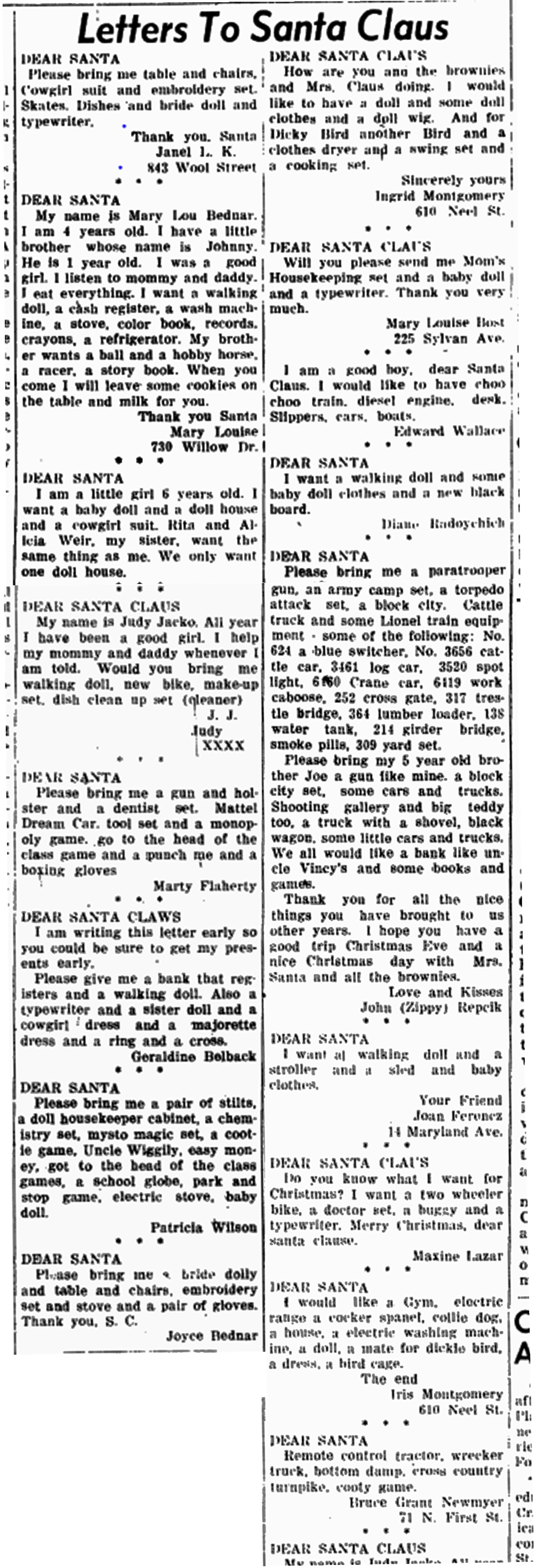
Voices of Duquesne – Christmas 2017

Hi James,

I am in need of a recipe for Christmas Eve mushroom soup that uses fresh mushrooms and NO sauerkraut. That was my mothers recipe from a long time ago. My mother was born in Slovakia and must have gotten that recipe from her youth.

My wife has struggled with a reproduction for many years. My mother did not write down a lot of things.

I now need something written for a grandson attending college. My extended family is growing up.

Edward (Ed) Salaj , (Homestead Hunky)

Lincoln Place

Hi Ed. Merry Christmas! My Aunt Peg was always in charge of the mushroom soup on Christmas Eve. The recipe below is the one she always followed, however she would omit the sauerkraut juice. Everytime I taste it I think of family, snowy Christmas Eves and warm memories. Good luck. Let me know if you like it.


Merry Christmas Jim and to all the hunkys in Duquesne & West Mifflin. This blog always brings back extremely fond memories especially at Christmas. This posting was virtually identical to my recollection in my mind’s eye. Again, thank you and your contributors. I have a question however, what is the hunky name of the fried dough cakes sprinkled with powdered sugar? I have seen various names however none ring a bell with me.

Again, Merry Christmas and a safe and Happy New Year

Mike Korinko

Hi Mike! Merry Christmas to you too! 

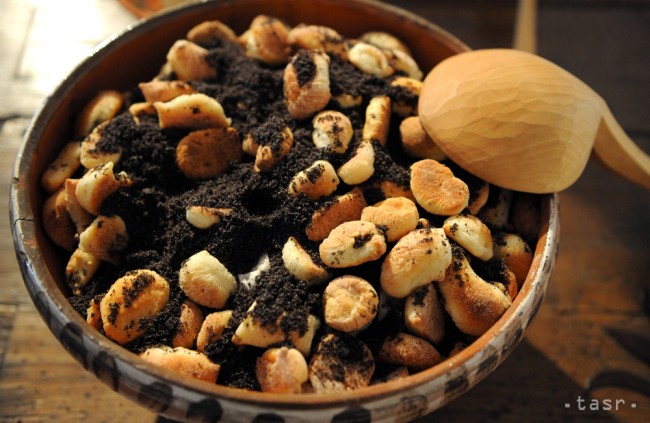
I think you are refering to Cheregis. I remember my dad getting them from a church in Duquesne on Fridays. I still remember the brown paper bags, spotted with frying oil,  full of cheregis that were covered with powdered sugar!

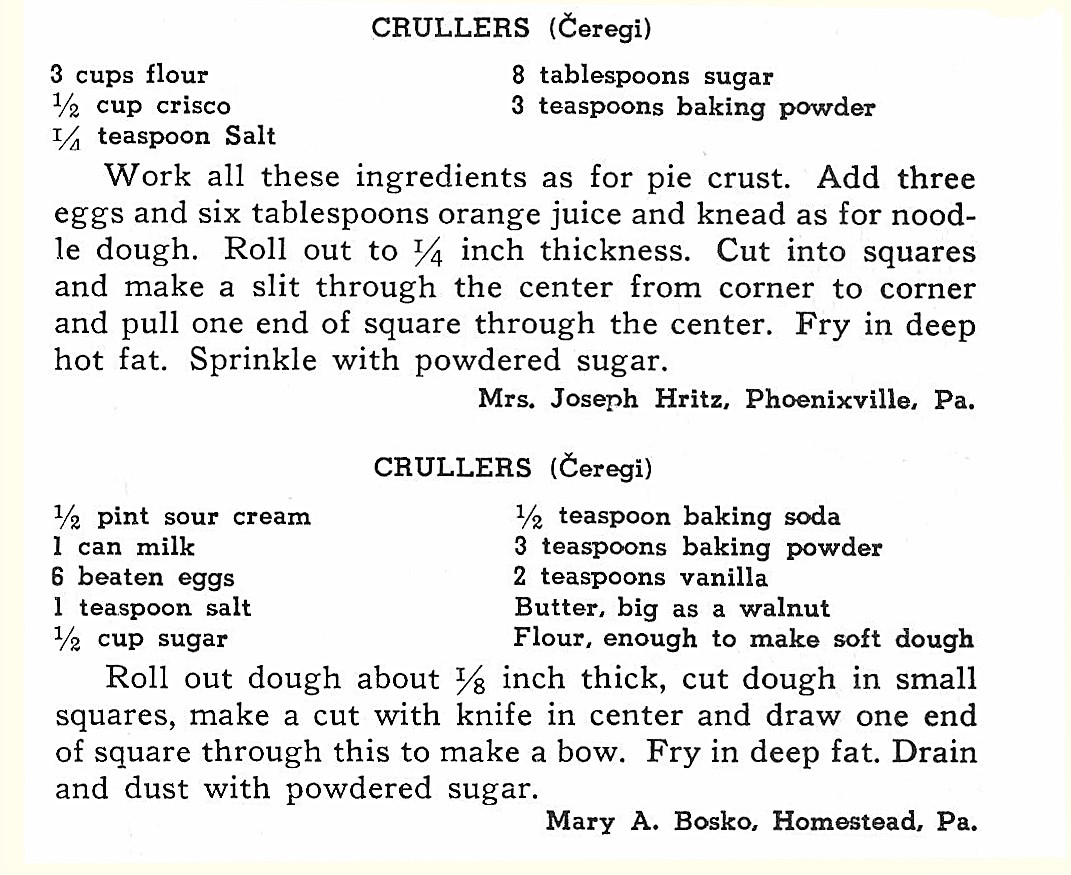
Now here’s a challenge for you Mike…… I found two different recipes for cheregi in an old Slovak cookbook I have. You need to make Vera proud and whip up a batch to enjoy over the holidays! Good luck!!

Good Morning, Merry Christmas.

My parents and grandparents were all from Duquesne and I had many other relatives that lived there… Most all worked for Duquesne Works U.S. Steel. I also lived there with my parents as a child. I worked there during college summer vacations.
Although I moved with a job many years ago, I always went home for Christmas with the family, and still have very fond memories. Most of my family is now gone as I am 70 years old, and haven’t been back for some time… 

Anyway, I’m writing to ask if you can give me the name of a Bakery that would sell Christmas rolls, cookies and especially bobalki. One of my favorite “Pittsburgh” ethnic Bakeries is in McKeesport called Minerva’s… but they don’t ship/sell on-like. If you know of a place and can share, I would really appreciate it.

Thanks,

Ron Yurick

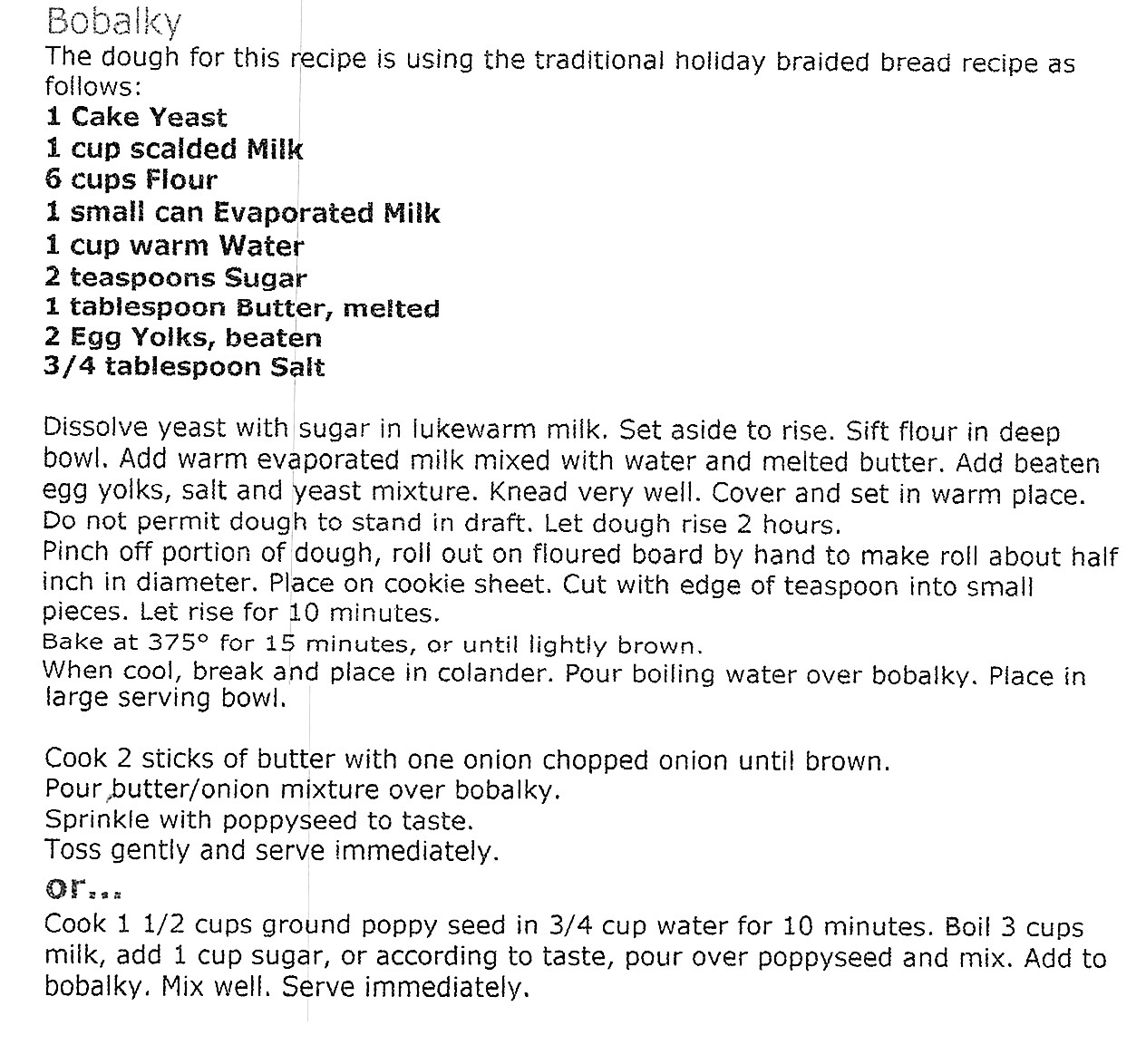
Hi Ron, here is my Aunt Peggy’s recipe for bobalki. I used to look forward to it every Chirstmas Eve. Enjoy!

I’m trying to figure out at what point did the GBU start accepting Hunky members. My father, my grandfather and I all belonged. Lots of strong inexpensive drinks, lots of bosses and union reps talking civilly with each other, great bartenders and free sandwiches. You had to be sponsored and risked the chance of a blackball, which was common. My father told me a little about the GBU being investigated by the feds for ties to subversive German American Bunds in the late 30s. He also talked about the pressures put on German management in the Duquesne Works. Is there something to this?

Mike Bilcsik, Late 70’s


 Submitted by Colleen Byrne Travis                                                                                           Written by: Steve Mellon                         Published: September 12, 2017  / Yinz

This is from a special section of The Digs featuring images provided by their readers.

Heartbreak and tenderness in a steel town
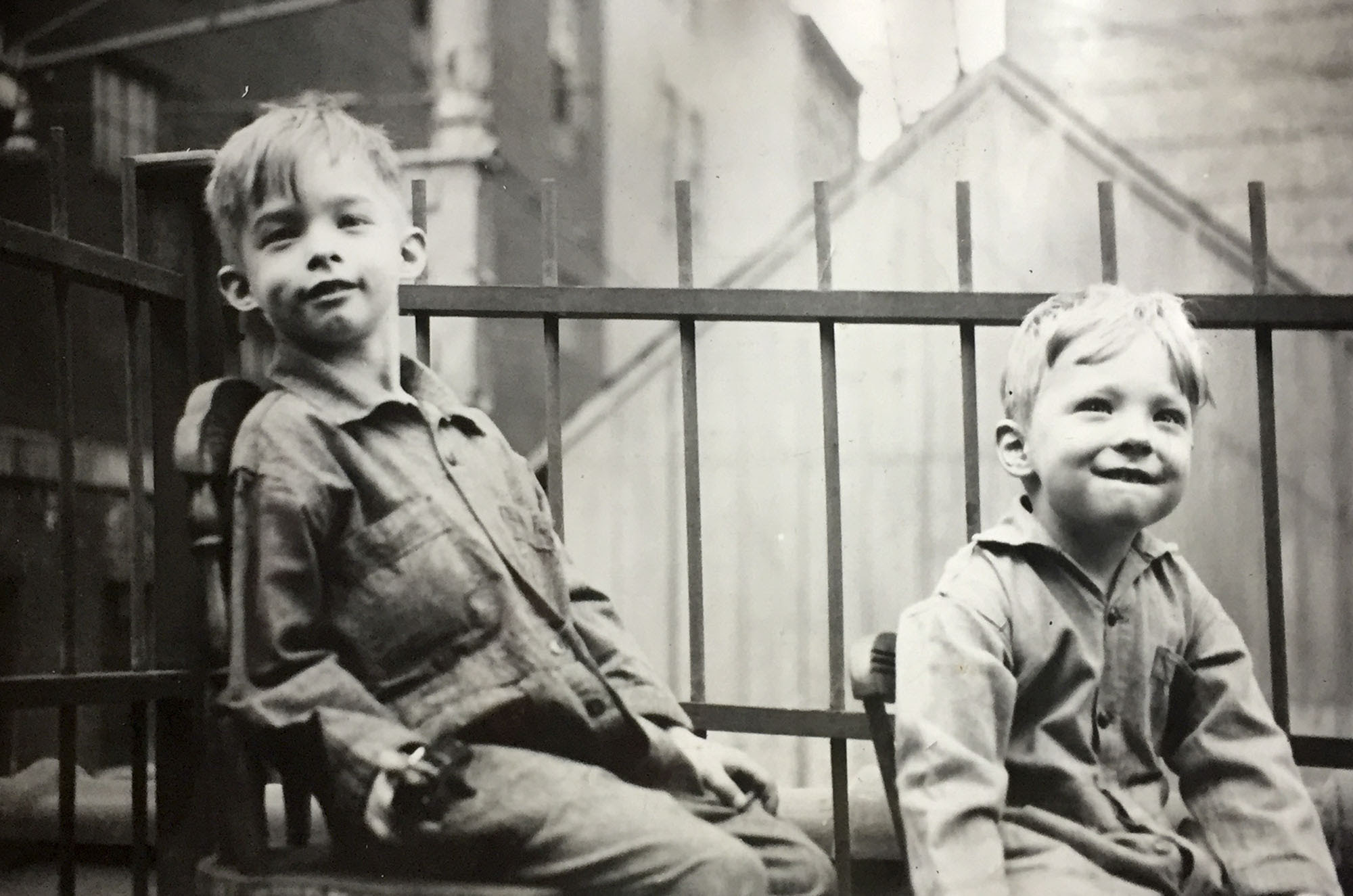
Murt Shaughnessy Jr. and little brother Michael. (Courtesy Eileen Connelly)

Finches hopping on a cracked sidewalk in Duquesne’s devastated business district took flight one morning last week, the birds flapping upward as a cluster toward Grant Avenue, several narrowly avoiding a fast-moving sedan. Then the cluster disappeared behind a storefront building that stood defiant and alone, a middle finger to departure.

Duquesne these days is a monument to a thousand goodbyes. So many vacant lots, vibrant green in the morning sun. Library Place minus its library. The pharmacy empty, spiderweb cracks across its storefront windows.

Truth is, folks here have been saying painful goodbyes for decades, long before the steel mill stopped shooting its vibrations through town, long before endless fluorescent isles of inexpensive goods and easy parking in the suburbs drained the business district of people and prosperity.

Farewell stories flutter from this battered community’s history. They offer glimpses of perseverance, compassion and hope in the face of overwhelming sadness.

Rosemary Terza (now Fuga) grew up in Duquesne. One of seven children brought into the world by Sylvester and Elizabeth Terza, she remembers the day in January 1941 when her sister Jean bathed 3-year-old brother Johnny and noticed a boil on the boy’s leg. Jean, 13 years old, knew the boil was trouble. She immediately told her mother, who summoned a doctor.
The open boil oozed liquid. Blood poisoning, said the doctor. Don’t move the boy or the poison will spread.

Alarmed family members pushed two chairs together and created a small bed in the living room of the family’s home on a hillside above the rumbling mill. There Johnny would stay, watched over, fed and bathed by his parents and siblings.

The doctor visited every day for two weeks and treated Johnny with sulfa drugs. But the boy couldn’t be saved. He died in his makeshift bed shortly after 7 p.m. on Feb. 6, 1941.


Johnny Terza. (Courtesy the Terza family)

The loss devastated Sylvester and Elizabeth. For months they grieved. Rosemary was 12 at the time, and to her the sadness seemed unbearable. Guilt and depression wracked Elizabeth. Rosemary wondered, would happiness ever return to the family’s Overland Avenue home?

Family friend Murt Shaughnessy noticed the the gloom enveloping the Terza family. Murt owned and operated a funeral home on North Duquesne Avenue. He embalmed, restored and dressed the bodies of those whose days were ended by disease, old age, auto crashes, industrial mishaps or suicide. Grief to him was unavoidable in the way sawdust is unavoidable to a carpenter.

But something about the Terza family’s sadness moved him. One day early in the summer of ‘41, Murt stopped by the Duquesne post office, where Sylvester worked as a mail carrier.

“Have your family ready on Friday afternoon,” Murt told Sylvester. “I’m going to take you up to the mountains to our cabin.” Murt owned a small cabin in Stahlstown, about 50 miles from Pittsburgh.

The prospect of a vacation shot a bolt of excitement through the Terza house. The family had little money, no car and no phone. Vacation was a dream.

On Friday, Murt arrived at the Terza home in a big funeral car. The Terzas piled in and, after a drive that seemed to last forever, Murt dropped off the family at his small cabin. “I’ll be back in two weeks to take you home,” he said.

The mountains buoyed the family’s spirits. The kids played in a creek, splashed in a swimming hole, the parents walked among pine trees, attended square dances. Sylvester was a skilled carpenter and, as a gesture of gratitude, made a few repairs on the cabin.

“It was a complete change for all of us,” recalls Rosemary. Her family eventually acquired land near Stahlstown and built its own cabin. “Murt was so wonderful to have that insight.”
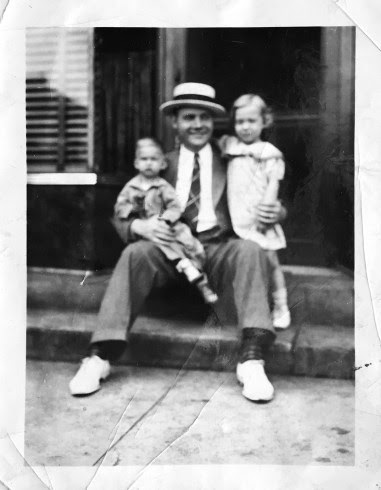
Murt Shaughnessy with son Murt Jr. and daughter Eileen. (Courtesy Eileen Connelly)

In addition to running a funeral business, Murt and his wife Margaret were raising three children of their own — daughter Eileen and two sons, Murt Jr. and Michael. On a snowy Friday, Jan. 25, 1946, Murt Sr. drove past a section of Mifflin Street where 10-year-old Murt Jr. and several of his friends were sledding.

The day was a special one — students had been dismissed from school early after completing exams, and a blanket of snow covered the Mon Valley. Murt Sr. stopped his car and spoke briefly to his son, who said he was having a great time. Then the father continued on his way.

A few hours later, around 5 p.m., Murt and Margaret received a phone call. It was from McKeesport Hospital. Murt Jr. had lost control of his sled and plowed into a fire hydrant. The impact fractured the boy’s skull. The parents were urged to come quickly to the boy’s side.

Murt and Margaret kept a vigil, waited for their son to regain consciousness after surgery. Friday night passed, then came Saturday. Priests visited, anointed the boy and gave him Holy Communion. The next day, Sunday, daughter Eileen, 12, saw her father break down and cry. At 8:40 p.m., Murt Jr. died.

The parents found rosary beads in the boy’s coat pocket. Murt laid out his son, a devoted altar-boy, in a white casket. The child was dressed in a cassock and surplice.

Murt Jr.’s death shocked Duquesne. Over a three day period, hundreds of friends and residents arrived to say goodbye to the boy and offer comfort and condolences to the family.

Thursday, Jan. 31, arrived bright and clear, the sky blue. By 9 a.m. Holy Trinity church was packed with mourners and students who’d been dismissed from school to say goodbye to a classmate. Six altar boys served as pallbearers.
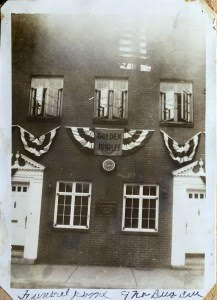
Shaughnessy Funeral Home on North Duquesne Avenue. (Courtesy Eileen Connell

Seven decades later, Eileen (now Connelly) remembers her attempts to ease her mother’s grief by lying next to her in bed and telling silly jokes. Murt, Eileen says, made a number of changes to his life. He sold the building that housed his funeral home on North DuquesneAvenue and moved the business to Second Street, across from the police station. He sold the family cabin in Stahlstown, quit drinking and attended Mass every day.

Murt remained an active member of the community and in 1983 was named “Man of the Year” by the Duquesne/West Mifflin Chamber of Commerce. He died in 1987, three years after the silencing of the town’s famous mill.

— Steve Mellon  


Hello,

My Grandfather, Steve Turlik, was one of the original members of the Zemps.  Family folklore has it that he once pitched a no-hitter and that it made the newspaper.

I tried some years ago to find this article, but at that time I assumed it was in the McKeesport paper (I didn’t know about the Duquesne paper).

I would love to find an early roster with his name on it or even the elusive article recapping that big game.

Would you know of any resources that I could use to investigate those early teams?

Thank you!

Frank Fiori

Hickory PA


Hi Jim

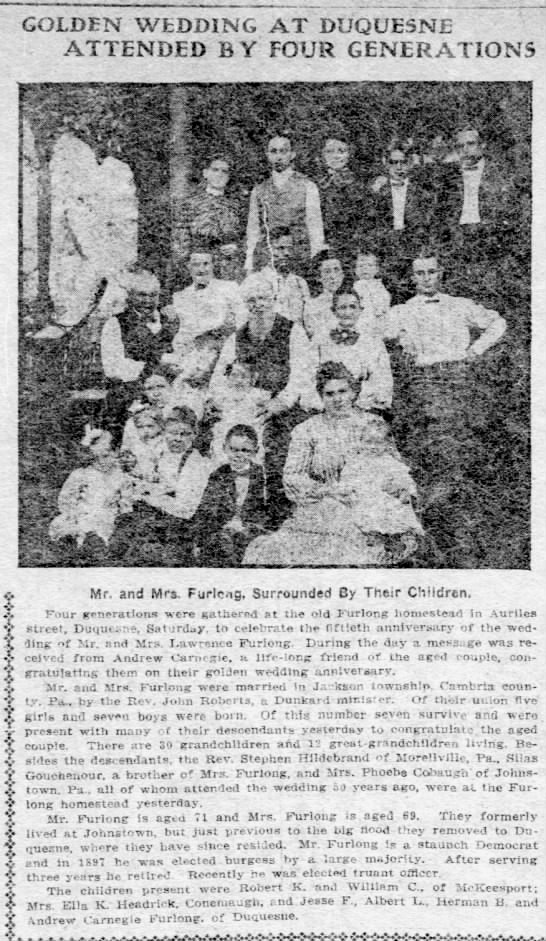
My name is Cheryl Wilson and I am the great granddaughter of Lawrence Furlong. He was the first Burgess of Duquesne, and responsible for bringing gas street lights to Duquesne, and also went around lighting them.  He also brought the first doctor (Dr. Botkin)  to Duquesne.

Attached is a copy of that article of their anniversary, but as you can see it is very hard to see the picture and also the writing. I was wondering if you might have any idea where we could get a clearer copy for our family bible and also to pass on to family who have are in family history.

I think it might have been in either the Duquesne Times of the McKeesport Daily News, since they would have been the only two newspapers in the area at the time.  I know that the picture would have been taken at their home on Earl Street.

I recently did my DNA thru Ancestry and one of the names on my list and also my cousin Bob Woods is the granddaughter of a lady in the picture, so we would balso like to get a copy for her.

Thank you for any help that you might be able to give us.

Cheryl D. Wilson


                                                                                                                                                       I recently did a Google web-search, for:

Ruben’s Quality Furniture – McKeesport, PA since 1902

I didn’t see any specific mention of …. Ruben’s ??

Do you know when it closed , or where I could locate a news article, or something (anything) about it ??  

I recently discovered a piece of furniture, with their “tag” on it …….. and was wanting to get any idea, of how-old …. it might be.

Cynthia


I just posted this on Monongehela WordPress regarding Holy Trinity Church in Duquesne. Thought you’d be interested. Love your website. The research you have done is amazing. 

Ann Marie

I’m late to the party here, I realize, but I’d like to comment that in all the articles I have read on this subject, no one has mentioned one of the main reasons that Holy Trinity Catholic Church in Duquesne was relocated to the West Mifflin location on West Grant Avenue, and there were several. And Vatican II changes had nothing to do with the move. 

When the church was built in the early 1900’s, it was built in one of the finest parts of town, with many gorgeous mansions and a beautifully landscaped area. Over the years, especially in the 60’s the area declined greatly, along with other areas of the cities. It was not safe to walk in that area at night, there were very few parking spots near the church and to worship, you had to walk several blocks sometimes. There was an illegal abortionist ‘clinic’ just a few doors down the street and drug sales in this area were rampant, not to mention the homeless and alcoholics we had to pass, who even sat on the church steps as we entered and exited for services.

In addition, the structure of the church was already declining: the wooden altar (not marble) was falling apart and had to be ‘topped’. The organ pipes were disintegrating and became like ‘sugar’ particles. The choir loft was no longer safe.

The pastor at the time held a vote of all the congregation, and it was nearly unanimous, save SEVEN parishioners: build at the cemetery, where there was plenty of land which the church owned and would not have to purchase anywhere else. The location was not far from the core of the congregation which was already visiting its deceased relatives there anyway as well as moving more north toward the West Mifflin area if not leaving the area completely. 

The church was sold to a local (Baptist?) group, deconsecrated, and few looked back. The Catholic Church in the entire Pittsburgh area was declining at the time. Decisions had to be made. I recently was ‘home’ and drove past the lot where the beautiful church stood. No one wishes more than I that that church still stood and would have been remodeled to its previous glory that some of us remember from our very early childhood. (I was an organist for the church for nearly 10 years.) But if it had been remodeled, it would almost be a stand-alone structure with nothing around it to support it, and for what purpose? The best we can say about Duquesne today is that the population seems to have stabilized recently with no further dramatic drop. Another good thing we can say is that we have many, many wonderful memories of a church structure that served many immigrant Slovaks well in their faith. Mine was planted and nourished there.


James,

I enjoy reading “The Duquesne Hunky” and I hope you will keep it current again. 

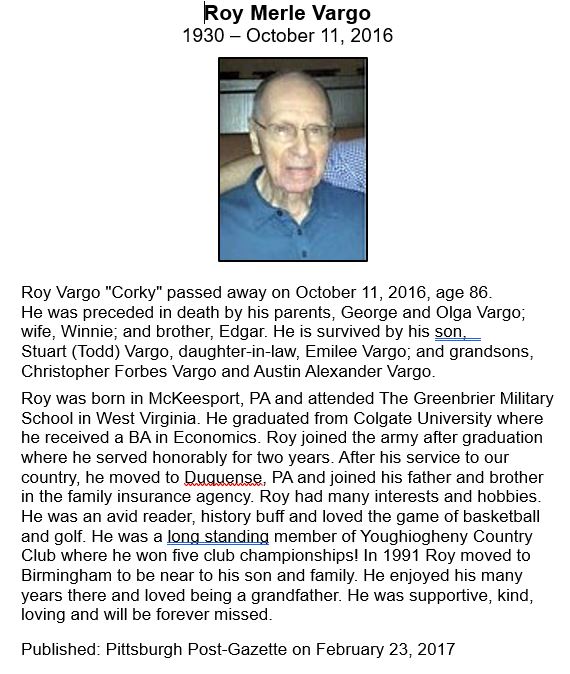
I did not live in Duquesne but, I had a relative that did Sophie Evkovich Vargo – she was a clerk at Sally’s Fashion.  Her first husband was Steve Robert Vislay and her second husband was Roy Merle Vargo.

Roy Merle Vargo parents were George Vargo Jr. and Olga Margaret Furia. He had a brother Edgar George Vargo.   The Vargo family owned the Vargo Insurance in Duquesne, Pennsylvania.

I’m doing my family genealogy and any information you have on the Vargo Family or Sophie Evkovich Vargo I would truly appreciate.

Attached is the recent death notice for Roy Merle Vargo.  Maybe your readers will remember this family.

Sincerely,

Denise Gotch

Jim, there’s way too much on your site to go through everything and so if this is old news, sorry. You mentioned listening to music or rather lack of, Terry Lee was doing an internet thing once or twice a week. I haven’t sought it out for quite a while (Pandora is easier) but it was pretty cool. He’s was selling reverse mortgages or some kind of thing for all of us old people.

BTW, don’t come to Florida waxing the virtues of our youth in Duquesne. No one has even heard of Pittsburgh, let alone Duquesne down here. If we see three Pennsylvania plates a season (when the snow birds attack us), it’s a miracle.

I was born on Polish Hill and spent most of my “growing up” across from the water tank on Highland Avenue near Mayor Kopriver’s home. His son “Buddy” used to go down to Kennedy News (or something like that) right on the corner of Peter St and Kennedy Ave and buy up all the baseball cards. We’d go with him and he’d give us the duplicates he already had. Before someone asks, no, it was not Kennedy Market, it was catty corner to them, small place, junk food for kids, I think that’s where I saw my first “Playboy” magazine.

Does anyone remember Boy Scout Week in the 50’s? Everyone had a retailer’s window down on Second Avenue; one of the images that glides past my brain every once in a while.

Cheerio, Alex Baranyi


Hello,

      Good site on Duquesne.  My Dad’s parents lived on Priscilla Ave, I can remember having to walk to St Peter and Paul Church for my Saturday classes.  As for my Dad, he passed a few years ago; born and died in Duquesne.  But I’m sure he would of wanted no other way.  And was wondering if you ever heard our name, Pinkovsky, he worked at the bar mill gate.  Ok, good site and keep up the great work, you take care.

Tony Pinkovsky

Ohio


 Jim, 

I have enjoyed your site, Thanks for your time and effort. I was born in 1959 with a lineage from Duquesne that starts with a Slovak emigrant Grandfather named Andrej Polakovic whom had 2 sons. One was John Polakovic (who changed his name to Plake) and my dad Stephen Polakovic. My uncle was the one and only teacher John Plake, and my dad worked at homestead. My childhood on 2nd street has many memories; Holy Trinity school, the barber in the alley, the Slovak club Christmas parties, etc. Once our family moved out of Duquesne to West Mifflin it never really felt the same. Anyhow, I get the Hunky part, we were all the same, just trying to live the dream. I am very proud of my roots and try to explain it to my adult 4 daughters but they somehow don’t get it. In ending, thanks again.

Mark Polakovic


Good afternoon James!

I came across your blog about Duquesne, Pennsylvania while doing some genealogical research on my great-great-grandfather. His name was John/Johan Peter Viktor Stabler and he lived on Mill Street near River Avenue. I’m trying to find out any information about that section of town. Johan subsequently moved to Clairton about 1899/1900 but I can’t seem to find information about what happened to that section of town.

If you have any information that may shed some light, I would greatly appreciate it. Thank you!

Sincerely,

Ashley Stabler


Jim,

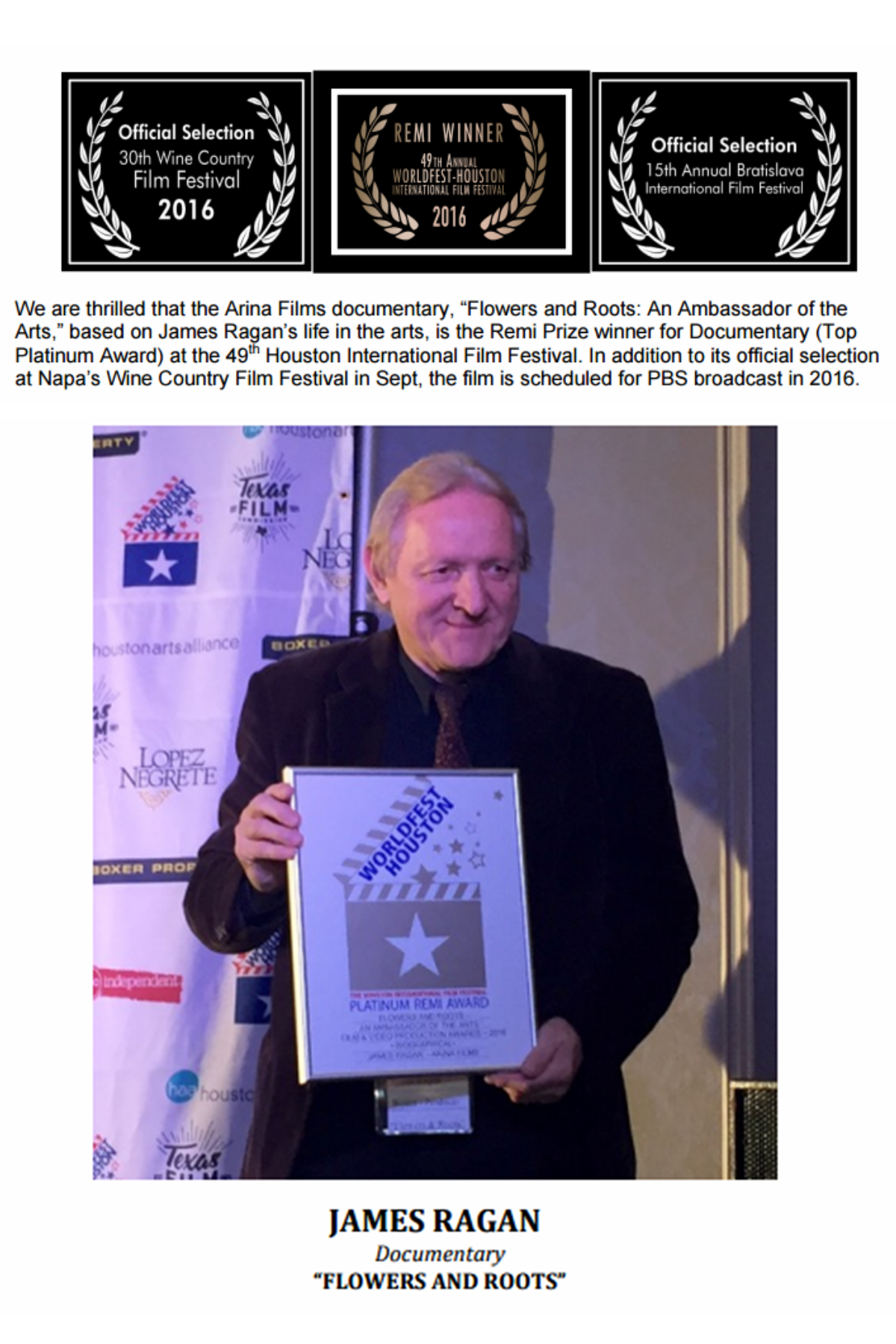
Recently discovered a living legend who was born in Duquesne, PA.  His name is James Ragan and he is an internationally acclaimed poet.  If you have not already done so, perhaps you might do a feature with him and the other three VIP intellectuals from Duquesne. (of course, I am not one of them) He is a super nice person and resides in LA.  His poetry, that I have read, is as fluid a Spring’s breeze. I like it – a lot. Perhaps, with his permission, you might in your publication, quote some of his earlier work that deals with his youth in Duquesne. 

Regards,

George Bornyek  


Posted in Christmas Memories, Church and School - Holy Trinity, Feedback From Our Friends, Food and Restaurants, Hunky Celebrations, Miscellaneous | 11 Comments

Be Sure To Tune In

Hello friends! Long time no see, or should I say long time, no hear from me. More on that later, I promise a new post very soon.

I received an email from Dennis Ragan and Jim Ragan informing me that there is going to be a special broadcast of  Jim Ragan’s documentary,“Flowers and Roots, Ambassador of the Arts,” on Sat. Nov 5 at 9 pm on “Filmmakers Corner.” Arina Films had chosen to document his life in the arts, including the influence his Duquesne upbringing and ethnic roots have had on his poetry, drama, and films, as well as his role on the international stage.

BE SURE TO TUNE INTO WQED ON SATURDAY, NOVEMBER 5th AT 9 PM.

james-ragan

Dennis, Jim’s nephew has also sent me some valuable Hunky information as we roll into the beginning of the holiday season! Learn how to make a REAL iconic Hunky dish…

“Real Potato” Halusky Class

For anyone interested in learning how to make “real” halusky like Baba (grandma) made it, I’ll be doing a cooking class at Westmoreland County Community College in Youngwood (on the Duquesne side of Greensburg).  This is the real stuff made with potatoes and flour (not noodles), a real Slovak dish brought to this country by our grandparents and great-grandparents.  The class is this Tuesday, Nov. 1, from 6 pm to 9 pm.  I do a brief talk about halusky, then we proceed to the WCCC culinary kitchen to make it.  Then we have a halusky meal afterward. I’m from Duquesne of course and have been teaching this course for about seven years.  WCCC charges a tuition fee of $22 plus $5 material fee. To register, contact Sylvia Detar, director of Continuing Education, at WCCC.  800-262-2103 x 4190 or email her at detars@wccc.edu

Posted in Duquesne History, Duquesne's Special Citizens | 4 Comments

My Christmas Memory Quilt

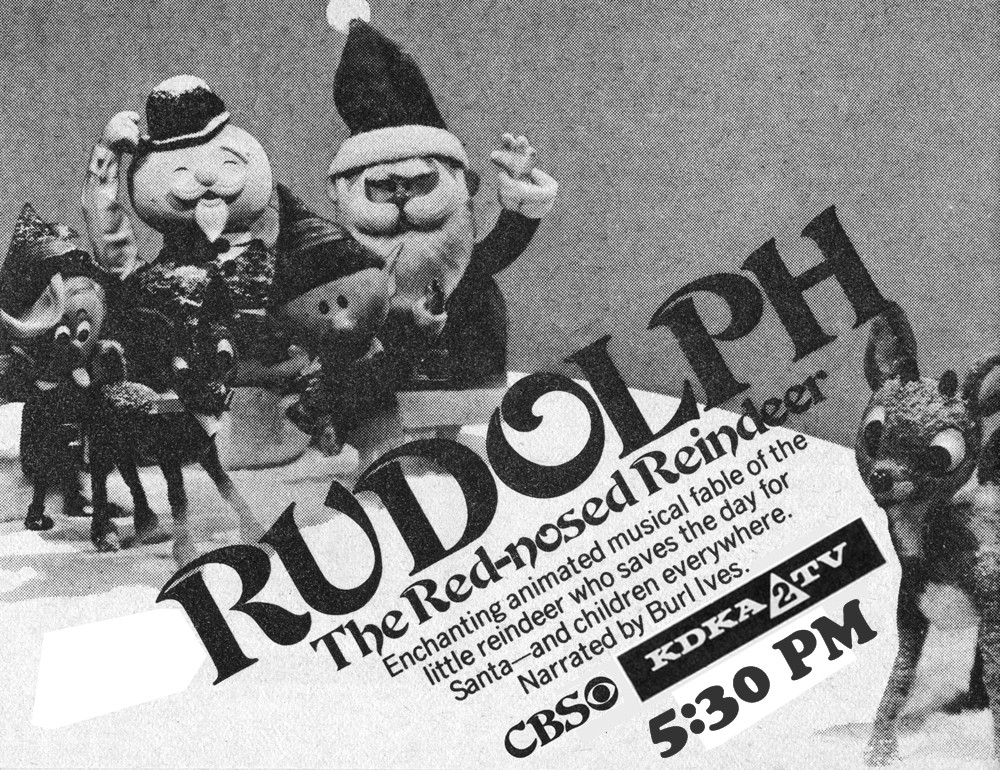
RudolphA few nights ago, I sat and watched the perennial Christmas TV Special, Rudolph the Red-Nosed Reindeer. Not an unusual thing for one to do, except if you consider that I’m 64 years old, and I was alone! However, I was not about to break my viewing streak of 50 years! Since Rudolph was first aired on December 6, 1964, I have watched it every single year. This year marked the 51st consecutive year for me. Some people take on the Boston Marathon or Tour de France, but this little hunky tackled Rudolph the Red-Nosed Reindeer!!

I believe my real reason for watching the show year after year is a simple one. I recall watching the program with my mom in 1964. We watched it on our black and white Zenith TV set. There was a light snowfall that evening, and the temperature was in the lower 20’s making for perfect Christmas special viewing weather. I remembered the details so vividly, as that was the one and only time I was able to enjoy the show with my mother. She passed away the following August at 45 years of age. Each year since ’64, that memory returns, and an emptiness is filled in my heart.

When you get right down to it, the holidays are all about those very unique and very personal snippets of memories that occurred throughout your life at Christmastime. There were the traditions which families had continued for decades on end; such as the cutting down the family Christmas tree, making holiday cookies together, the Christmas Eve Valeija or perhaps attending Midnight Mass together.

Our family’s tradition could be easily described as the cadence of Christmas visits that began on Christmas Eve and culminated on The Feast of the Epiphany. Every evening between the two days meant a visit to an aunt for uncle or a visit FROM the entire gang. Considering that I had a total of 21 aunts and uncles living in the immediate area then add in about 30 cousins, and each night was one crazy Hunky Hullabaloo!

When I think of MY Christmas memories, I certainly remember the visits and parties, but I also recall tidbits of memories that come together to mentally form my own sensory patchwork Christmas quilt.

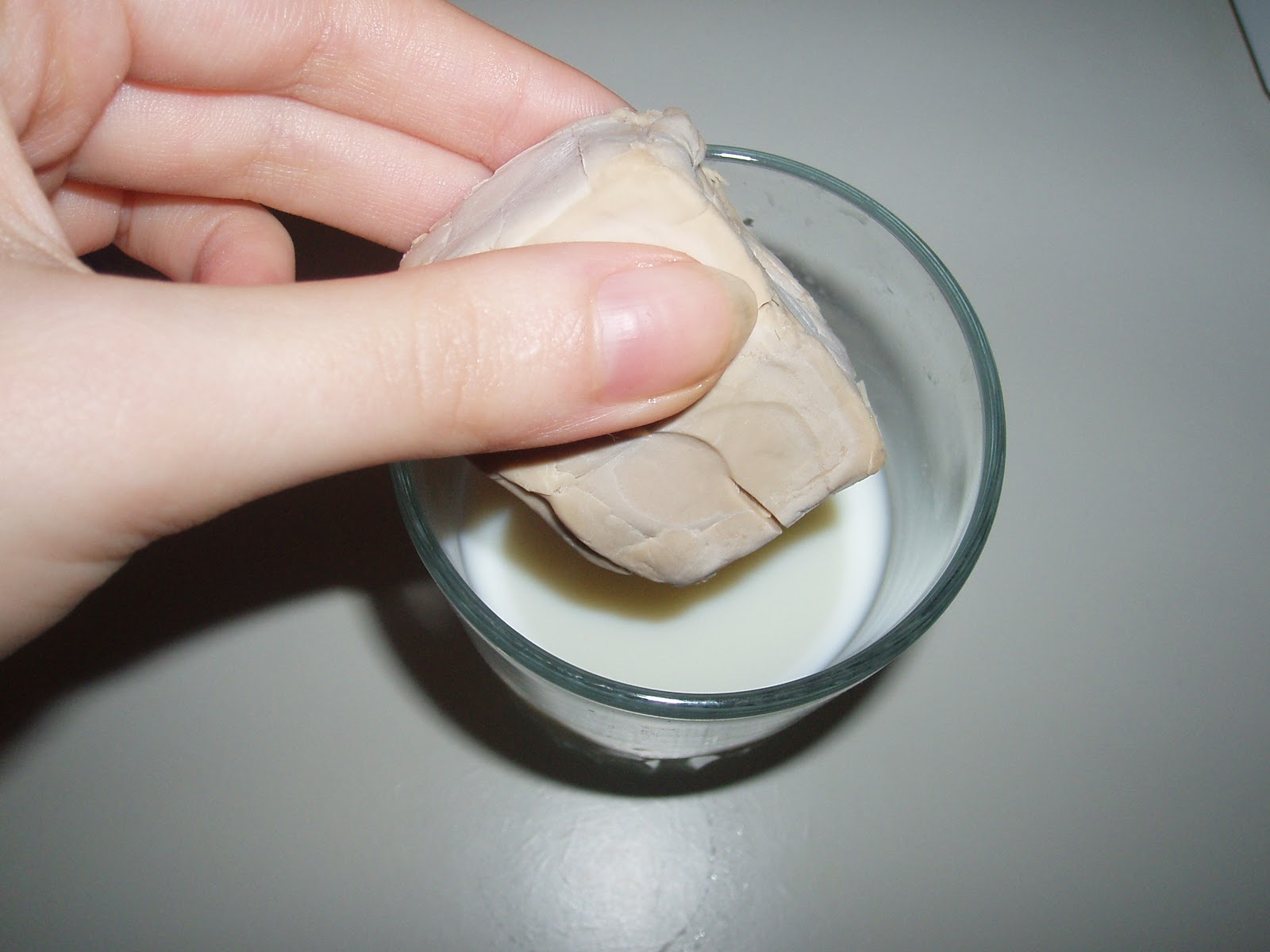
  • Among the multitude of the patches that are part of MY quilt, there would be one patchYeast that helps me to remember the very distinctive aroma of yeast cubes being dissolved in milk on the stove. It seems that every home in the neighborhood began preparing their poppy seed and nut rolls during the same week. If I happened to be visiting a friend or a relative, I was also quick to pick out that aroma and knew that before the visit was over, I’d be enjoying a freshly baked slice of poppy seed roll.
  • Another patch would represent another distinctive holiday smell. My parents purchased their first artificial Christmas tree in 1963. With that tree’s arrival, several sets of new multicolored mini-lights arrived as well. Sadly, that meant that the blue C7 lights we used on the live trees in years prior were retired and eventually discarded. Although we were all excited about the new tree and lights, it took years before I realized how the new tree impacted a piece of my memory.

d91ba0486b8acb1ebcbc3f665533e247Like most families in Duquesne, we chose our live Christmas tree from one of the many lots that would spring up throughout the area. Each one looked the same with strings of white lightbulbs illuminating the huge assortments of fresh pines, and an old oil drum with a toasty fire to stand next to and keep warm. Dad would pick out the best tree, get an ok from my brother and me, gather up a bundle of extra branches, tie the tree in the trunk and then head up Kennedy Avenue towards home.

Once we arrived at home, Dad would immediately show the tree to Mom and try to convince her that it would fit in the house AND he can add branches to make it the perfect shape. Once he had moved the tree into our garage, he’d begin to drill holes into the trunk and insert the extra branches around the tree until he created the “perfect tree.” As he drilled the holes into the fresh pine tree trunk, the garage was filled with the scent of pine from the sap that was released and the heat that was generated from the drill bit as it was doing its job.

After Dad had finished shaping the tree, he would move it into the house and the nextour tree with us step took place. Dad was in charge of stringing the blue Christmas lights onto the tree. He would meticulously clip each light onto the tree in a precise location. He said he wanted to be sure it looked nice and full, and bright. What followed the satisfactory blue light placement was yet another very distinctive smell that to me, only meant that it was Christmas. Each year, my father would flock the tree with can after can of spray snow. Aside from the toxic fumes that were released when he was spraying (he made us leave the room and go up to our rooms,) however, it was the smell of the spray snow as it dried on the hot C7 bulbs that I recall. The fact that my dad never tried to remove the snow from the bulbs resulted in years of residue on the bulbs, however it never caused an issue.

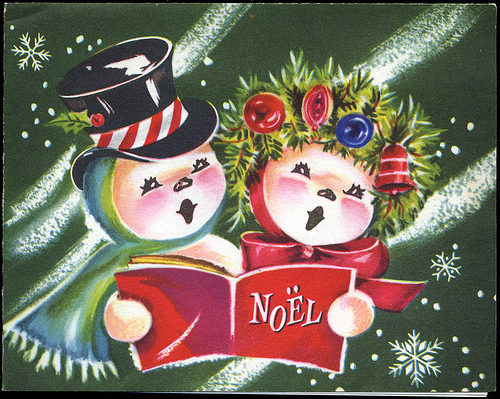
  • A piece of my memory quilt would be reserved for Christmas cards. My recollection isn’t anything unusual except when compared to what occurs now. I remember the hours and hours Mom would spend at the dining room table addressing all of the cards. Typically, she would send out 100 or more cards as a result of our large family, my parent’s many friends, and my dad’s customers from his auto repair business. There were piles and piles of outgoing cards stacked on the table, each appropriately stamped with their 4 cent stamp, neatly addressed and bundled with twine according to where they were being sent. Approximately 2 weeks before Christmas, my dad would drop the bundles of cards off at the Duquesne Post Office on Second Street. 

1950sChristmasCardRoadsidePicturesFlickrI always looked forward to the reciprocal nature of sending cards back then. In the weeks before Christmas, our mailbox would be overflowing with incoming holiday greetings. My job was to open them up with my mom. She in turn would check off the sender’s name in her red Christmas card ledger book and make sure the return address on the envelope was the same as the address she had sent hers to. We would stack all of the cards that we received into a small wooden sleigh that sat on our buffet during the Christmas season. By Christmas Day, it was overflowing!

What a contrast to today’s society, myself included. I probably send out a sum total of 20 cards. One box of cards is always enough. Of course, the cost of the postage for the 20 cards alone is more than double the cost of sending out 245 cards in the 50’s. I certainly miss receiving the cards. Opening an email with a Christmas greeting is great, but it isn’t the same as opening an envelope and getting a cascade of glitter in your lap!

There are so many other bits of sights, sounds and smells that add more and more substance to my quilt of Christmas memories including:

  • The sound that the foil Christmas bell decorations made each time they hit the window when the wind blew.
  • The whistling sound of the wind through our windows on snowy nights in spite of the storm windows that were hung each year.
  • Watching my mom make some of the traditional food that we had for our visitors each year. Grinding beets, making stuffed cabbage, cooking and slicing a huge ham, peeling green onions and so on. Mom always found a way to allow me to help and always made me part of the fun, although I doubt she would have called it that!
  • Driving past Holy Name School and seeing all of the classroom windows that had been decorated with poster paints in an array of Christmas themes.
  • Attending children’s Christmas parties at the Duquesne Annex, the Slovak Club, the Croatian Club or the Moose and coming back with a bag of goodies.
  • Listening intently to the radio each day for an occasional Christmas song to validate that the holiday was really coming.
  • Watching Christmas cartoons while lying on the living room floor with my feet propped up on the wall over the heating vent. (This always irritated Mom.)
  • The beautiful amber glow of snowfall when looking out our windows at night on Thomas Street.

What a wonderful time to think back to all of the special memories that make up your own Christmas Quilt. Share with us if you would like by commenting on this post. Perhaps the mention of your own special memory will trigger warm memories for someone else. Let’s keep the spirit of community alive!

Amber snow


Posted in Christmas Memories, Wintertime | 32 Comments

Once Upon A Time

Even though Christmas Day and New Year’s Day, 2015, are behind us now, I decided to check the Duquesne Times from 100 years ago. I wanted to gain some insight into how the holidays were celebrated and reported in 1915. What I discovered was an amazing chronicle of “life, the way it was,” reading more like a page from a Mark Twain book.

When you pick up a newspaper today, you’re confronted with accounts of war, terrorism, corruption and scandals. However, when I began to explore the January 1, 1915 issue of The Duquesne Times, was inspired as well as amused by the stories that were published.

I also was amazed at some of the feats that Duquesne’s citizenry accomplished in that era. For instance:

  • Did you know that Duquesne’s Community Christmas Tree in 1915 was 45 feet tall?
  • The 1st National Christmas Tree did not make its debut until 4 years later in 1923 AND was a mere 3 feet taller that Duquesne’s 1915 tree.
  • The Community Christmas Tree was not lit until Christmas Eve in 1915, not a month ahead of time.

Beyond the wonderful account of the holiday celebration, there were several other stories that I knew I had to share with you. From pigs to geese to a boy who parties a bit too much, here are a few articles I’m sure will put a smile on your face to start the New Year off right! – Enjoy!!

I really enjoyed seeing the picture below and reading the description of that very event as it occurred. Although the picture is dated 1915, the article following the photo was published one week later on New Year’s Day, 1915.

christree1Tree

 I would chalk up the following story from the same 1/1/1915 edition of the Duquesne Times on a slow news day, but the paper was full of similar lighthearted fare. Sure beats  reading about ISIS!

Silly Goose


Goose

 Obviously, the use of today’s politically correct terms for handicapped people was not an issue in 1915. Its a good thing some things have changed for the better.

Here’s another wonderful article from the Times. I can just imagine what this must have looked like when it happened.

Hog Wild pIC

Hog Wild On a slightly more serious side, here’s an account of a young man who apparently “partied like it was 1999!”

Drunk


Oh, the joy of youth!!

Now, to report on yet another newsworthy item:

Chicken Heist

Project1


An so, as businesses, and especially schools gear up to start anew after the holidays, the following cartoon from page one of the Duquesne Times about sums it up.I hope you all have a FANTASTIC Holiday Season!!!! Happy New Year my friends!

All Over


Posted in Christmas Memories, Duquesne History, Hunky Celebrations, Life in General, Wintertime | 10 Comments

Only In My Dreams!

This year, Christmas, more than any other recent Christmas, has been very bittersweet for me. Although it truly has been a blessed year with the birth of my newest grandson, Mason, this Christmas seems to be a struggle for me.

As you all know, Christmas when I was growing up in Duquesne was all about family. The entire time between Christmas and New Years was a social whirlwind. My mom and dad and brother visited every aunt, uncle and cousin during those seven days. The season was joyous and happy beyond belief. By New Year’s Day, we were all ready for the traditional pork and sauerkraut meal after a week of ham, stuffed cabbage and poppyseed rolls! I would love to be able to spend a Christmas, just one more time, back home.

I leave tomorrow, Tuesday, to visit my daughter, son-in-law, and two grandsons in Philadelphia, and I am super anxious. Unfortunately, my wife and I will be driving back home on Christmas Day, so our excitement will be short-lived, but such is life.

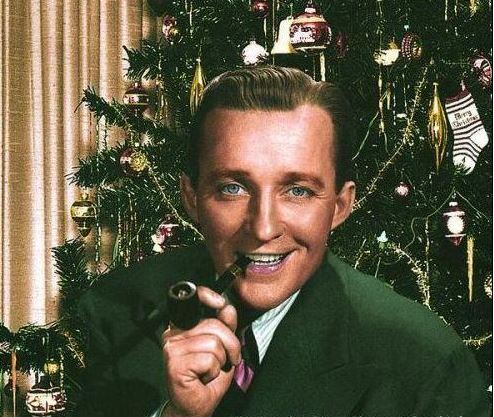
bingI am reminded of Bing Crosby’s hit, I’ll Be Home For Christmas, right now. I found out this year that it was one of my mom’s favorite Christmas songs, and I understand why. On a happier note, I am reposting a few previous articles that I wrote previously to conjure up some very special memories of Christmas in Duquesne. I hope you enjoy them.

Merry Christmas Everyone!!!


I’ll be home for Christmas,
You can plan on me
Please have snow and mistletoe
And presents on the tree 

Christmas Eve will find me,
Where the love light gleams.
I’ll be home for Christmas
If only in my dreams. 

There is a wonderful story that relates to this song and it occurred the very same Christmas this holiday classic was first released. While I’ll Be Home for Christmas was not written about this account, it very well could have been.

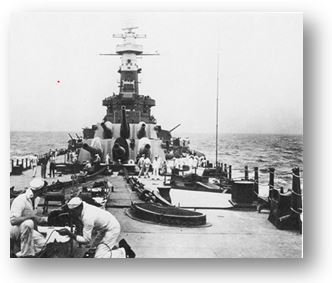
The story is about the crew of the Battleship North Carolina, and it will now forever be cemented in my mind when I hear I’ll Be Home for Christmas around this time of year.

The story goes that around Christmas in 1943 the chaplain onship the Battleship North Carolina knew that the crew was feeling homesick as they were expected to still be overseas during the holiday season. He had an idea and collected $5 from every crew member that had children back home.

The chaplain made a list of all that gave him money for their children at home and he sent that money along with the addresses of the sailor’s home to Macy’s department store. The request was made for Macy’s to buy gifts using the money provided for the crew’s family and have the gift mailed to their homes in time for Christmas.

As Christmas approached, the service men on the ship gathered for the annual Christmas show that involved songs, skits and entertainment for the troops aboard the Battleship North Carolina. When the entertainment had ended, the chaplain had a surprise to reveal.

When Macy’s had received the money from the chaplain along with the list of the addresses, they thought that in addition to just giving gifts to these military families at home, they should give a one of a kind gift to the soldiers as well. Since they had the addresses for all the sailors’ homes, they reached out to each family and asked if they wanted to come to the Macy’s store and send a special message to their loved one who would not be able to be home for Christmas.

The mean aboard the Battleship North Carolina sat there and saw their wives, children and loved ones appear before them on the screen as Macy’s had videoed each of their families sending them a Christmas message. These rugged sailors watched, wept and rejoiced. They weren’t home for Christmas, but what made their homes special was the Christmas gift they received on that December 25th in 1943.

Now that you know this story you can see how that sentiment is also found in the song, I’ll Be Home for Christmas. I know that I can’t hear that song without thinking of the brave men and women serving overseas to protect the freedoms we all enjoy.

– – – – – – – – – – – – – – – – – – – – – – – – – – – – – – – – – – – – – – – – – – – – – – – – – – – – – – – – – – –

Jim and Steve SantaPerhaps some of my fondest memories growing up in Duquesne are those associated with the Christmas season. Being part of a HUGE hunky family, Christmas always meant LOTS of celebrating, visiting and fun.

Each day leading up to Christmas brought more and more excitement. Christmas activities and preparations never really began until well after Thanksgiving, quite different than the present day “overkill” that exists. In our house, timing always seemed to be centered around “how long will it be before the tree drops its needles?”

The concept of an artificial was not even in the vocabulary of people in those days. The irony is that my dad, in his own way, created an artificial tree of sorts. You see, he was never satisfied with the shape that the good Lord had bestowed on any Christmas tree he decided to purchase. Instead, he spent at least two days, tucked away in our freezing cold garage sculpting the “perfect tree.” In addition to any “Charlie Brown” tree that he had drug home, he also brought piles of extra greenery. He would spend hours and hours drilling into the tree truck and inserting the extra branches until the tree took on the “perfect” shape! I remember being in the garage with him, coaxing him to hurry, and all the while enjoying the crisp, clean smell of fresh pine needles and pine sap.

Once Dad had completed that transformation of our Christmas tree, he would then begin the next step of the transformation. For the next couple of hours, the garage became an indoor blizzard of sorts as my dad began spraying each and every branch of the tree with artificial snow. Within a short amount of time, a perfectly shaped white Christmas tree stood ready for its entrance into the house. Transformation completed, the last step was to let the tree stand overnight in a bucket of water that had been laced with aspirins. The aspirins apparently had some mystical power to extend the life of the tree. Hey, it works for humans with heart issues, why not trees??

Our white flocked tree was always decorated with blue lights. There was always that special smell the lights had when they were first lit up for the year. The scent may have just been my excited imagination that sensed the smell, or it could have been the hot lights next to the fake snow or the crusty old frayed wires heating up that caused the smell. Fortunately, the magic aspirin always did its job and prevented any smoky result!

The introduction of the tree into the house and then the lights to the tree always seemed to produce the discovery that at least a dozen of the blue lights were burnt out. Of course for some reason, my dad and mom would never anticipate this dilemma, and Dad and I would soon be out and about to buy a few packages. The trip always took us to one of my favorite haunts, a virtual  wonderland in Duquesne, Schink’s Hardware Store on Grant Avenue. As we drove down Grant Ave. on the way to Schink’s, the traditional street decorations shined brightly as we drove under each one. Although they were simple in design by today’s standards, to me they are legendary! Simple straight wires with multicolored standard incandescent light bulbs provided the magic. In the center of the span was a circle of the bulbs that I suppose symbolized a wreath. These light strings were alternated with similar lines of lights which held three oversized illuminated bells. Each bell in the set of three would blink independently in order  to try to created a special effect of sorts. Hey, I was a kid, it worked for me!!

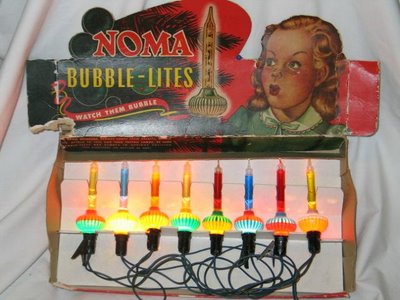
Schink’s always had their Christmas items gathered into one area of the store. Since energy conservation was not a thought in anyone’s head in the 50’s, the lighting area glowed with Christmas lights. There were no mini-lights that are used today virtually everywhere. There were basically light sets in two sizes, small bulbs for indoors and larger bulbs for outdoors. Of course, there were one type of lights that we unfortunately were unable to afford, bubble lights!

After our excursion to Schink’s, Dad and I made our way back home to finish the tree.  The ornaments were the same from year to year. No theme, just tradition. There were drummer boys, angels, Santas and snowmen that were all made of wax, As fragile as they were, somehow my mother always was able to keep them intact from year to year. There were silver colored filigree bells and shiny bright silver balls as well. Our tree top was an angel of course, and when the tree was lit, the blue, silver and white looked magical.

The tree seemed to kick off our holiday season and the holiday preparations! Things seemed to shift into high gear at that point and didn’t stop until well after Christmas Day. Check back later and see what I mean!

Merry Christmas!

Veselé Vianoce

– – – – – – – – – – – – – – – – – – – – – – – – – – – – – – – – – – – – – – – – – – – – – – – – – – – – 

My mother was Croatian, my father was Slovak. As a result, I was immersed in two different Eastern European cultures, each with their own set of traditions. It seems that these traditions came to the forefront during the holiday season.

As a Slovak, I was fortunate to be able experience one of the most beloved Christmas traditions, the Vilija (pronounced vă – lē´ -yă.) Vilija is the traditional Christmas eve gathering and dinner that is rich with traditional foods, religious symbolism and family.

The vilija continues to this day in my family, and although the venue may have changed, the traditions and symbolism remains intact. What an incredible testimony and homage to the parents, grandparents and hunky culture that helped to set our moral compass.

As part of this posting, I have included a 2005 article from the Pittsburgh Tribune-Review by Karin Welzel. The author does an outstanding job of explaining the tradition, the content and the meaning behind the celebration. Rather than be redundant, allow me to give you my impressions and memories of the event as I experienced it in the 50’s.

The vilija always took place at my Uncle Gary and Aunt Helen’s home in West Mifflin. Just like a scene from “A Big Fat Greek Wedding,” I remember entering their house and immediately getting drawn into the crowd of family that were already preparing the feast.

Their home was always decked out with Christmas decorations galore and every light in the house seemed to be burning. Usually, by Christmas eve in Western Pennsylvania, the weather had usually taken a definite turn and it was normally either snowing or on the verge of doing so. For that reason, whenever I entered their home, it felt so toasty warm compared to the outdoors. Their windows were usually steamed up from all of the cooking that was occurring and from the cranked-up thermostat (Grandma was always cold you know). And then there were the smells! The freshly cut Christmas tree scent hit me as soon as I entered the house. (It must have been the magic aspirins!) Combined with the smell of fresh pine was the amazing aroma emanating from the kitchen and dining room.

All of my aunts were buzzing around a rather cramped kitchen preparing all of the traditional foods. Somehow, all of the foods which were part of our every day lives growing up as a hunky smelled so much better on Christmas Eve!  Stuffed cabbages, pirogies, kielbasa and poppy seed rolls smelled like food for the gods! I was a very picky eater in those days, but somehow, a became a modern day foodie during the vilija.

My uncles had the responsibility of creating a dining surface large enough to accommodate our ever growing family. Since my dad was one of 8 children, the number of people attending was quite large. There was no such thing as a “kids table” in those days, so the eating surface had to accommodate approximately 25 people PLUS the feast itself. The table was usually assembled using two tables which supported large sheets of plywood. It was at least 16 feet long, extended from the dining room into the living room and was always covered with crisp white linens. There were never any decorations on the table, only food, lots and lots of food! The chairs that surrounded the table were a potpourri of chairs from around the house, the out-of-town neighbors and often times from St. Michael’s Church hall. Your seat may not have matched with the neighboring chair, but every family member had their place.

The timing of the dinner was very strategic. It was essential that we ate and were finished with dinner by 6 p.m. In those days, it was important that we allowed for the correct about of time before receiving communion at midnight mass. The Roman Catholic Church has very specific rules governing communion.

Grandpa would always begin the vilija with a blessing. This would be followed by the passing of oplatky (non-blessed communion bread). We would pass a large square piece of oplatky and each person would break a small piece off to be consumed in unison at the end of Grandpa’s blessing. I remember tha the oplatky would always come to the table in an envelop that was decorated with a colorful representation of the birth of Christ.

Once we had taken our oplatky, the feast began. With amazing speed and dexterity, plates and bowls of food were passed around the table and plates were loaded up to the max. Jokes, teasing, memories, and plans for the holidays were just some of the discussions that occurred during the meal. My dad would always be yelled at by my mom and my Aunt Helen for something he might have said to instigate some trouble, but that was expected, and welcome. After the main courses were completed, out came platters and platters of goodies. Poppyseed, apricots and walnuts seemed to be part of every creation. Each would probably be capable of clogging any artery in the room, but somehow, it either didn’t happen or didn’t matter in those days. Naivety was bliss in those days.

Once the dinner was over, my aunts would begin clean-up. Sexist or not, that was the way it was in those days. The men would gather and have some celebratory “shots” and beers, the kids would share their wish lists with each other and the ladies would clean-up the remnants of the feast. There seemed to be an unspoken exception to the communion rule in our family that shots and beers didn’t count when it came to abstaining before communion. Go figure.

After everything was in order, each family departed to get ready for midnight mass at their own parish church. Fully stuffed and raring to go, the remainder of the Christmas Eve activities still laid ahead.

More later………


Celebrate Slovak Style

By Karin Welzel
TRIBUNE-REVIEW
Sunday, December 11, 2005

From the straw scattered under the dining table to the honey that is spread onto thin oplatky to share among diners, the Slovak Christmas Eve meal — called the Vilija table — abounds with religious symbolism.

Christmas Eve is the most awaited day of the Christmas holiday season, according to Albina and Joseph Senko of Mt. Lebanon, members of Western Pennsylvania’s Slovak community.

“The big day is Christmas Eve rather than Christmas Day,” says Albina Senko, a native of Spis in Slovakia. She is a director of the Western Pennsylvania Slovak Cultural Association, founded by her husband in 1997.

A certified public accountant with McKeever Varga & Senko and a certified financial planner, Joseph Senko also is honorary consul to the Slovak Republic.

The Senkos continue to observe the customs and traditions of their ancestry — Joseph Senko was born in Pittsburgh to Slovakian immigrants — and have made it a personal mission to educate Slovak-Americans and the general public about their culture. They are Roman Catholic, as are most of the inhabitants, but they say Byzantine and Orthodox Rite worshipers might follow similar traditions. Slovakia features a wide variety of dialects and customs, varying from region to region, village to village, family to family.

Albina Senko has her home decorated Slovak-style, including a table-size tree festooned with edible ornaments, such as whole walnuts and wrapped candy. There are intricate ornaments made from straw. On larger trees many years ago, family members used apples, paper roses and candles for decorations, too. The top of the tree often was a star made from straw.

Slovak cooks are busy on Christmas Eve, Albina Senko says. Sauerkraut-mushroom or pea soup, bobalky (sweet dough dumplings) and a variety of fish are a must, as well as meatless pirohy, to maintain the fast observed by the faithful during Advent, which begins the fourth Sunday before Christmas.

In anticipation of the celebration, hay or straw is placed under the tablecloth or under the table — or both places — to symbolize the poverty of Christ in a humble manger. Some families place straw in the center of the Advent candle wreath, Albina Senko says, and a figure of the baby Jesus is placed on top.

The table is covered with a white cloth as a symbol of the swaddling clothes of the Christ child. Another tradition is to set an extra place setting to receive a stranger or in honor of a deceased loved one.

The dinner starts at the sighting of the first star of the evening.

“You tell the youngest child to look for it — it may be that it’s just to keep them occupied, because there is a lot of expectation,” says Albina, adding that there is just as much merriment at her house for Christmas Eve now as when her six children were small. She has grandchildren who are excited about the lights, the dinner and gifts.

After the house and table are blessed using a pine bough and holy water, a mulled red wine steeped with cinnamon sticks or herbs and honey is served to diners. Albina Senko sweetens her wine with cranberry juice, cinnamon-sugar and a dash of nutmeg.

The ceremony then focuses on a waferlike “bread” called oplatky (altar bread) that is broken, dipped in honey and distributed to each family member, starting with the husband to his wife. The head of the household dips his thumb in honey and makes the sign of the cross on the foreheads of each member of the household so they will be reminded to keep Christ foremost in their thoughts and praying that harmony will sweeten their lives.

Part of this ceremony focuses on daughters who are eligible for marriage.

Says Albina Senko: “The mother takes honey on her finger, makes a cross on their heads and says, ‘May you be sweet and find a husband soon!’ I did it with my own daughters.”

The next course usually is a tart soup — sauerkraut and mushroom is a popular choice — to represent the bitter destiny of Christ and his suffering for humanity. The family then loads up their plates with bobalky, sweet dough balls baked and mixed with sauerkraut or poppy seeds, symbolic of a plentiful crop. Joseph Senko likes a topping of cottage cheese on them, too.

Platters display a variety of fish that has been floured and quickly sauteed in oil. Because Slovakia is land-locked, carp and trout are common, but Albina Senko likes white fish such as tilapia to grace her table.

Also served are pirohy stuffed with fillings ranging from sauerkraut to cheese and potato; and English peas, which represent a bountiful growing season. Albina Senko folds peas into a mayonnaise-rich potato salad; other families fold peas into hot mashed potatoes. Holubky are cabbage rolls stuffed with ground mushrooms and rice.

The Vilija ends on a sweet note, with nut and poppy seed rolls. Walnuts in the shell and apples also are placed on the table.

None of the foods contain meat, still keeping with the Advent fast.

To wrap up the meal sweetly, Slovaks traditionally serve kolaci, pastry rolls made with sweet dough filled with poppy seeds, dried fruit or nuts.

In recognition of the empty seat at the table, none of the food is removed from the table after the diners are finished. “It’s for the people who couldn’t be there,” Albina Senko says. Before midnight in Slovakia, the animals in the barns are given remnants of the meal — the food from the table is supposed to make them healthy and productive for the coming year.

The Senkos host tours regularly to Slovakia to acquaint Americans with their culture. Albina Senko is a retired travel tour operator, as well as a frequent translator for Slovakian visitors and officials who visit Pittsburgh. It is their wish to improve the lives of their countrymen across the sea and bring Slovakian culture into the homes of the general public.

These traditional dishes of a Slovak Christmas Eve table feature simple, earthy ingredients — plus a bevy of sweets.

Slovak Christmas Eve Soup
(Sauerkraut Soup)

This recipe is adapted from one by Albina Senko, a native Slovakian who lives in Mt. Lebanon. Senko is from Spis in the northeast region of the Carpathian Mountains. Although Slovakia is only about the size of West Virginia , with 5.5 million people, Senko says, there is a lot of variety in customs among the towns and villages.

  • 2 tablespoons vegetable oil
  • 1 medium-size yellow onion, chopped
  • 1 cup sliced mushrooms
  • 1 can (16 ounces) sauerkraut, drained but rinsed only lightly
  • Water
  • Paprika, to taste
  • Salt and ground black pepper, to taste
  • 1 vegetable bouillon cube, optional
  • 1 carrot, sliced
  • 1 potato, peeled and diced

Heat the oil in a soup pot. Add the onions and mushrooms and saute until translucent. Add the drained sauerkraut, water to cover the sauerkraut, paprika, salt, black pepper and the bouillon cube, if desired. Let simmer — do not boil — adding more water so you still have broth.

Add the carrot and potato and simmer until tender, for about 15 to 20 minutes, adding more water as needed to keep a souplike consistency.

Bobalky

These bite-sized dumplings can be made from frozen and thawed sweet bread dough to save time. Form portions of the dough into 1-inch rolls, then cut small pieces and bake. The National Slovak Society offers this recipe.

  • 1 package active dry yeast
  • 1/2 cup lukewarm water
  • 1 teaspoon salt
  • 2 tablespoons granulated sugar, divided
  • 6 cups all-purpose flour, more for dusting board
  • 1/4 cup vegetable oil, more for greasing baking sheet
  • About 2 cups tap water
  • Boiling water

Dissolve the yeast in the lukewarm water. Add the salt and 1 tablespoon sugar. Let set to proof, for about 10 minutes.

Sift together the flour and remaining 1 tablespoon sugar. Add the yeast mixture, 1/4 cup oil and enough of the 2 cups tap water to make a workable dough. Knead well. Let the dough rise until doubled.

Meanwhile, grease a cookie sheet with oil.

Punch down the dough. Cut off portions of the dough about the size of an egg. Roll each out on a floured board by hand to make rolls about 1 inch in diameter. Cut into 1-inch pieces. Place the pieces on the prepared cookie sheet and let rise for about 20 minutes.

Heat the oven to 350 degrees.

Bake the dumplings for about 10 minutes, or until lightly browned. Let cool, then separate. Place in a colander and pour boiling water over them. Drain quickly to prevent sogginess.

Combine these mixtures with half of the bobalky.

Sauerkraut: Saute 1 small onion, chopped, in 2 tablespoons vegetable oil. Add 1 pound drained sauerkraut. Cook for about 15 minutes. Add to half of the bobalky.

Poppy seeds: Combine 1 cup ground poppy seeds, 2 tablespoons honey and 1/4 cup water. Add to the remaining bobalky.

Oplatky

Commercially prepared Oplatky — the thin wafers coated with honey and then broken at dinner on Christmas Eve and shared among diners — is available from specialty food markets, Slovak and Polish churches and can be purchased through the Internet. Or, you can make your own, using a hot iron form or mold. This recipe is from the National Slovak Society.

  • 5 cups all-purpose flour
  • 1/4 cup granulated sugar
  • 5 teaspoons butter, melted
  • 2 cups cold milk
  • 3 3/4 cups cold water

Combine all ingredients in a large bowl until the mixture has a “pancake” batter texture — smooth and thin. Pour small portions — about a heaping tablespoon — onto a very hot iron form or mold.

Makes 98 oplatky, about 5 inches in size.

The Slovak Christmas Eve dinner does not contain dairy or animal products because the day before the Feast of the Nativity is one of strict fast and spiritual preparation. Here are some foods likely to be served. Their appearance depends upon whether the family is Roman Catholic, Byzantine or Orthodox.

Bandurky — Potatoes, usually boiled, to which onions sauteed in oil have been added. Many families prepare potatoes that are mashed and mixed with peas or prunes.

Bobalky — Small balls of dough prepared with honey and poppy seeds or sauerkraut

Borscht — Beet soup sometimes prepared with cabbage

Fasolji — Prepared brown bean paste spread onto bread

Garlic — Eaten raw on the Christmas bread dipped in honey, intended to keep away the evil spirits

Holuby — Cabbage rolls stuffed with ground mushrooms and rice

Hribi — Mushrooms sauteed with onions in oil

Kapusta i bandurky — Sauerkraut mixed with grated potatoes

Kasa — Rice, sometimes served as a separate dish with zapraska or macanka over it as a gravy

Kvasna Kapusta — Sauerkraut

Loksa (Loksha) — Unraised biscuits

Med — Honey, symbolic of the sweetness of being with the Lord.

Mezanec — An unleavened Christmas bread usually dipped in honey and eaten with a slice of raw garlic

Orehi — Nuts

Pagac — Two layers of dough between which cabbage or potatoes have been spread, then baked

Pirohy (often spelled pierogies) — Dough packets filled with sauerkraut, potatoes, sweet cabbage or prunes

Riba — Fish, usually a white fish baked or smoked, which is symbolic of the Christian faith because Christ was the fisher of men

Sol — Salt

Suseni slivki — Stewed prunes

Zapraska — A thick brown sauce used to prepare various soups and gravies. Among the soups prepared with Zapraska base:

Macanka (Machanka)— A thick mushroom soup

Sauerkraut Soup, with sauerkraut juice added. Usually single ingredients such as green beans, peas, lima beans, mushrooms or butter beans can be added.

Lima Bean Soup

Mushroom-Sauerkraut Soup

Green Split Pea Soup

Caraway Soup

Green Bean Soup

Rice and Mushroom Soup

— National Slovak Society, Canonsburg

– – – – – – – – – – – – – – – – – – – – – – – – – – – – – – – – – – – – – – – – – – – – – – – – – – – –

When I was just a wee one in Duquesne, I remember shopping at Christmas with my mom. Although it is had to imagine if you visit Duquesne today, but as I was growing up, there were a number of shops and stores where my mom enjoyed. The shopping Mecca in Duquesne, as I remember it, was primarily located on First Street between Grant Avenue and Hamilton Avenue and on Grant Avenue between First and Second Streets. There were several other shops that Mom enjoyed going to that were further up Grant Ave. such as Salkowitz’s Dress Shop, but for the most part we stayed in main shopping area.

There were no such things as malls in those days. Stores were street front and we were exposed to the elements as we shopped from store to store. The stores I remember shopping in with my mother were Sally Fashions for her clothes and Adler-Green for men’s and boy’s clothes. There were two other stores that I remember that I enjoyed visiting. One was the G. C. Murphy 5 & 10 on First Street. I think it was located right behind Alexander’s Market which was on the corner of First and Grant. Just like Perry Como’s song “Its Beginning to Look A lot Like Christmas”, at Christmas, Murphy’s was glistening with candy canes and silver lanes aglow.

And then there was Elsie’s, otherwise known as Avenue News. Just two doors up from First Street on Grant Ave., Elsie’s wasn’t really a Christmas shopping destination, but rather a meeting place for the locals. I remember being in the vicinity of Avenue News around shift stage time at the mill. 7 a.m., 3 p.m. and 11 p.m. were the crazy time at Elsie’s. The steel workers who worked from 7 a.m. till 3 p.m. called it the “Daylight Shift.”  If they worked from 11 p.m. until 7 a.m., they worked “Night Turn.” But for some reason, the 3 p.m. until 11 p.m. shift was only know as “3 to 11.” Go figure! However, I’ve digressed…..

I have stronger childhood memories of Christmas shopping in McKeesport than in Duquesne. Shopping in McKeesport was our equivalent of shopping in New York City! What a wealth of stores; Cox’s, The Famous, Jaison’s, Immel;s, Katzman’s, David Israel’s, and Kadar’s. Then there were the specialty stores like; The Golden Rule, National Record Mart and the variety stores like; G.C.Murphy and H.L.Green,

I remember going to McKeesport with my dad once when he was Christmas shopping for my mother. Dad was never the type of guy who planned too much ahead. To this day, it never surprised me that we were shopping on Christmas Eve. It seemed perfectly normal. I remember going to Katzman’s with him to buy my mom a slip. The lingerie department was on the mezzanine of the store. The saleslady pulled out several different slips from the wall of drawers that lined the wall behind the glass showcases. She pulled out dozens until Dad finally settle on the perfect color. Leopard skin!!!! It was like the 1950’s of Victoria’s Secret!

Yet another early memory about Christmas shopping was my Christmas Club check. Every year, my mom would start a Christmas Savings Club account for my brother and I at Duquesne City Bank. She would put 25¢ a week in my club account and the same in my brother’s club account. By the time November rolled around, we each received a Duquesne City Bank check what we view as an astronomically large amount………… $12.50!!!! It was amazing how I was able to make that $12.50 cover all the gifts I wanted to buy; Mom, Dad, my brother, 3 of my aunts and 2 of my cousins. Bubble bath was always a top choice for Mom, big bottle, low price, the perfect combination. My dad used to roll his own cigarettes back then, so rolling papers were always a good and thrifty choice. (Today, I would be accused of trying to buy drug paraphernalia when I bought rolling papers, times have changed!) I was always able to find some kind of sports magazine or book for my brother and my aunt and cousins always seemed to end up with lavender soaps. I really made it stretch since there was always enough left for me to buy a pound or so of sugar wafers at the cookie counter at the 5 & 10!

It was always exciting counting the days down until Christmas. I remember that  on the very last page of the McKeesport Daily News, there was always a small block that indicated the number of shopping days left til Christmas along with a reminder to by Christmas seals. Oh, those were the days……..


Posted in Christmas Memories | 7 Comments

Them’s Fightin’ Words!!

OpinionsIn my last post, I mentioned how I constantly get spam comments and how I filter out all of the garbage so it doesn’t hit our blog. However, I occasionally get comments or emails that intrigue me. One such email came to me and my curiosity was peaked due to vagueness of the content. I am purposely not including the author’s name or website information, as to not incite a debate with them beyond what has already occurred.

Let me begin………………………….

In an email dated January 2, 2014, I received the following statement:

Hi!

While your weblog is both lovely and interesting, I can’t help but wonder why you claim to be “Hunky” if you are Slovak and Croatian….

Sincerely,

XXXXXXXXXX

I was curious about the statement and being stubborn, I just couldn’t let it drop without further inquiry. I responded with the following on January 2, 2014 in reply:

Dear XXXXXX,

I don’t quite understand your email, so I’m not really able to respond.

Jim

I felt it was a fair reply. Non-confrontational, but clearly stating my confusion about the statement. I really didn’t expect a response and I thought the matter was over. Lo and behold, the very next day brought a reply and a clarification of the previous statement’s intent. The email contained the following statement:

Someone posted a link to your weblog “The Duquesne Hunky” in Delphi Forums. I looked through it, in fact, bookmarked it.

“Hunky” nationally usually means Hungarian or Magyar, not Slovak or Croatian. The customs are somewhat similar and all are often tinged with Austrian, but the languages and historically the people are different. That’s why the latter voted themselves independent after the first world war.

Although many Slovak and Croatian people have been able to speak Hungarian — in later imperial years Hungary administered half of the empire homeland — and even have Hungarian blood lines, Hungary wasn’t exactly beloved.

I just found it strange that someone rather clearly not Magyar would rather generally claim be so in this day and age. Slovak is a Slavic (Indo-European) language like Polish or Russian. Hungarian or Magyar is Ural-Altaic (one of just four such languages in all of Europe). It was invasion from the east.

Sincerely,

XXXXXXXXXXXX

Now, I have often been accused of being overly sensitive. I accept that as one of my faults. However, I became rather offended about being accused of incorrectly calling myself a hunky after 62 years of existence. How could anyone be so naive as to not recognize people of Slovak, Croatian and other Slavic heritages as hunkies!! I took a bit of time and composed myself. I only wish I had some cabbage rolls to eat to remind me of my roots and gain inspiration before responding, however that was not in the cards. Instead, I settled for some holiday ham, a hard-boiled egg and some frozen perogies as motivation. I finished my meal and proceeded to respond as follows:

Dear XXXXXXXX,

Thank you so much for helping me to understand how you view the historical etymology of the term “Hunky.”

My blog is intended as homage to my hometown and the era that I grew up in. My hometown, Duquesne, was a typical industrial town located in western Pennsylvania. The vast majority of the male residents were employed by USS (United States Steel,) and were of East-Central European descent. USS had a major facility in Duquesne called The Duquesne Works. You can read more about The Duquesne Works at this site: The Duquesne Works.

I explored the web a bit about the term Hunky and found the following on Wikipedia (not that Wikipedia is the definitive source for etymology):

“It originated in the coal regions of Pennsylvania and West Virginia, where Poles and other immigrants from East-Central Europe (Hungarians (Magyar), Rusyns, Slovaks) came to perform hard manual labor on the mines. They were called hunkies by the American public which lumped them together into a category of Slavic immigrants, irrespective of their individual ethnic background. The use of the term as an ethnic slur has fallen into disuse, but the term hunky and the public image associated with it has historic relevance in the perception of Slavic immigrants in the United States. There is some usage of the term in other forms; for example, it is used to describe any mill worker in regions of Pennsylvania. The term would be Mill Hunky.

The term Hunky or Bohunk can be applied to various Slavic and Hungarian immigrants who moved to America from the Austro-Hungarian Empire. The immigrants came en masse prior to the turn of the twentieth century (starting around 1880) seeking opportunity and religious freedom.”

“The overwhelming majority of these economic immigrants (initially 85%, later 65%) consisted of young working age men. Originally they planned to spend only a few years in America, and then return to Hungary with enough capital to transform themselves into independent farmers or self-employed artisans. This was precisely the reason why, instead of moving into agriculture in line with their traditions, they went to work in the coal mines and steel mills. Only in heavy industry did they have a chance to collect enough money to be able to fulfill their goals back in the Old Country.” – Wikipedia

Although I am certain that when the city was originally settled by the immigrants, their cultural and political differences were an issue as evidenced by the nationality based churches that were established. However, by the time that first generation Americans, our parents, were working at the Duquesne Works, the name Hunky had come to mean ANYONE of East-Central European descent, regardless of their parent’s original country or region of origin.

When I decided to write my blog, I had come to think of the term Hunkies as a word that was synonymous for all the citizens of Duquesne who embraced and demonstrated the strength, unity, love of family and formidable moral fiber, that WAS our parents. Coupled with this awe-inspired respect for its people, my blog is intended as a tribute and to serve as a recollection of the environment of friendship and the actual bricks and mortar of our city.

With all of that said, I hope you read through some of my posts. Take them for what they are intended, a loving heart-felt tribute to the town I grew up in and to the very people that provided my moral basis.

Keep well and Happy New Year!

Jim

I thought to myself after sending my reply, that I had clearly stated my point-of-view without being offensive. I had provided historical information to substantiate just WHY we all call ourselves hunkies. I felt that I had been victorious in defending my heritage and had set the story straight. But alas, I was wrong. On January 7th, the gauntlet was thrown down with the following:

Hi, again!

I’m sure you were well-intentioned with your weblog, just missing a little background information.

I wrote because someone actually mostly Hungarian (like me) looking for information is mislead. I did look at (partly skimming) the first of your work and saw nothing I would call Hungarian. …But, of course I don’t know everything.

……… Personally speaking, if it were me, I would alter your title to read something like “The Duquesne Mill Hunky” and stick a few words of explanation somewhere. No regular reader would particularly notice the difference.

Good luck to you in the new year.

Sincerely,

XXXXXXXXXXX

I have stewed for a while now, debating whether I should respond to this “person” or just angry-babylet it go. I decided to take the high road and not stir the haluski any further. Instead, I decided to seek affirmation and comfort among all of you, my circle of friends! Whether our ancestors were Polish, Bulgarian, Hungarian, Slovakian, Croatian, Serbian, or of another  heritage, we ALL are Duquesne. We come together to remember, reconnect and rekindle friendships. It has been over three years that we’ve shared stories, thoughts and recollections. That’s what makes this blog, “The Duquesne Hunky,” appropriate and correct! I know we’ve got each other’s back!

Posted in Duquesne History, Miscellaneous, My Hunky Family, Surveys and Opinions | 84 Comments

Duquesne – FIT FOR A KING!!

DUQUESNE – FIT FOR A KING! 

We have all come to realize that our beloved hometown, Duquesne, has fallen into a serious state of disorder and ruin. The Duquesne that existed when we were being raised in the city is a mere shadow or skeleton of what it was. 

The population of Duquesne has dwindled to a mere 5,565 citizens according to the 2010 census. History indicated that Duquesne was very much a boomtown however in the early 20th century. The population, according to the 1920 US Census was just over 19,000 people, just shy of a 21% increase from the 1910 census. Again, the population grew during the 1920’s by another 12.5% from 1921 to 1930 to 21,396 citizens! The numbers areFit for a King staggering but not surprising. 

Just after Christmas, I received an email from the great grand-daughter of a former Duquesne resident. As you will read, one thing led to another, and I discovered a piece of Duquesne history that I was totally unaware of. I hope that you enjoy reading about this piece of Duquesne history.


12/28/2013 

I have an old photo taken outside the Duquesne Mill at the turn of the century and I would love your help finding out who the VIPs in the picture are. My great grandfather, who was an orderly in the hospital, is in the picture, so it is a family heirloom, but the story has been lost. Some say it might be the King of Belgium. May I email it to you with more detail? Perhaps you can refer me to some historians or archivists. 

Thanks!

Krista Ruhe

Albert at Mill

12/29/2014 

Attached is the picture. My great grandfather, John Wargo, an immigrant from Hungary, is the young man in white standing in the doorway. He worked as an orderly in the mill infirmary after he lost his leg in an accident while on the job. He built a house on First Street just a few blocks from the mill. 

I circulated the picture to my uncle and mom’s first cousins. I have pasted below their theories about the picture. It is so easy to lose old stories! 

At the foot of the photo it says Carnegie Steel. From what I have read Carnegie sold to US Steel in 1901 so this photo must pre-date the sale. 

Response 1:

Very vaguely I remember a story Uncle Jim told me on a visit to Mich. several years ago. Apparently the King of Belgium was touring the Duquesne Mill (which King and when I do not know). This may be a picture from that occasion. 

The King had a limp and when he got to the mill infirmary ( a stop on the tour – Dr. Botkin was doctor and probably is in the picture), Grand pap asked one of the King’s aides about the limp. He was told that the King had an infection that the Belgium doctors were having problems healing. Grand pap was granted permission, and treated the wound with some “black salve “ of his own making. The King returned home shortly thereafter and in a few days the infection was healed. Apparently the King sent a letter and possible a medal that was presented to Grand pap. I believe I saw a picture of that presentation. If these relics still exist (or ever did), Jim would most likely have had them. Anyway, it makes a good story.

Bob 

Response 2:

Believe the central figure may be George Farris a contemporary of Andrew Carnegie

I decided to share these emails, the photograph and all of the stories connected to it with all of you. I do so as a way of expressing pride in our hometown. The fact that Duquesne hosted true royalty on two different occasions speaks to the vibrancy it once possessed.

The Wargo family’s heirloom photograph is indeed an image of the October 23, 1919 visit

The King and Queen with the Gov. Stephens of California

The King and Queen with the Governer of California

to Duquesne by KING ALBERT I, King of Belgium and QUEEN ELISABETH OF BAVARIA, his wife.  From September 23 through November 13, 1919, King Albert, Queen Elisabeth of Bavaria, and their son Prince Leopold took an official visit to the United States. During their 51 day tour of the United States, the Royal Family traveled coast to coast touring major manufacturing facilities and points-of-interest throughout the county.

The news of the royal visit was covered in The Duquesne Times, and the articles provide a thorough understanding of the historic event. I hope you find the articles as interesting as I did.

 1919 King Albert Visit

Another article that appeared the same day as the one above explains the chance encounter of King Albert I and Duquesne’s own Robert Walker. I wonder if his desire to visit Duquesne was to be able to once again see the young man who helped him during World War I?

They Met Before - King

Also appearing in The Duquesne Times was a recap of the visit of then Prince Leopold prior to becoming King Albert I of Belgium.

1898 King Albert Visit

It was obvious that the King and Queen’s visit caused a frenzy of excitement in Duquesne based on the number of articles written about the event. One week after the visit, the following article appeared in The Times and provided further insight into the day of the visit.

Week After Visit

Inserted below is additional information about the King and Queen. I found it to be interesting reading, so I encourage you to check it out. What a source of pride I’ll now feel about the importance of “Little Ol’ Duquesne.”


 KING ALBERT I OF BELGIUM – Wikipedia

Albert I (April 8, 1875 – February 17, 1934) reigned as King of the Belgians from 1909 to 1934. This was an eventful period in the History of Belgium since it included the period of World War I (1914 – 1918), when 99 percent of Belgium was overrun, occupied, and ruled by the German Empire. Other crucial issues included the adoption of the Treaty of Versailles, the ruling of the Belgian Congo as an overseas possession of the Kingdom of Belgium along with the League of Nations mandate of Ruanda-Urundi, the reconstruction of Belgium following the war, and the first five years of the Great Depression (1929 – 1934). King Albert was killed in a mountaineering accident in eastern Belgium in 1934, at the age of 58, and he was succeeded by his son Leopold.

Born Albert Léopold Clément Marie Meinrad (in German Albrecht Leopold Clemens Marie Meinrad) in Brussels, he was the fifth child and second son of Prince Philippe, Count of Flanders, and his wife, Princess Marie of Hohenzollern-Sigmaringen. Prince Philippe was the third (second surviving) son of Leopold I, the first King of the Belgians, and his wife, Marie-Louise of France, and the younger brother of King Leopold II of Belgium. Princess Marie was a relative of Kaiser Wilhelm II of Germany, and a member of the non-reigning, Catholic branch of the Hohenzollern family. Albert grew up in the Palace of Flanders, initially as fourth in the line of succession to the Belgian throne. When, however, the only legitimate son of his uncle, Leopold II, died as a child, and Albert’s older brother, Prince Baudouin of Belgium, who had been subsequently prepared for the throne, also died young, Albert, at the age of 16, unexpectedly became second in line (after his father) to the Belgian Crown.

Retiring and studious, Albert prepared himself strenuously for the task of kingship. In his youth, Albert was seriously concerned with the situation of the working classes in Belgium, and personally travelled around working class districts incognito, to observe the living conditions of the people.[1] Shortly before his accession to the throne in 1909, Albert undertook an extensive tour of the Belgian Congo, which had been annexed by Belgium in 1908 (after having been previously owned by King Leopold II of Belgium as his personal property), finding the area in poor condition. Upon his return to Belgium, he recommended reforms to protect the native population and to further technological progress in the colony.[2]

He was the 1,152nd Knight of the Order of the Golden Fleece in Austria and the 851st Knight of the Order of the Garter in 1914.

Marriage

Albert was married in Munich on 2 October 1900 to Duchess Elisabeth Gabrielle Valérie Marie in Bavaria, a Wittelsbach princess whom he had met at a family funeral. A daughter of Karl-Theodor, Duke in Bavaria, and his wife, the Infanta Maria Josepha of Portugal, she was born at Possenhofen Castle, Bavaria, Germany, on 25 July 1876, and died on 23 November 1965. Based on the letters written during their engagement and marriage (cited extensively in the memoirs of their daughter, Marie-José) the young couple appear to have been deeply in love. The letters express a deep mutual affection based on a rare affinity of spirit.[3] They also make clear that Albert and Elisabeth continually supported and encouraged each other in their challenging and difficult roles as king and queen. The spouses shared an intense commitment to their country and family and a keen interest in human progress of all kinds. Together, they cultivated the friendship of prominent scientists, artists, mathematicians, musicians, and philosophers, turning their court at Laeken into a kind of cultural salon.[3][4]

Children

Albert and Elisabeth had three children:

• Léopold Philippe Charles Albert Meinrad Hubertus Marie Miguel, Duke of Brabant, Prince of Belgium, who became later the fourth king of the Belgians as Leopold III (born 3 November 1901, and died at Woluwe-Saint-Lambert on 25 September 1983).

• Charles-Théodore Henri Antoine Meinrad, Count of Flanders, Prince of Belgium, Regent of Belgium (born Brussels 10 October 1903, and died at Ostend on 1 June 1983).

• Marie-José Charlotte Sophie Amélie Henriette Gabrielle, Princess of Belgium (born Ostend 4 August 1906 – 27 January 2001). She was married at Rome, Italy on 8 January 1930 to Prince Umberto Nicola Tommaso Giovanni Maria, Prince of Piemonte (born 15 September 1904 and died on 18 March 1983 at Geneva, Switzerland). He became King Umberto II of Italy.

Accession

Following the death of his uncle, Leopold II, Albert succeeded to the Belgian throne in December 1909, since Albert’s own father had already died in 1905. Previous Belgian kings had taken the royal accession oath only in French; Albert innovated by taking it in Dutch as well.[1] He and his wife, Queen Elisabeth, were popular in Belgium due to their simple, unassuming lifestyle and their harmonious family life, which stood in marked contrast to the aloof, autocratic manner and the irregular private life of Leopold II. An important aspect of the early years of Albert’s reign was his institution of many reforms in the administration of the Belgian Congo, Belgium’s only colonial possession.[5]

Religion

King Albert was a devout Catholic.[3][6][7] Many stories illustrate his deep and tender piety. For instance, when his former tutor General De Grunne, in his old age, entered the Benedictine monastery of Maredsous in Belgium, King Albert wrote a letter to him in which he spoke of the joy of giving oneself to God.[6] He said: “May you spend many years at Maredsous in the supreme comfort of soul that is given, to natures touched by grace, by faith in God’s infinite power and confidence in His goodness”.[7] To another friend, a Chinese diplomat, who became a Catholic monk, Albert wrote: “Consecrating oneself wholly to the service of Our Lord gives, to those touched by grace, the peace of soul which is the supreme happiness here below”.[7] Albert used to tell his children: “As you nourish your body, so you should nourish your soul.”[3] In an interesting meditation on what he viewed as the harm which would result if Christian ideals were abandoned in Belgium, he said: “Every time society has distanced itself from the Gospel, which preached humility, fraternity, and peace, the people have been unhappy, because the pagan civilization of ancient Rome, which they wanted to replace it with, is based only on pride and the abuse of force” (Commemorative speech for the war dead of the Battle of the Yser, given by Dom Marie-Albert, Abbot of Orval Abbey, Belgium, in 1936 ).

World War I

AlbertJust before World War I, Albert complied with a British demand that he not acquiesce to a German request to move troops through Belgium in order to attack Britain’s ally,[citation needed] France, which Germany anticipated was about to declare war on Germany in support of Russia; Britain was one of several European Great Powers guaranteeing Belgian neutrality under an 1839 treaty. King Albert refused passage of the Kaiser’s, his uncle’s, soldiers through his nation. When Germany subsequently invaded Belgium, King Albert, as prescribed by the Belgian constitution, took personal command of the Belgian army, and held the Germans off long enough for Britain and France to prepare for the Battle of the Marne (6–9 September 1914). He led his army through the Siege of Antwerp and the Battle of the Yser, when the Belgian army was driven back to a last, tiny strip of Belgian territory, near the North Sea. Here the Belgians, in collaboration with the armies of the Triple Entente, took up a war of position, in the trenches behind the River Yser, remaining there for the next four years. During this period, King Albert fought with his troops and shared their dangers, while his wife, Queen Elisabeth, worked as a nurse at the front. During his time on the front, rumors spread on both sides of the lines that the German soldiers never fired upon him out of respect for him being the highest ranked commander in harms way, while others feared risking punishment by the Kaiser himself. The King also allowed his 14-year-old son, Prince Leopold, to enlist in the Belgian army as a private and fight in the ranks.[2][5]

The war inflicted great suffering on Belgium, which was subjected to a harsh German occupation. The King, fearing the destructive results of the war for Belgium and Europe and appalled by the huge casualty rates, worked through secret diplomatic channels for a negotiated peace between Germany and the Entente based on the “no victors, no vanquished” concept. He considered that such a resolution to the conflict would best protect the interests of Belgium and the future peace and stability of Europe. Since, however, neither Germany nor the Entente were favorable to the idea, tending, instead to seek total victory, Albert’s attempts to further a negotiated peace were unsuccessful. At the end of the war, as commander of the Army Group Flanders, consisting of Belgian, British and French divisions, Albert led the final offensive of the war that liberated occupied Belgium. King Albert, Queen Elisabeth, and their children then re-entered Brussels to a hero’s welcome.

Post-War years

Upon his return to Brussels, King Albert made a speech in which he outlined the reforms he desired to see implemented in Belgium, including universal suffrage and the establishment of a Flemish University in Ghent.

Postwar trip to the United States

From September 23 through November 13, 1919, King Albert, Queen Elisabeth of Bavaria, and their son Prince Leopold took an official visit to the United States. During a visit of the historic Indian pueblo of Isleta Pueblo, New Mexico, King Albert decorated father Anton Docher with the Order of Léopold.[8] Docher offered the King a turquoise cross mounted in silver made by the Tiwas Indians.[9][10] Ten thousand people traveled to Isleta for this occasion.

Introduction of universal suffrage

In 1918, King Albert forged a post-war “Government of National Union” made up of members of the three main parties in Belgium, the Catholics, the Liberals, and the Socialists.[1][5] Albert I remembered the Belgian general strike of 1913, and the promise following that of a Constitutional reform for an actual one man, one vote universal suffrage.

On April 18, 1893, at the end of the Belgian general strike of 1893, universal suffrage, approved by the Belgian Parliament, gave plural votes to individuals based on their wealth, education, and age, but this was clearly not a universal suffrage.[11]

The King Albert attempted to mediate between the parties in favor of universal suffrage, or those opposed to it, in order to bring about one man one vote universal suffrage. King Albert succeeded in this.[12] Some people have named this the “conspiracy of Loppem” because the one man, one vote suffrage was effected without changing the Constitution of Belgium.

Paris Peace Conference

The Belgian government sent the King to the Paris Peace Conference in April 1919, where he met with the leaders of France, Britain and the United States. He had four strategic goals: 1 to restore and expand the Belgian economy using cash reparations from Germany; 2 to assure Belgium’s security by the creation of a new buffer state on the left bank of the Rhine; 3 to revise the obsolete treaty of 1839; 4 to promote a ‘rapprochement’ between Belgium and the Grand duchy of Luxemburg. He strongly advised against a harsh, punitive treaty against Germany that would eventually provoke German revenge.[13] He also considered that the dethronement of the princes of Central Europe and, in particular, the dissolution of the Habsburg Empire would constitute a serious menace to peace and stability on the continent.[6] The Allies considered Belgium to be the chief victim of the war, and it aroused enormous popular sympathy, but the King’s advice played a small role in Paris.[14]

Albert spent much of the remainder of his reign assisting in the post-war reconstruction of Belgium.

Albert was a committed conservationist and in 1925, influenced by the ideas of Carl E. Akeley, he founded Africa’s first national park, now known as Virunga National Park, in what is now Democratic Republic of Congo. During this period he was also the first European monarch to visit the United States.[15]

Death

A passionate alpinist, King Albert I died in a mountaineering accident while climbing alone on the Roche du Vieux Bon Dieu at Marche-les-Dames, in the Ardennes region of Belgium near Namur. His death shocked the world and he was deeply mourned, both in Belgium and abroad. Because King Albert was an expert climber, some questioned the official version of his death. Nonetheless, rumors of murder have been dismissed by most historians. There are two possible explanations for his death: the first was he leaned against a boulder at the top of the mountain which became dislodged; or two, the pinnacle to which his rope was belayed had broken, causing him to fall about sixty feet.[16] King Albert is interred in the Royal Crypt at the Church of Our Lady of Laeken in Brussels.

In 1935, prominent Belgian author Emile Cammaerts published a widely acclaimed biography of King Albert I, titled “Albert of Belgium: Defender of Right.” In 1993, a close climbing companion of the King, Walter Amstutz, founded the King Albert I Memorial Foundation, an association based in Switzerland and dedicated to honoring distinguished individuals in the mountaineering world.

Celebrating 175 years of Belgian Dynasty and the 100th anniversary of his accession, Albert I was recently selected as the main motif of a high-value collectors’ coin: the Belgian 12.5 euro Albert I commemorative coin, minted in 2008. The obverse shows a portrait of the King.

Queen Elizabeth

Monarch Profile: King Albert I of the Belgians 

King Albert IThe future third King of the Belgians was born Prince Albert Leopold Clement Marie Meinrad on April 8, 1875 to Prince Philippe Count of Flanders and Princess Marie of Hohenzollern-Sigmaringen. On the surface he would have seemed unlikely to ever become a monarch. He was the second son out of five siblings in his own family and his own father was the third son of the first Belgian king. However, after the death of the only son of King Leopold II and the death of his father and older brother Prince Baudouin, Prince Albert became heir to the Belgian throne. He was only 16 when his father became heir to the throne but even by that time he had the makings of a great monarch. His parents ensured that he was well grounded and sincerely religious. He was serious and studied hard and from the first moment he knew he would become king someday he set to work preparing himself for that task. The reputation of the Belgian monarchy had suffered during the reign of Leopold II and Albert was determined, even as a young man, to set a new tone. 

Part of this new tone was to be the domestic life of the Royal Family. In 1900 he marriedQueenElisabethofBelgium1929 Duchess Elisabeth of Bavaria in Munich, beginning what would be a very long, happy and fruitful marriage marked by mutual respect and devotion. The succession was also quickly secured as the following year Princess Elisabeth gave birth to the future King Leopold III. In 1903 another son was born, Prince Charles Theodore, giving Belgium an “heir and a spare”. In 1906 the family was completed with the birth of Princess Maria Jose, the future Queen of Italy. Albert was a very devoted husband and father who set a fine example in his private life. This, in itself, was quite significant given the unhappy marriage of King Leopold II and Queen Marie Henriette of Austria. Together, Albert and Elisabeth would project a united front of domestic fidelity. 

Prince Albert also made himself familiar with every section of Belgian society. He studied the problems of the working class and came up with recommendations to improve their working and living conditions. A firm believer in the principle of “go thyself”, in 1909 he traveled to the recently annexed Belgian Congo to see the situation for himself and what conditions were like for the natives. He had, perhaps, learned from the experience of his uncle, King Leopold II, that it was not safe to simply take the word of officials as to what life was like in the central African colony. He took seriously his duties to all of his future subjects, Belgians and Africans alike, and when he returned home presented a detailed report and recommendations on improving the lives of the natives and for further modernization in the Congo. His role in the rapid improvement in conditions in the Congo is not often stated but it was significant. 

Later that year, in December 1909, King Leopold II passed away and his nephew was formally sworn in as King Albert I of the Belgians. Whereas Leopold II wanted his reign to be known for grandeur and greatness, King Albert I, at least in his own life, was best known for his simplicity and moderation. He was a hard working monarch not at all enthralled by pomp and ceremony. He was also a very humble man, reluctant to accept any praise or adulation no matter how well deserved. He wanted peace, prosperity and contentment in Belgium but he was not blind to the growing threat across the border in Germany. He tried to strengthen the Belgian army and give them more up-to-date weapons but was hampered by an uncooperative government and the fact that Germany itself was the source of most of their rifles and artillery. In 1912 his generals estimated that it would not be until 1918 that the military was fully prepared to successfully defend the national territory. As we know, Belgium was not to have that long. 

In August of 1914 the ultimatum arrived from Germany stating that Belgian neutrality would be violated and that if resistance was met Germany would consider Belgium an enemy. No effective resistance was expected. King Albert I, however, boldly rejected the ultimatum, famously stating that “Belgium is a country, not a road”. A very upright and moral man, he had no other option. Belgium was bound to neutrality by treaty and if the Belgians had simply stood aside and allowed the Germans to pass through in order to attack France this would be a violation of that neutrality, not only by Germany but by Belgium as well as they would be passively cooperating in the invasion of France. Despite the impossible odds arrayed against them, King Albert I took command of the Belgian army and led a heroic defense of his country. The tall, serene soldier-king of “brave little Belgium” was tailor-made for the newspapers of the day and he quickly became a hero amongst the Allied nations for the stubborn defense of his country. The German timetable was upset and French and British forces had just enough time to rally in front of Paris to defeat the invasion force at the First Battle of the Marne.


King Albert, after being forced to withdraw from Antwerp, pulled back behind the Yser River and established a defensive line on the last corner of his native soil from which the Germans could never dislodge them. It was important to him to remain at the front, with his soldiers, on Belgian soil. He oversaw the rebuilding of the army which had been shattered in the initial invasion and in time they were better armed and equipped than they were at the outset. This was an extraordinary feat considering that almost the entire country was under German occupation and the sector the Belgians had to defend, the Flanders coast, was easily the most miserable on the western front, low, open and constantly waterlogged. As commander-in-chief he also had to oversee the operations of the Belgian colonial forces in Africa, where they met much success. It was a very trying time for the King, but his deep and sincere faith helped sustain him. A devout Catholic, King Albert impressed the importance of religion on his children and when Pope Benedict XV called for a peaceful end to the war he was the only Allied head-of-state to take the issue seriously. Unfortunately, his efforts to arrange peace with the Emperor Charles of Austria-Hungary were thwarted by the other Allied powers. 

In 1918, since Belgian troops could only legally be commanded by their King, Albert was made commander of “Army Group Flanders” made up of the Belgian army and elements of the British II Army and French VI Army and he led these forces in a series of successful advances as part of the overall “Grand Offensive” or “Hundred Days Offensive” which brought the war to a successful conclusion by the Allies. There were wild celebrations in Brussels as the King rode in at the head of his army to liberate the country. However, there was no rest for the King as he immediately set to work rebuilding the devastated Belgian economy. He implemented government reforms such as universal suffrage and at the peace conference in Paris obtained reparations payments for Belgium but also showed his magnanimity by opposing overly-harsh treatment of the Germans. He could see, if none of his fellow Allied heads of state could, that the downfall of the German princes and the dissolution of the Hapsburg empire would dangerously destabilize all of central Europe. Alas, his warnings in this area went unheeded.

The interwar years were a period of recovery and King Albert I was kept very busy. He became the first reigning European monarch to visit the United States, paying tribute to the men of the AEF who helped clinch the Allied victory in the war, he opened the first national park in Africa in the Belgian Congo and he showed solidarity with the Dutch-speaking community of Flanders whose region had suffered the most in the war. He also saw his son Leopold married to Princess Astrid of Sweden and his daughter married to Crown Prince Umberto of Italy. When he did have some time for himself he loved mountain climbing. He was climbing in the Ardennes, near Namur, when, on February 17, 1934 he died in a tragic accident. His sudden death was a cause of great mourning and it is probably accurate to say that he was the most beloved King the Belgians ever had up to that time. He was upright, hard-working, devoted to his God, his family and his country, courageous in the face of disaster and humble in the face of praise and adulation. He was a great man and a great king.


Posted in Duquesne History, Duquesne's Special Citizens, Historic Events, The Steel Mills, Visits to Duquesne | 12 Comments

2013 In Review

First of all – – – – –

BEST WISHES FOR A HAPPY NEW YEAR TO EVERYONE WHO HAS ENJOYED READING THIS BLOG AS MUCH AS I HAVE HAD WRITING IT!

The WordPress.com Stats Helper Monkeys prepared a 2013 annual report for my blog. Since YOU all have helped me by faithfully reading and spreading the word about The Duquesne Hunky Blog, I had to share the information with you.

A special “call out” and thank you to Colleen Byrne Travis, Ken Denne,   Bob Chermonitz ,  Lou Andriko  & Frank Mullen for sharing their thoughts with us and for being the top 5 commenters!

I also wanted to mention one other thing regarding comments. I know it can be frustrating whenever you make a comment and you don’t see it appear right away. The reason is that I have this blog set-up in a way that I need to see comments before they are posted. The purpose of that is so that SPAM comments do not get posted. Since I began this blog, I have received over 37,000 SPAM comments!!! Can you imagine have to wade through all of those? So, I promise to get to YOUR comments and get them posted as quickly as I can.

Here’s an excerpt:

The Louvre Museum has 8.5 million visitors per year. This blog was viewed about 120,000 times in 2013. If it were an exhibit at the Louvre Museum, it would take about 5 days for that many people to see it.

Click here to see the complete report.

Posted in Christmas Memories, Miscellaneous | 13 Comments

FInal Christmas Thoughts and Wishes

Amid the craziness that surrounds the holidays, I’ve decided to publish another post for your enjoyment. I determined that it was a better option to write a post than it was to wrap gifts, help with baking, or going out again for yet one more round of shopping.

Of course, I’m taking the easy way out with this post by presenting a few tidbits and snippets of Christmas and Duquesne articles and photos for your enjoyment. The first is a non-Christmas photograph that I ran across that was featured in 1949 Christmas edition of The Duquesne Times. It features one of Duquesne’s sons as he received his freshman football sweater from Indiana University:

Gedman IU Sweater

60 years ago, in 1953, the following photograph appeared on page one of The Duquesne Times. I didn’t recognize any of the young men in the photo, but perhaps you will:

Holy Name Choir 1953

It is always a lot of fun to read the “Letters to Santa” section of The Duquesne Times. The following are the letters that appeared in the 1953 edition of the paper. I’m sure you’ll recognize some of the names and addresses:

1953 letters to santa

100 years ago, the Times’ front page showcased the following greeting for the citizens of Duquesne. Actually, I thought it was pretty forward thinking for the era. It demonstrates how Christmas, even then, was perceived as a special time for children:

100 Years Ago

Finally, I thought you would appreciate the following article, again published 100 years ago in 1913. As I read through the information, I was amazed at the vast celebration that the City of Duquesne organized for Christmas. Due to political restraints, political correctness, budgetary restraints, etc., this type of celebration would never occur today. It also unequivocally proves that a bunch of hunkys REALLY knew how to celebrate the season… and still do!!

Christmas in Duquesne 100 Years Ago

And so, once again,

THE VERY BEST WISHES FOR A MAGICAL AND EXTRAORDINARY CHRISTMAS SEASON FOR YOU AND YOUR ENTIRE FAMILY.


Posted in Christmas Memories, Life in General, Wintertime | 4 Comments

Remembering The Sights, Sounds and Smells of the Christmas of My Youth

There are so many memories that come rushing back to me at this time of year. Each one of my senses trigger a recollection of Christmastime. I consider these a few of MY favorite things:

* The aroma that emanates from a good old hunky kitchen as the smell of stuffed cabbage cooking mixes with the smell of nut rolls baking in the oven.
 Pine* The overwhelming fragrance of the Christmas tree as you walk into the living room. Viewing windows that have steamed-up from all of the Christmas cooking being done in the home’s kitchen.
* Looking out of your bedroom window and watching snow gently fall at night with the amber glare of the streetlights causing it to glisten and sparkle.
* The feel of the soft needles of your Christmas tree and the stickiness of the sap as it seeps out of the branches.
* Walking in a snowfall and feeling the flakes fall gently on your reddened cheeks.
* Attempting to remember and sing the Twelve Days of Christmas with your friends and NEVER getting it quite right.
* Hearing Christmas carols from the speakers at City Hall as you pass by on a snowy December evening.
* Walking between stores in McKeesport and hearing the bells ringing as Salvation Army volunteers stood guard at their red kettles.
* Lying in bed as a child and waking up you sibling or your parents cause you were convinced that you heard something or someone walking on your roof on Christmas Eve.

I remember the thrill of seeing the windows at Holy Name School after we had paintedHoly Name them with Christmas images. It was always a big debate as to what we would paint. We would do every window in the class room, using about 5 or 6 basic colors of poster paint. Red, green, blue, yellow, black and white were our color choices. I would always volunteer to paint and we would work in teams. By the end of the day, the windows began to resemble stained glass windows and we all felt an enormous sense of pride and accomplishment.

Rather than continue to describe the sights, smells and sounds of the Christmases of my youth, I thought it better to allow you to journey with me. I have provided four videos for you to watch below. To do so, all you need to do is to click on the white arrow in the middle of each screen. There might be a short commercial before the video begins, and it might take a few seconds to load, but I am confident that you’ll enjoy each one.

In A Manger LowlyThe first video is one that I produced to do along with one of my favorite Christmas carols. For those of you who attended Holy Name Grade School in Duquesne, the familiarity is especially heartwarming since the nuns who were singing were our own Sisters of St. Joseph from Baden, PA.

Beyond all other Christmas music, this song and album immediately “brings it home” for me. In the early 60’s, as a student attending Holy Name Grade School, we were charged with the job of selling a Christmas album that was recorded by the Sisters of St. Joseph in Baden, Pa. The album was titled “In A Manger Lowly” and contained primarily just the voices of the sisters at the Motherhouse in Baden and occasionally some pipe organ accompaniment.

On the back of the album, aside from the lyrics to the songs that were included, there was narrative about the origin of the title song, “In a Manger Lowly.” It reads –

The feature carol of this record, “In a Manger Lowly,” was written in 1916 by Sister M. Victoria, S.S.J., who at present is completely blind, and a patient in the Sister’s Infirmary at Baden, Pennsylvania. Although handicapped, Sister still assists in the work of the community through her apostolate of prayer and suffering. It is the wish of Sister Victoria that all who hear this carol may have a special share in her daily prayers for the needs of all Christians.

I spoke to Sister Sally, the archivist for the Sisters of St. Joseph in Baden. She gave me some interesting information regarding Sister Victoria. The Sister was born on 8-6-1869 and died on 10-27-1963, a short time after the album was released. Sister Sally indicated that Sister Victoria was born the very year that the Sisters of St. Joseph expanded into Western PA.

I visited the Sisters of St. Joseph – Baden website, again and discovered that the album was still available on CD through their Gift Shop. If you would like to get a copy for yourself, here’s how:
Click HERE for CD order form.
Click HERE to visit The Sisters of St. Joseph Motherhouse Website
Or you can call the main number, (724) 869-2151, and order by phone. Just ask to be connected to The Book Nook Gift Shop and they will take care of you. You can pay by credit card and have it mailed out immediately. As a final alternative, you can print out the order form and mail it to the Motherhouse at the following address:
The Sisters of St. Joseph
The Book Nook Gift Shop
1020 State Street
Baden, PA 15005-1338

The next audio recording is a real throwback. I can remember listing to this story when IAngel Snow was little but cannot remember when and where. It might have been at my grandfather’s house, perhaps when I was attending Holy Name School, or even in our own home. It’s the story of “The Littlest Angel.” This version was recorded in 1949 with none other than Loretta Young as the narrator!! The recording is over 17 minutes long, but worth EVERY minute. Be sure to pour yourself a nice hot cup of coffee, tea or cider to listen to this one, and be sure to light your Christmas tree as well.

Finally, I offer you two videos that are by current groups. I know, don’t roll your eyes. I am confident that you will love them. The first is a Christmas version of the current popular song “Hallelujah.” This is not the familiar Hallelujah Chorus that we all know and love. This is a totally different song. I’ve included the lyrics for you to follow along with if you would like. It is by an American group called Cloverton and was recorded at a New York coffee house. Take the time to enjoy the entire piece. It is so uplifting!

I’ve heard about this baby boy
Who’s come to earth to bring us joy
And I just want to sing this song to you
It goes like this, the fourth, the fifth
The minor fall, the major lift
With every breath I’m singing Hallelujah
Hallelujah

A couple came to Bethlehem
Expecting child, they searched the inn
To find a place for You were coming soon
There was no room for them to stay
So in a manger filled with hay
God’s only Son was born, oh Hallelujah
Hallelujah

The shepherds left their flocks by night
To see this baby wrapped in light
A host of angels led them all to You
It was just as the angels said
You’ll find Him in a manger bed
Immanuel and Savior, Hallelujah
Hallelujah

A star shown bright up in the east
To Bethlehem, the wisemen three
Came many miles and journeyed long for You
And to the place at which You were
Their frankincense and gold and myrrh
They gave to You and cried out Hallelujah
Hallelujah

I know You came to rescue me
This baby boy would grow to be
A man and one day die for me and you
My sins would drive the nails in You
That rugged cross was my cross, too
Still every breath You drew was Hallelujah
Hallelujah

Drummer BoyFinally, one of my mother’s favorite Christmas carols was Little Drummer Boy. I remember her singing along with it while she would be cooking. I have always enjoyed the song myself and have heard it performed by countless groups. However, the version below is by a group of young people who accomplished their performance acappella. It is outstanding and so different. Take the time to enjoy this special song…. I sure did.

Peace, blessing and wishes for a fantastically Merry Christmas to all of my friends, neighbors and family who read this blog.

Posted in Christmas Memories, Church and School - Holy Name, Life in General, Movies, Music, Radio and TV, Wintertime | 6 Comments